Search customer journey orchestration and every result on page one is a software vendor explaining why you need their platform. That isn’t a conspiracy, it’s a gap. The category is defined almost entirely by the companies selling it, and most of them describe a consumer world of cart abandonment, loyalty points, and app push notifications. For a B2B team working a nine-month deal across a committee of eight, that framing raises more questions than it answers.
The first question is usually the same one. You already run marketing automation, maybe an email track or two and a lead-routing rule. So is orchestration just a bigger word for the same thing? It isn’t, and the difference is the whole point. A workflow automates one sequence. Orchestration decides, in real time, which sequence each person should be in at all, or whether they should be left alone.
This is the neutral version. It covers what customer journey orchestration is, how it differs from automation and from journey mapping, the technology underneath it, what changes when the buyer is a committee instead of a shopper, and how a B2B team puts it in place without buying the most expensive tool in the demo.
Direct answer – what is customer journey orchestration?
Customer journey orchestration is the real-time coordination of a single customer’s experience across every channel, using unified data and AI to decide the next best action as their behavior unfolds. It differs from marketing automation, which runs pre-set sequences, and from journey mapping, which documents an intended path on a diagram. Orchestration operates the live journey instead of scripting or drawing it. In B2B, it coordinates a whole buying committee, not one shopper.
Key Takeaways
- Customer journey orchestration coordinates one customer’s cross-channel experience in real time, deciding the next best action every time they act, instead of sending a whole segment the same message on a schedule.
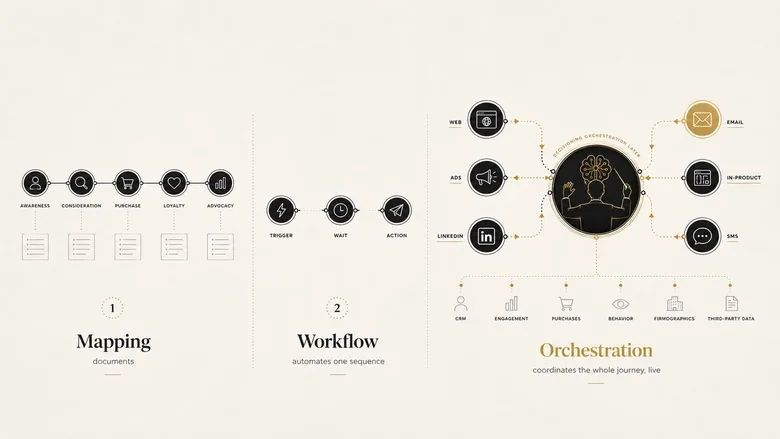
- The three-way distinction settles most confusion: mapping documents the intended journey, a workflow automates one sequence, and orchestration coordinates the entire journey as it happens.
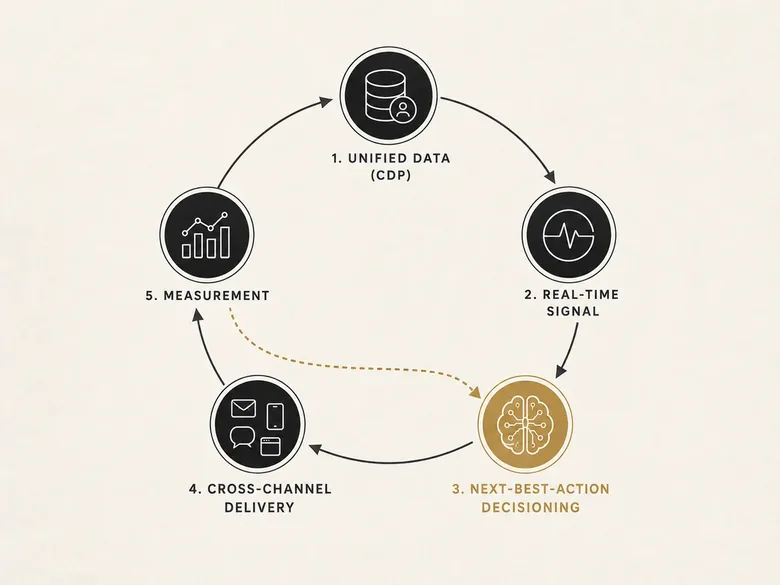
- It runs on a loop: unify first-party data, read a live signal, decide the next best action, deliver it on the right channel, then measure and feed the result back.
- A journey orchestration platform rests on four capabilities: a visual journey builder, real-time triggers, omnichannel delivery, and AI-powered optimization.
- B2B changes the unit of orchestration from one shopper to a buying group of six to ten people over six to eighteen months, and it makes the marketing-to-sales handoff a journey step.
- Start with one high-value journey and clean data, not a full platform rollout. Orchestration scales whatever data quality you feed it.
Before the sections, here is the distinction the rest of this guide builds on. These four terms get used as synonyms in vendor copy, and they are not the same thing.
| Approach | What it is | Operates at | Use it when |
|---|---|---|---|
| Journey mapping | A diagram of the intended journey, its stages and touchpoints | Planning and workshops | You are designing or auditing the experience |
| Marketing automation workflow | One pre-set sequence triggered by a rule | A single channel or track | You want to automate a known, repeatable sequence |
| Journey orchestration | Real-time coordination of the whole cross-channel journey, per person | Every channel, live | You need to decide the next best action as behavior changes |
| Journey analytics | Measurement of how journeys actually perform | Reporting and analysis | You want to see where journeys convert or stall |
What is customer journey orchestration?
Customer journey orchestration is the practice of coordinating each customer’s interactions across channels in real time, using unified behavioral data and AI-driven decisioning to deliver the next best action for that person at that moment. Instead of sending everyone in a segment the same email on the same day, it treats the journey as a live decision that updates every time the customer acts.
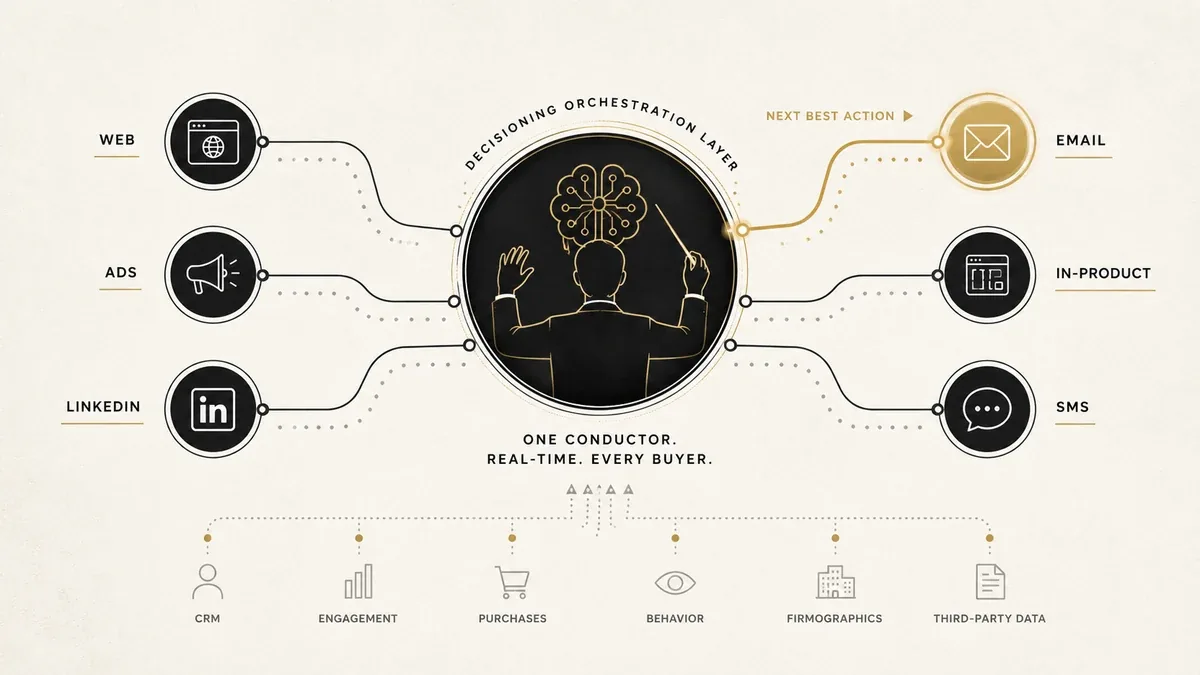
The word is borrowed from music on purpose. A conductor doesn’t play the instruments; they decide who plays, when, and how loud, so the parts add up to one piece instead of noise. Orchestration does the same across your channels. It is always making three calls at once: which message someone should get next, on which channel, and whether they should get one at all. It can trigger an offer when intent spikes, hold back a redundant email when a buyer has already replied to sales, and move a contact from email to LinkedIn when that is where they respond.
Two things separate it from ordinary campaign sending. The first is that decisions are made at the level of the individual, not the segment. The second is that they happen in real time, on live signals, rather than in a batch scheduled last Tuesday. Vendors sometimes label this real-time interaction management, and the engine that makes the call is usually described as a decisioning engine choosing the next best action. Underneath it all sits a single, unified view of the customer, which is why data is the part most implementations get stuck on.
Journey orchestration vs. automation, workflows, and mapping
The clearest way to understand orchestration is to line it up against the three things it gets confused with: journey mapping, a single automation workflow, and marketing automation as a whole. Each one is real and useful, and none of them is orchestration.
Journey mapping is a diagram. It documents the stages a buyer moves through and the touchpoints along the way, and it is the right tool for designing or auditing an experience. But a map is a plan drawn once; it doesn’t do anything when a real buyer behaves in a way the map didn’t predict. Mapping describes the intended path through the end-to-end b2b customer journey, while orchestration operates the actual one as it happens.
A marketing automation workflow is one sequence: a trigger, some conditions, a set of actions, an exit. It is genuinely valuable, and most teams should build several before they think about orchestration at all. The mechanics of designing one, from trigger to sales handoff, are their own discipline covered in our guide to building a single automation workflow that doesn’t over-message. The limit is in the name: a workflow runs its sequence regardless of what else is happening to that person on other channels. Run five of them and nothing stops the same buyer from landing in three at once.
Automation runs a set sequence. Orchestration decides which sequence the moment calls for, and adapts as behavior changes.
That line is the whole difference. Marketing automation executes predefined campaigns, one channel or track at a time. Orchestration is the decision layer that sits above your workflows and chooses which one each person should be in, suppressing the others so the buyer sees one coherent story rather than four competing ones. It plugs into, rather than replaces, the wider b2b marketing automation program that captures leads, scores them, and syncs to the CRM.
How customer journey orchestration works
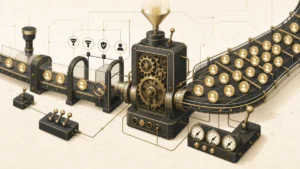
Customer journey orchestration works as a continuous loop: unify the data, read a real-time signal, decide the next best action, deliver it on the right channel, then measure and feed the result back into the next decision. Every step depends on the one before it, which is why a weak first step caps the value of everything after.
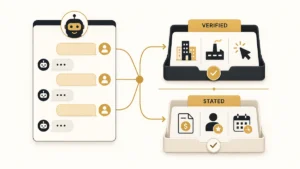
Unified data comes first. The engine can only coordinate a journey it can see, so behavioral, profile, and account data from the website, product, CRM, and ad platforms have to resolve to one identity. This is the job a customer data platform is built for, and it runs on first-party data rather than the third-party cookies that are now unreliable. Signal detection is next: the system watches for meaningful events, a repeat visit to the pricing page, a stalled renewal, a demo request, and treats each as a prompt to decide something.
The decisioning engine is where orchestration earns its name. Given the signal and everything known about the person, it picks the next best action from the options available, using rules, models, or increasingly an AI agent. Handing that choice to software is one of the more concrete ways AI agents are being put to work in marketing, and the quality of the decision depends heavily on the inputs, including how well you have defined the fit and intent signals that mark a lead as ready. Then comes delivery across whatever channel fits, and finally measurement, which closes the loop by telling the engine whether the last action helped.
Core capabilities of a journey orchestration platform
A customer journey orchestration platform is built on four capabilities. When you cut through the branding, most tools in this category are competing on how well they do these same four things.
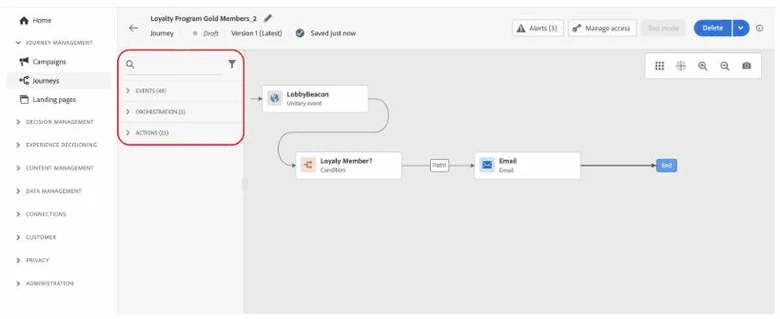
- Visual journey builder. A drag-and-drop canvas for designing multi-step journeys with decision points, branches, A/B splits, and wait steps, so a marketer can change logic without engineering.
- Real-time triggers. Responses that fire on in-the-moment behavior, such as a repeated pricing-page visit or a renewal date approaching, rather than on a fixed schedule.
- Omnichannel delivery. Coordinated messaging across email, web, ads, LinkedIn, in-product, and SMS, so a buyer sees one story across channels instead of four disconnected campaigns.
- AI-powered optimization. Models that recommend the next best action, predict send time, and tune content, learning from outcomes over time.
Those four are the checklist a demo should be measured against. The visual builder is what makes orchestration usable by a marketing team instead of a data-science one, and the AI layer is what separates a modern platform from a scheduled-campaign tool wearing a new label.
B2B customer journey orchestration: what’s different
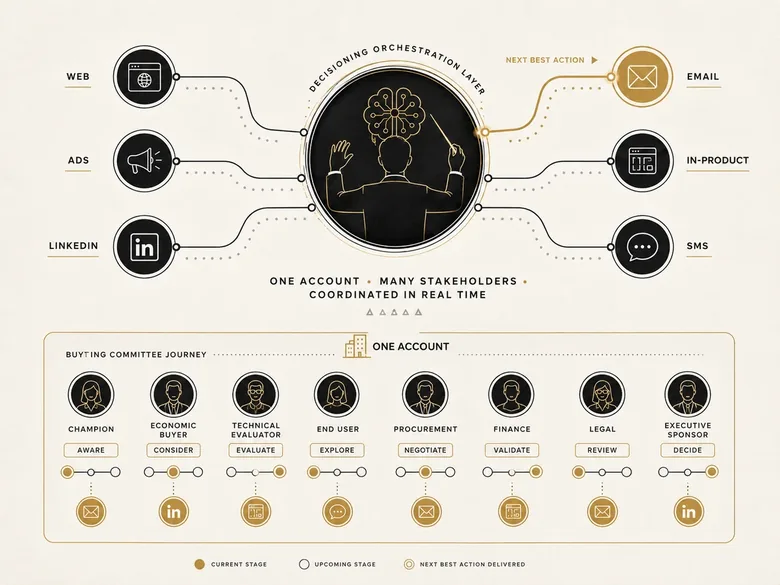
In B2B, customer journey orchestration has to coordinate a buying committee, not an individual shopper, across a cycle measured in months rather than minutes. Every consumer example you read about, the abandoned cart, the birthday coupon, the win-back push, assumes one person making one decision quickly. B2B breaks all three of those assumptions, and that changes what orchestration is for.
The buyer is a group. Gartner finds that a typical complex B2B purchase involves six to ten decision-makers, who spend only 17% of the journey meeting with any potential supplier. Orchestration in this world means coordinating messaging across several stakeholders who each see different content, at different stages, while sharing one account context. A signal from one committee member should inform what the others are shown, which is the essence of orchestrating at the account level rather than the individual lead. Salesforce’s 2026 State of Marketing report put 89% of B2B marketers on an account-based platform, feeding exactly that kind of signal.
The clock is different too. A B2B deal can run six to eighteen months, so most of orchestration’s job is timing and memory rather than a fast conversion. The friction is real: Forrester’s State of Business Buying found that 86% of B2B purchases stall and 81% of buyers are dissatisfied with the provider they chose. A well-run journey exists to keep deals from stalling, by noticing when momentum drops and changing the next action before the deal goes quiet.
Then there is the handoff. A consumer journey ends at checkout; a B2B journey passes through a human sales conversation, so the moment a lead crosses from marketing to sales is itself a step the orchestration has to manage, not a wall it throws leads over. Even as buyers self-educate with AI, Gartner’s 2026 research found 69% of B2B buyers still turn to a sales rep to validate what they found, so the machine warms the deal and a person usually closes it. Orchestration coordinates the whole path a buyer takes through the stages of the B2B funnel, leaning on intent data to know which of the mostly-not-ready accounts is starting to move.
IMPORTANT
Orchestration amplifies your data quality, it does not fix it. Point a real-time decisioning engine at fragmented, duplicated account data and it will make faster, more confident wrong calls. Unify the data and tighten targeting first, then let the engine coordinate.
Customer journey orchestration platforms
The main customer journey orchestration platforms fall into three camps, and which camp fits you depends less on the feature list than on where your data and channels already live. Treat the categories below as a map of the space, not a ranking; the right choice is the one that matches your data maturity and your buying motion.
Marketing-cloud suites orchestrate inside a broader enterprise stack. Adobe Journey Optimizer, built on Adobe Experience Platform, and Salesforce Marketing Cloud with Data Cloud both offer real-time, individual-level coordination and are the heavyweight options when you already run those ecosystems. Engagement platforms lead with the journey builder itself: Braze (through its Canvas Flow builder), Insider, Optimove, Emarsys, and Bloomreach are strong here, though several skew toward high-volume consumer messaging, so check the B2B fit. Data and CX layers round it out, with Twilio Segment as a CDP feeding other tools, and Qualtrics and Talkdesk orchestrating on the experience and contact-center side.
Two cautions before you shortlist. Most of these platforms were built for B2C scale and price on message volume or contact count, which can distort the value for a B2B team that sends fewer, higher-stakes touches. And a heavy platform assumes you have the data foundation to feed it; if you don’t, a lighter tool plus disciplined process will out-perform an enterprise suite running on messy inputs.
How to implement customer journey orchestration
To implement customer journey orchestration, unify your customer data first, then orchestrate one high-value journey before you scale to the rest. The order matters more than the tool. Teams that buy the platform first and sort the data later end up with an expensive engine idling on inputs it can’t trust.
- Unify your data. Resolve website, product, CRM, and ad data to one customer and account identity, on first-party sources. This is the foundation the rest sits on, and it is where most projects stall.
- Pick one high-value journey. Choose a single motion that matters, an onboarding sequence, a stalled-deal re-engagement, a renewal, rather than trying to orchestrate the whole map at once.
- Define the triggers and next-best-actions. For that journey, write down which signals matter and what the best response to each is, including the option to do nothing.
- Connect the channels you actually use. Wire in email, web, ads, and sales touches so the engine can coordinate and suppress across them, not just send more email.
- Set measurement before you launch. Decide what a good outcome is and instrument it, so you can see how journeys perform with journey analytics and tie touches to pipeline through attribution that credits the full path, not the last click.
- Test, then optimize the loop. Run it, read the results, and refine the triggers and actions. That ongoing work of improving the journey against real outcomes is where orchestration compounds.
Not every problem needs orchestration, and pretending otherwise is how teams over-buy. Use full orchestration when you have multiple channels, real-time signals worth acting on, and journeys complex enough that a single sequence can’t coordinate them. A single automation workflow is enough when the motion is linear and one channel does the job. And you are not ready for orchestration at all if your data is still fragmented across tools, because the engine will only industrialize that fragmentation.
PRO TIP
Prove the model on one journey before you expand. A single well-orchestrated re-engagement flow that recovers stalled deals will teach you more, and build more internal trust, than a platform-wide rollout that touches everything and moves nothing.
Our honest take: for most B2B teams, the platform is the least important decision here. Unified data, one carefully chosen journey, and a real measurement loop will beat a “better” tool bolted onto scattered data every time. Orchestration is a discipline you grow into one journey at a time, not a switch you buy and flip. Closing that measurement loop means crediting the orchestrated touches back to revenue, which is what customer journey attribution does.
Frequently Asked Questions
Customer journey orchestration is the real-time coordination of a single customer’s experience across every channel, using unified data and AI to decide the next best action as their behavior unfolds. Instead of sending a segment the same scheduled message, it treats each journey as a live decision that updates every time the person acts. In B2B, it coordinates a buying committee across a long cycle.
The five stages are awareness, consideration, decision, retention, and advocacy. A buyer becomes aware of a problem, weighs options, chooses a solution, then, if the experience holds up, stays and eventually recommends you. Orchestration acts across all five, coordinating the next best action at each stage rather than treating them as separate campaigns.
A journey orchestrator is the software engine that coordinates a customer’s cross-channel experience in real time, deciding and delivering the next best action on live signals. Some vendors use the term for a specific product, such as Salesforce’s Journey Builder or Adobe Journey Optimizer. It can also describe the person who owns journey strategy, though the term usually points to the engine.
Marketing automation runs predefined sequences, one channel or campaign at a time. Journey orchestration is the decision layer above those sequences: it chooses, in real time, which sequence each person should be in, suppresses the ones that don’t fit, and coordinates across channels. Automation executes; orchestration decides and coordinates. Most teams run automation first and add orchestration as their data and channels mature.
Customer experience orchestration is a broader term that coordinates every interaction across marketing, sales, and service, not just marketing touches. It extends the same real-time, data-driven approach into support and post-sale experiences, so a service issue can change what marketing does next. Journey orchestration is often the marketing-facing part of a wider customer experience orchestration effort.