
Barndoor AI launched AgentProfile on July 28, 2026, giving each AI agent a separate governed record instead of making it rely on a human or shared machine identity. The profile connects a human sponsor with the agent’s permissions and credential sets for the tools, models, and data its job requires.
Barndoor says the record attributes tool use, model calls, runtime activity, token usage, and cost to the individual agent. Policies are enforced continuously, credentials are scoped to the agent, and access can be removed centrally.
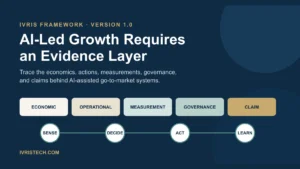
For B2B teams, the shift is accountability. An agent inventory is useful only when operators can connect ownership, access, action, and economics without rebuilding the story from separate dashboards. That is the same problem covered by the IVRIS Evidence Layer for AI-led growth, now applied to non-human actors.
Direct answer — What does Barndoor AgentProfile do?
Barndoor AgentProfile gives each AI agent its own governed record, human sponsor, permissions, credentials, activity history, and cost attribution. It is designed to replace borrowed human or shared machine identities with agent-level accountability. AgentProfile is available on Barndoor Pro and Enterprise, but per-agent LLM spending data requires the LLM Gateway included with Enterprise or sold as a Pro add-on.
Key Takeaways
- Barndoor introduced AgentProfile on July 28, 2026 as part of its AI Agent Governance Platform.
- Each agent receives a distinct record with a human sponsor, scoped permissions, and credential sets.
- Barndoor says tool activity, model calls, token usage, and spending can be attributed to the individual agent.
- AgentProfile is available on Pro and Enterprise; per-agent LLM cost attribution requires LLM Gateway.
- Both paid plans use contact-sales pricing, while a 14-day trial includes MCP Governance, LLM Gateway, and 100,000 LLM requests.
What Barndoor AgentProfile Actually Adds
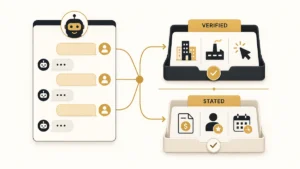
AgentProfile is not another employee account with an agent’s name attached. Barndoor’s technical explanation describes a distinct agent record with a bound key, governed MCP access, and activity and cost data returned to one dashboard. The intended unit of control is the agent and the transaction it performs, not the interface a person would use.
The record answers six operating questions: who owns the agent, what job it performs, which tools and models it may call, which credentials it uses, what it did, and what it cost. Barndoor says policies can be changed centrally and agents deprovisioned across connected systems.
The design matters when one agent crosses functions. An onboarding agent may need narrow actions in HR, identity, payroll, and IT systems without receiving any human role’s full access. A dedicated profile can express that smaller path while a person retains high-impact approvals. The Rank Math Support Agent permission path shows the inverse risk: an agent tied to a human administrator credential can inherit far broader effective authority than its narrow support task suggests.
Why a Separate Agent Identity Matters
Traditional IAM answers whether a user or service account can enter a system. Autonomous agents keep acting after that first decision, often across tools and at machine speed. Governance therefore moves from login to each consequential action: which agent requested it, under whose authority, with which credential, and inside which policy. Visa’s agreement to acquire BioCatch points to a complementary question before payment: does the behavior and device context still look legitimate even when the identity and credentials appear valid?
Our reporting on Cordial’s headless AI infrastructure made the same point from the application side. Opening services to external agents increases the value of a stable identity that follows requests across systems. A shared key shows something happened; a profile is meant to show which agent did it and who owns the outcome.
Our read: the launch matters because it treats identity, access, observability, and cost as one operating record. That is more useful than adding another agent registry. It is not, by itself, proof that every connected action is safe, correctly classified, or tied to a business result. That distinction is central to the new U.S. cyber-capability tests, which aim to measure advanced models’ hacking ability without yet disclosing the metrics, reporting rules, or participants.
The Hidden Catch Is Coverage, Not the Profile
A profile is only as complete as the execution paths that feed it. Buyers should ask what happens when an agent uses a direct provider key, calls a tool outside the governed MCP layer, changes orchestration platforms, or spawns a sub-agent. Those architecture choices determine whether the record is authoritative or partial. Obsidian Security’s AI-agent security buyer test adds the adjacent control question: can security teams discover those paths continuously and block a dangerous action at execution time rather than merely record it afterward?
Spending also needs a careful read. Barndoor says per-agent LLM spend and cost attribution depends on its LLM Gateway, which is included with Enterprise and offered as an add-on to Pro. That distinction matters as agents gain their own spending authority and buyers demand the source-level evidence examined in our AI pricing transparency research.
The public Barndoor pricing page lists contact sales for both plans. It confirms a 14-day trial with MCP Governance, LLM Gateway, 100,000 LLM requests, and no credit card, but it does not publish subscription or add-on prices. Procurement teams will need the commercial terms before they can calculate a cost per governed agent or workflow.
What B2B Teams Should Test Before Deployment
Start with one production workflow, not an enterprise-wide agent directory. The deployment discipline in our guide to AI agents for RevOps applies here: narrow the job, define the owner, map every system action, and test the failure path before expanding authority.
- Inventory every execution path. Document model endpoints, MCP servers, direct APIs, sub-agents, and fallback routes that could bypass the profile.
- Eliminate shared credentials. Give the pilot agent its own keys and verify that every tool and model call maps back to the same record.
- Separate permission from approval. An agent may prepare a refund, contract change, or purchase request without receiving authority to approve it.
- Run a deprovisioning test. Revoke the agent and confirm access ends across every connected system without disabling the human sponsor.
- Reconcile spend with outcomes. Compare the profile’s model and tool costs with completed work, exceptions, and human review time rather than treating token totals as ROI.
Barndoor AgentProfile gives enterprises a clearer unit for governing AI work: one agent, one accountable record. The buyer test is whether that record stays complete across the execution stack and supports policy enforcement, incident review, and cost analysis.
Frequently Asked Questions
Barndoor AgentProfile is a governed record for an individual AI agent. It links the agent to a human sponsor, its permitted tools and models, scoped credentials, runtime activity, and spending data so teams can manage the agent without borrowing a person’s identity.
A service account mainly provides machine access to a system. AgentProfile is designed to connect access with the agent’s owner, purpose, tool-level permissions, model credentials, runtime actions, and cost. Barndoor also positions policy enforcement as continuous rather than limited to authentication.
Yes, with an important plan dependency. Barndoor says per-agent LLM token usage and cost attribution require its LLM Gateway. The gateway is included with Enterprise and available as an add-on to Pro, so buyers should confirm the add-on price and covered execution paths.
AgentProfile is available on Barndoor Pro and Enterprise. Barndoor does not publish list prices for either plan and directs buyers to contact sales. Its public trial lasts 14 days and includes MCP Governance, LLM Gateway, and up to 100,000 LLM requests.