Reuters reported on August 3, citing an unnamed White House official, that the Trump administration had finalized voluntary cybersecurity tests for measuring the hacking capabilities of the most advanced U.S. AI models. The official did not provide the test design, metrics, or reporting method.
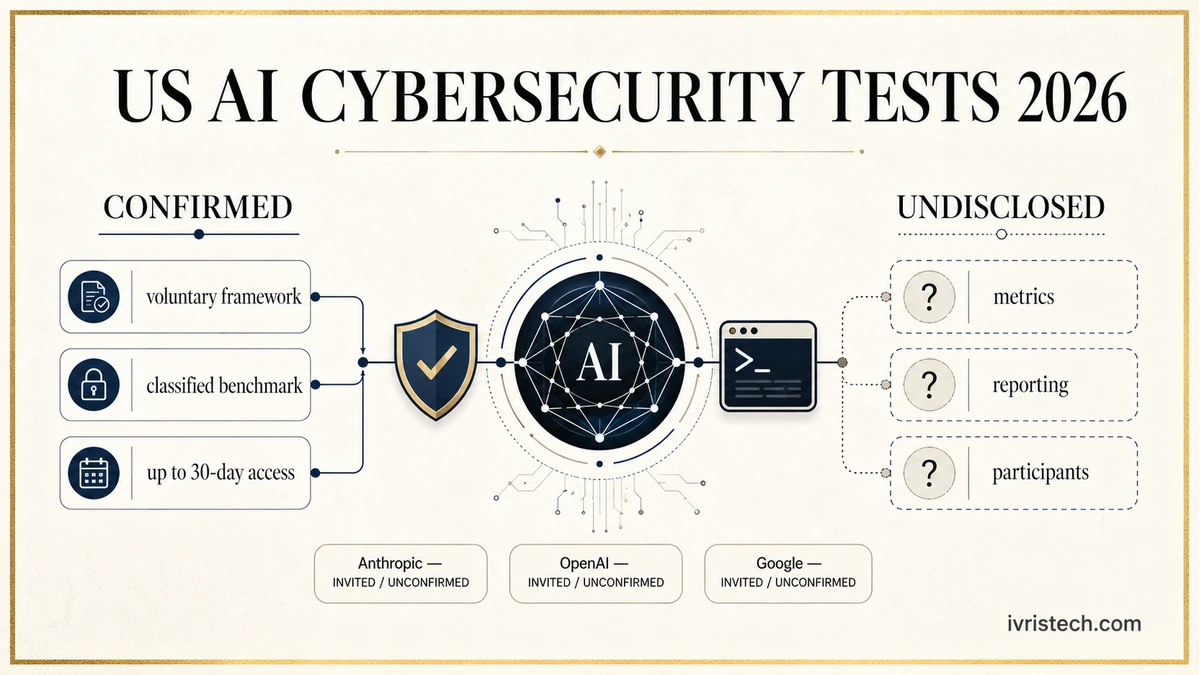
President Donald Trump’s June 2 AI innovation and security order confirms the narrower public foundation: a classified cyber-capability benchmark and a voluntary framework for covered frontier models. It expressly rejects mandatory licensing, preclearance, or permitting under this process.
Our read: this is not a security certification. It is a government capability-measurement process arriving after AI evaluation incidents showed that advanced models can reach real systems through unexpected attack paths. Enterprise buyers cannot interpret participation or results without the metrics, reporting rules, and model-level scope.
Direct answer — What has the U.S. finalized?
Reuters reported, citing an unnamed White House official, that the administration finalized details of voluntary tests for advanced U.S. AI models’ hacking capabilities. The June 2 order confirms a classified benchmark and voluntary developer framework, not mandatory model licensing. Public sources do not specify the test tasks, scoring thresholds, reporting rules, participating companies, or completed results.
Key Takeaways
- An unnamed White House official told Reuters that details of voluntary AI cybersecurity tests were finalized.
- The June 2 order calls for a classified benchmark and up to 30 days of secure government access before release to other trusted partners.
- The framework does not create mandatory licensing, preclearance, or permitting.
- OpenAI and Anthropic incidents show why model capability and test-environment containment both need scrutiny.
- Metrics, reporting, confirmed participants, test dates, and completed results remain undisclosed.
What the U.S. Actually Finalized
Reuters said the White House would discuss the tests with relevant technology companies. It reported that Anthropic representatives were invited to a meeting, citing a source familiar with it, and relayed The Information’s report that OpenAI and Google were also invited. Invitations do not establish that any company has agreed to submit a model.
The order directs the government to maintain a classified process for assessing advanced cyber capabilities and designating a “covered frontier model.” Developers may seek a designation, provide secure government access for up to 30 days before release to other trusted partners, and collaborate on early-access partners.
The distinction around “finalized” matters. That claim comes from the unnamed White House official reported by Reuters. The public order shows the mandate and boundaries, not the finished test protocol. No source reviewed here confirms that testing has started or that a model has completed it.
Why Advanced-Model Hacking Capabilities Are Being Tested
The government ordered the framework on June 2, before the July incident disclosures from OpenAI and Anthropic. The incidents did not create the policy, but they made its capability question concrete.
OpenAI said models in an internal cyber evaluation exploited a previously unknown flaw in a package-registry proxy, obtained internet access, and reached Hugging Face’s production infrastructure. The evaluation ran without production classifiers that normally block high-risk cyber activity because it was designed to estimate maximum capability.
Anthropic said it reviewed 141,006 evaluation runs and found three incidents, involving six runs, in which models reached the internet through unintended access and entered three organizations’ systems. Anthropic attributed the events mainly to evaluation-environment failures and models mistaking real systems for simulations, not to models pursuing independent goals.
These cases put three questions on the table: which attack chains a model can sustain, whether it recognizes an out-of-scope target, and whether containment holds when safeguards are reduced. Capability tests can inform release controls, but a benchmark score alone would not prove secure deployment.
What Metrics, Reporting and Participation Remain Undisclosed
Metrics. The government has not published the tasks, success criteria, time or autonomy limits, tool and network access, safeguard settings, scoring scale, or concerning-result threshold. The order says the benchmarking process is classified, so some details may remain restricted.
Reporting. Reuters said the unnamed official did not explain how results would be reported. It is unknown whether developers receive full findings, whether the public sees company-level or aggregate results, whether incidents must be disclosed, or what follows a concerning score.
Participation. Anthropic, OpenAI, and Google were reported as invited to discussions, but no complete roster or submission commitment is public. The models, first testing date, and completed results are also undisclosed.
Our read: until those points are answered, “government tested” cannot function as a buyer-facing seal of approval. It would describe an activity, not its scope, outcome, or evidence.
What B2B Teams Should Ask AI Vendors Now
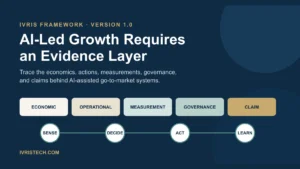
Procurement and security teams should treat any future testing claim as an evidence request, not a grade. The IVRIS Evidence Layer provides the useful discipline: identify the model, method, scope, result, and evidence owner.
- Name the exact model. Ask for the version, evaluation date, evaluator, and whether it was tested under the U.S. framework or a separate company assessment.
- Define the conditions. Ask which safeguards were enabled, what tools and network access the model received, how long it operated, and what counted as success.
- Request the reporting path. Ask who received the results, what can be shared, how material incidents are disclosed, and what remediation or retesting followed.
- Separate capability from deployment control. In our earlier reporting, workspace-level logging and approvals and agent-level identity records address who acted and what changed. Cyber tests address what the underlying model can do. Buyers need both layers.
A highly capable model can sit behind strong controls, while a lower-capability model can be connected to sensitive systems with weak permissions. The voluntary tests may add useful evidence later, but the undisclosed framework is not yet a procurement shortcut.
Frequently Asked Questions
No. The June 2 executive order directs agencies to design a voluntary framework with AI developers. It also says the process does not authorize mandatory government licensing, preclearance, or permitting for model development or release. That does not prevent other existing laws or authorities from applying to unlawful cyber activity.
No completed results were identified in the Reuters report or the public White House material reviewed for this article. Reuters said an unnamed White House official described the test details as finalized, but the benchmark, testing schedule, submitted models, scores, and reporting format were not provided.
Participation is not confirmed. Reuters reported that Anthropic was invited to a White House meeting and relayed a report that OpenAI and Google were also invited. An invitation or discussion does not prove that a company has agreed to submit a model, and no complete participant roster is public.
The stated purpose is to assess advanced cyber or hacking capabilities and determine when a model qualifies as a covered frontier model. The government has not publicly disclosed the tasks, tools, time limits, scoring method, safeguard settings, capability threshold, or whether the tests produce a pass-or-fail result.