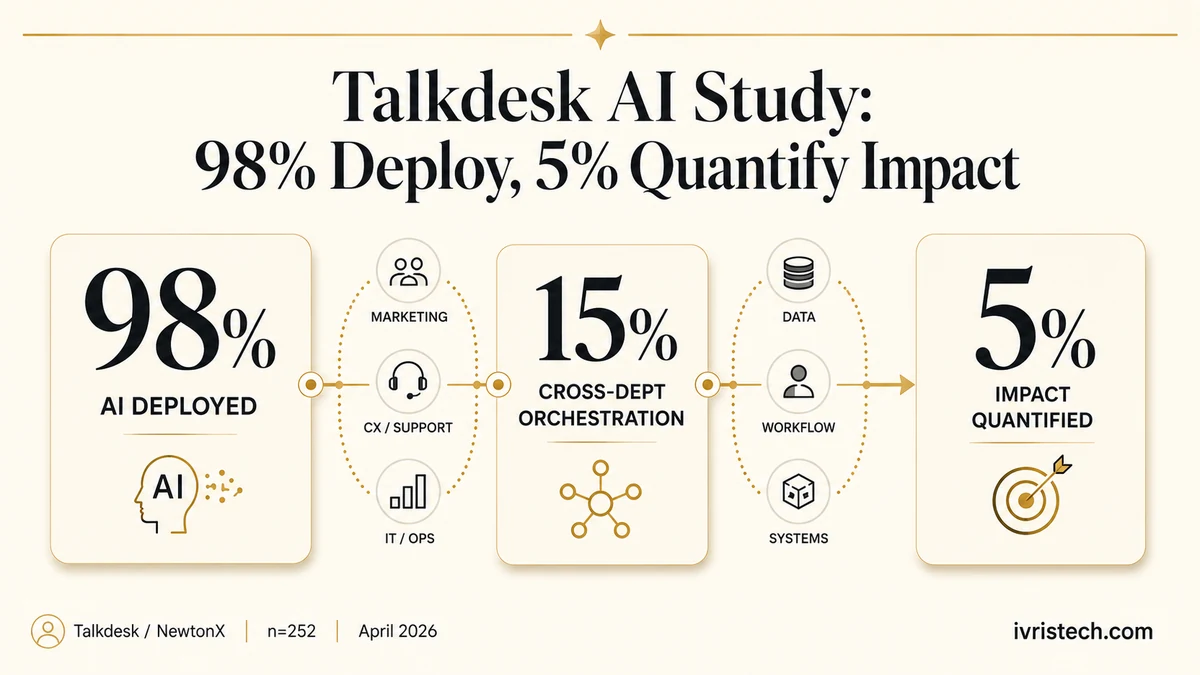
Talkdesk released The State of Agentic Automation in CX on August 25, 2026, reporting that 98% of respondents said their organizations had deployed AI in the customer journey, while only 5% said they could quantify AI’s impact on business outcomes.
The gap comes from a NewtonX survey of 252 director-level-and-above decision-makers and significant influencers responsible for CX, IT, operations, or AI strategy at mid-market and enterprise organizations. Another 15% reported combining agentic AI with cross-departmental orchestration for end-to-end resolution. Those numbers describe this surveyed population; they do not establish that 98% of all companies use AI or that the remaining 95% receive no value from it.
For B2B marketing, RevOps and CX teams, that distinction is the useful part. When we covered eClerx’s martech activation-gap research, the problem was getting from insight to action. Talkdesk’s survey exposes the next question: once AI is acting across a customer workflow, can the organization connect those actions to a business outcome?
Direct answer — what does the Talkdesk AI study mean for B2B teams?
Talkdesk’s NewtonX survey suggests AI deployment is running ahead of both cross-system orchestration and outcome measurement in customer experience. In the 252-person survey, 98% reported AI deployed in the customer journey, 15% reported agentic AI with cross-departmental orchestration, and 5% said they could quantify business impact. For B2B teams, deployment counts are therefore a weak maturity metric unless the underlying workflow, handoffs and business outcome are traceable.
Key Takeaways
- NewtonX surveyed 252 senior decision-makers and influencers across CX, IT, operations and AI strategy in April 2026.
- 98% reported AI deployed in the customer journey, but only 5% said they could quantify its impact on business outcomes.
- 15% reported combining agentic AI with cross-departmental orchestration for end-to-end resolution.
- The reported four-times CSAT/NPS association is observational survey evidence, not proof that orchestration caused the gains.
What the Talkdesk and NewtonX Survey Actually Found
Talkdesk commissioned NewtonX to survey mid-market and enterprise leaders across North America, EMEA, LATAM and APAC, including healthcare, financial services and retail. The public methodology identifies roles, sample size, fieldwork month and broad geography, but not enough detail to treat the results as a precise global prevalence estimate.
The report’s central sequence is 98%, 15%, 5%: AI is widely deployed among respondents; a much smaller group reports cross-departmental agentic orchestration; and fewer still say the organization can quantify business impact. Talkdesk also reports that organizations combining agentic AI and cross-departmental orchestration are four times more likely to report major CSAT or NPS gains.
That last figure needs the strongest caveat. This is a vendor-commissioned, observational survey based on reported organizational characteristics and outcomes. It can show an association inside the sample. It cannot, by itself, show that orchestration caused the satisfaction gains or rule out other differences between more mature and less mature organizations.
The 98%-to-5% Gap Is Not Proof That AI Failed
The easiest headline would be that 95% of companies cannot prove AI ROI. That would overstate the evidence. The survey asks whether respondents can quantify AI’s impact on business outcomes. An organization can be getting useful automation, faster handling or better employee support without having a defensible causal or financial measurement layer around it.
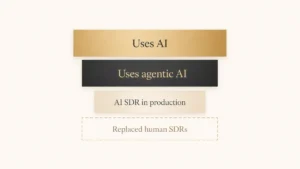
Our read: deployment has become an activity metric. Counting agents, copilots, automated interactions or AI-enabled journeys tells leadership what has been installed. It does not tell them whether a customer moved faster through a process, whether pipeline improved, whether cost fell, or whether retention changed because of the AI-assisted workflow.
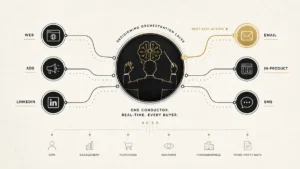
This is also why customer journey orchestration matters as a separate operating problem. A point automation can succeed locally while the end-to-end journey still crosses systems, owners and human handoffs that break context or measurement. Genesys adds a product-state version of the same problem: its context and governance layers are live now, but Navigator and Orchestrator arrive later, as the Genesys rollout map shows.
Where B2B Marketing, RevOps and CX Lose the Outcome
B2B teams are especially exposed because one journey can touch marketing automation, CRM, sales, support and finance before a commercial outcome appears. If each function measures its own AI activity, several successful dashboards can coexist without a shared answer to whether the journey improved.
The measurement chain should start with one workflow and one business outcome. For a demo journey, that might mean moving from request to qualified meeting to opportunity. For an existing customer, it might mean resolution to renewal-risk reduction. The important part is that marketing, RevOps and CX agree on the record being followed, the event definitions, the source of record and the point at which an outcome is counted.
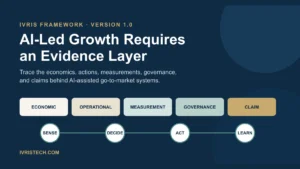
That is the same traceability problem addressed by the IVRIS Evidence Layer for AI-Led Growth: AI activity becomes decision-grade only when the action, outcome definition, denominator, ownership and evidence path can be reconstructed.
What B2B Teams Should Change Before Scaling AI
Start with one cross-functional journey. Do not benchmark maturity by the number of AI tools deployed. Pick a workflow that crosses at least two functions and has a named commercial or customer outcome.
Define the outcome before the agent action. Write down the event that counts, the eligible population, the time window and the system of record. If those are decided after deployment, the team is likely to measure whatever the platform happens to expose.
Carry one identity through the handoffs. The AI action, CRM record, account, opportunity or customer case needs a traceable relationship across systems. Otherwise activity and outcomes remain separate.
Separate operational improvement from causal proof. Pre/post comparisons, controlled tests and matched cohorts answer different questions. Use the strongest design the workflow permits, and label weaker evidence honestly rather than converting correlation into ROI.
Log exceptions and human intervention. A journey that appears automated can still depend on manual correction, escalation or re-entry. Those interventions belong in the measurement model because they affect both cost and the claim that AI completed the work.
Frequently Asked Questions
Talkdesk’s NewtonX survey found that 98% of respondents reported AI deployed in the customer journey, 15% reported agentic AI with cross-departmental orchestration, and 5% said their organization could quantify AI’s impact on business outcomes. The findings describe the 252-person survey sample, not every company.
No. The 5% figure concerns respondents who said their organization can quantify AI’s impact on business outcomes. It does not establish that everyone else gets no value, has negative ROI or has failed deployments. Measurement capability and realized value are related questions, but they are not the same question.
No. Talkdesk reports that organizations combining agentic AI and cross-departmental orchestration were four times more likely to report major CSAT or NPS gains. That is an association in an observational survey. It does not establish that orchestration alone caused the improvement.
Start with one cross-functional workflow and define its business outcome, eligible population, source of record, identity link, time window and owner. Then preserve the AI action, human interventions and final outcome in the same evidence path. That makes scaling decisions more defensible than counting deployed agents or automated interactions.