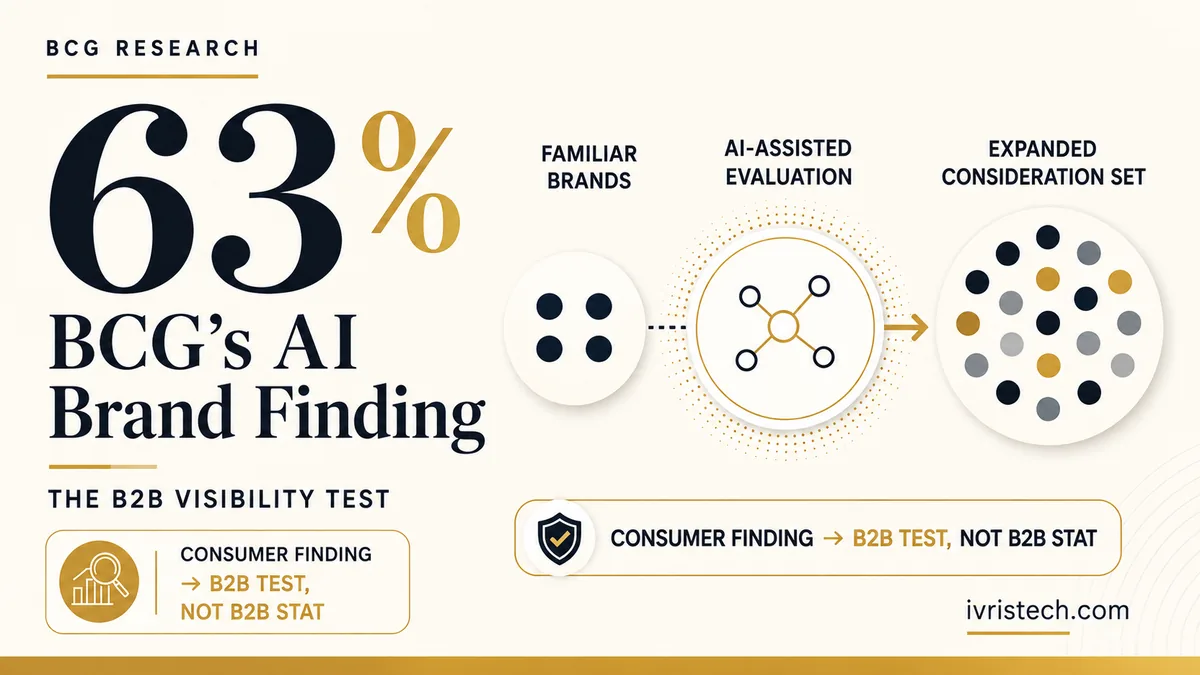
Boston Consulting Group’s August 26 Consumer of the Future research puts a sharp number on AI-led discovery: AI introduced consumers to brands they otherwise would not have considered in roughly 63% of AI-assisted purchase journeys. The finding matters because it shifts the visibility question from “Did the buyer search for us?” to “Did AI put us into the set of brands worth evaluating?”
The boundary matters. BCG surveyed more than 13,000 consumers across 12 markets and 13 categories, supplemented the survey with more than 100 interviews, and analyzed more than 1,000 brands against observed purchase behavior. This was consumer research, not a study of B2B procurement teams. The public report does not disclose the subgroup base size or confidence interval behind the 63% figure.
For B2B marketers, the useful move is not to copy 63% into a deck. It is to test who gets considered. In our earlier reporting on G2’s Answer Economy study, its separate March 2026 survey covered 1,076 B2B software buyers. G2 reported that 51% started research with an AI chatbot more often than Google, 69% chose a different vendor after chatbot recommendations, and one in three bought from a vendor they had not previously heard of. Those are B2B results, but from a different study.
Direct answer — What does BCG’s 63% AI brand finding mean for B2B marketers?
BCG did not measure B2B buyers. Its consumer research suggests a mechanism: AI can expand the brands considered. For B2B teams, the defensible response is to test whether priority buyer prompts name the brand, how accurately, and alongside which competitors. Separate G2 research shows AI can influence software vendor shortlists, but BCG’s 63% figure should not be transferred to B2B.
Key Takeaways
- BCG says AI introduced new brands into consideration in roughly 63% of AI-assisted consumer purchase journeys.
- The research covered more than 13,000 consumers across 12 markets and 13 consumer categories; it did not measure B2B buyers.
- Separate G2 research on 1,076 B2B software buyers found AI recommendations can alter vendor consideration, supporting a B2B test without borrowing BCG’s percentage.
- For SEO, AEO, and GEO programs, a more useful visibility measure is whether the brand is visibly named in relevant recommendation and comparison answers, not whether a page merely ranks or gets cited.
What BCG Actually Found About AI and Brand Discovery
BCG’s study examined five consumer shifts, including AI-guided decision making. Thirty-one percent of surveyed consumers said they use AI at least occasionally during purchase journeys. Within AI-assisted journeys, BCG reported that AI introduced brands consumers otherwise would not have considered roughly 63% of the time.
The strategic point is gatekeeping. Search exposes ranked pages and leaves the buyer to assemble a set. AI can compare options and name that set itself. Challenger brands may gain an entry point, while established brands face a new risk: omission.
Why 63% Is Not a B2B Buyer Statistic
The methodology is substantial consumer research, but it should not be stretched beyond its sample. BCG covered 12 markets, including the US, UK, India, China, Brazil, and several European and Asian markets. Its 13 categories included automotive, electronics, travel, food, beverages, mobile devices, and skin care.
None of that makes the result a proxy for enterprise software, industrial buying, professional services, or buying committees. Those journeys involve different risk, budgets, approvals, and evidence requirements. BCG’s brand analysis adds useful triangulation, but it does not turn 63% into a B2B benchmark.
The clean interpretation is narrower: AI can expand consumer consideration sets, while separate B2B research shows AI can change which software vendors buyers evaluate. The percentages answer different questions in different populations.
The B2B Question: Are You in the AI Consideration Set?
Our read: B2B teams should treat “consideration-set visibility” as a layer between search visibility and pipeline. A page can rank without the brand being recommended, or be used as a source without the brand being named. Our earlier analysis of AI citations versus visible brand mentions shows why those outcomes should not be collapsed into one score.
A practical measurement model has four stages: retrieval or citation, visible brand mention, inclusion in a recommendation set, and downstream commercial evidence where it can actually be observed. The first three can be audited directly. The fourth should not be inferred from visibility alone.
This clarifies the role of SEO, AEO, and GEO. SEO helps make authoritative pages retrievable. AEO makes answers and evidence easier to extract. GEO adds model-by-model monitoring of brand representation and inclusion. The labels overlap, and none guarantees a recommendation.
What B2B Marketing Teams Should Test Now
- Build a fixed prompt set around real buying jobs. Use high-intent category, use-case, comparison, alternative, integration, pricing, and risk questions. Keep prompts stable for repeatable comparisons.
- Record named inclusion, not just citation. Log whether your brand is named, which competitors appear, and what rationale the system gives. A source link without a visible brand name is not the same as entering the set.
- Audit the evidence behind the answer. Check product claims, integrations, pricing, customer proof, and category positioning across owned and credible third-party sources. Fix factual gaps before chasing mentions.
- Separate discovery metrics from revenue metrics. Consideration-set visibility shows whether you are surfaced; it does not prove pipeline impact. Connect commercial evidence only where attribution is supportable.
BCG’s 63% finding is useful without becoming a B2B statistic. It gives marketers a mechanism worth testing: AI may introduce brands before buyers reach owned channels. The B2B job is to measure whether that happens in your category, then improve the evidence behind who gets named.
Frequently Asked Questions
No. BCG’s August 2026 research surveyed more than 13,000 consumers across 12 markets and 13 consumer categories. The 63% figure describes AI-assisted consumer purchase journeys. B2B marketers can use it as a hypothesis about consideration-set expansion, but they should not present it as a B2B buyer benchmark.
Consideration-set visibility measures whether an AI answer actually names a brand among the vendors or products a buyer should evaluate. It is narrower than ranking or citation visibility. A page can be retrieved or cited while the brand itself never appears in the recommendation set the user sees.
Use a stable set of high-intent buyer prompts and track each AI surface separately. Record brand mentions, recommendation-set inclusion, competitor presence, answer accuracy, cited sources, and changes over time. Keep visibility measures separate from opportunity and revenue metrics unless you have evidence connecting the two.
No. SEO still helps make authoritative pages discoverable and retrievable. AEO focuses on making answers and supporting evidence easy to extract, while GEO adds monitoring of model-specific brand representation and inclusion. The disciplines overlap, and none of them can guarantee that an AI system will recommend a particular brand.