
The eClerx Marketing Report 2026 found that 78% of marketing leaders say their martech stacks do not support business goals despite years of significant investment. The report’s diagnosis is sharper than the usual tool-sprawl complaint: capable stacks can generate insights, but organizations still cannot turn those insights into action.
The survey covered 366 U.S.-based marketing leaders, including CMOs, VPs, and heads of marketing operations, digital, brand, and growth across more than 15 industries. Seventy-five percent make investment decisions using partial data. Only 25% describe a fully data-driven environment. Just 35% use real-time insights for optimization.
Our read: the activation gap is the most useful martech framing of the quarter because it changes the budget question. The problem is not “which tool should we buy next?” It is “which decision still waits for a spreadsheet, approval loop, or data handoff after the insight already exists?” B2B marketing teams should run a 30-day activation audit before approving another stack addition.
Key Takeaways
- 78% of marketing leaders say their martech stacks do not support business goals despite significant investment.
- eClerx surveyed 366 U.S.-based marketing leaders across more than 15 industries, with company revenue from $500 million to over $5 billion.
- 75% make investment decisions using partial data, while only 25% describe a fully data-driven environment.
- Only 35% use real-time insights for optimization; 37% struggle with slow approvals and rigid planning.
- The report calls the problem an activation gap: the space between generating an insight and acting on it.
What the eClerx Marketing Report 2026 Found
eClerx separates stack maturity from activation maturity. A stack can collect data, generate dashboards, and surface insights while the marketing organization still acts slowly. In the accompanying Business Wire release, eClerx Chief Marketing Officer Scott Houchin put the distinction plainly: stack maturity does not always translate to activation maturity.
The supporting numbers describe the bottleneck. Thirty-four percent cite data-quality issues as their biggest barrier. Thirty-seven percent struggle with slow approvals and rigid planning. Thirty-seven percent say data volume and quality make personalization difficult to scale. Forty-seven percent are only moderately confident in their ability to measure true ROI across channels. Twenty-four percent use media mix modeling to reallocate budgets based on live performance data, while 86% navigate with last year’s map.
The report also includes a Martech Maturity Scorecard. That is the right direction because the activation problem is operational, not theoretical. A dashboard does not create value when the campaign owner cannot change the audience, budget, creative, or next-best action quickly enough for the insight to matter.
Why More Martech Will Not Close the Gap
The activation-gap diagnosis lands at the right moment. The 2026 martech landscape has effectively plateaued at 15,505 products while gross churn reached 9.7%. The market already offers more tools than most teams can use coherently. SaaStr’s API report card added a second warning: even when vendors promise agents, the underlying APIs can still make safe orchestration difficult.
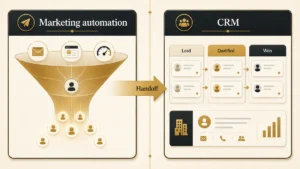
B2B teams feel this harder than ecommerce teams because the revenue feedback loop is slower. A campaign insight can appear today while pipeline impact arrives in 60 or 90 days. CRM fields, attribution windows, sales-stage definitions, offline events, and approval rules all sit between the marketing signal and the next decision. Each handoff adds delay and makes the insight easier to ignore.
When we covered GrowthLoop’s 2026 AI and Marketing Performance Index, the headline was that only 23% of marketers can reliably connect actions to business outcomes and 77% of winning tests fail at scale at least some of the time. The eClerx report describes the next layer down. Even when an insight exists, the operating system around the stack often cannot act on it.
The 30-Day Martech Activation Audit
The audit should start with decisions, not tools. Pick one revenue-adjacent workflow and measure how long it takes to move from signal to action. A demand-generation team can run the process against paid-campaign optimization, webinar follow-up, account scoring, or lifecycle nurture.
- Name five recurring decisions. Examples: pause an underperforming ad group, change an account segment, route a high-intent account, adjust nurture logic, or shift budget across channels. Assign one accountable owner to each decision.
- Measure time from insight to action. Record when the signal appears, when someone reviews it, when approval arrives, and when the change goes live. The delay is the activation gap in hours and days, not a vague maturity score.
- Mark every manual handoff. Spreadsheet export, Slack request, data-team ticket, CRM cleanup, legal approval, and agency handoff all count. Fix the highest-frequency handoff before buying another interface.
- Choose one closed-loop workflow. Automate a narrow action with a clear rollback rule. Do not start with full orchestration. Start with the smallest workflow where the stack can observe, decide, act, and report the outcome.
- Put the metric in the budget review. Track median activation delay, share of decisions using complete data, and share of campaigns optimized with real-time insight. Pair those with SaaS marketing metrics tied to revenue, not dashboard activity.
The audit gives the next martech dollar a job. If the bottleneck is data quality, fund the data model. If it is approval speed, change the operating rule. If it is an API limitation, escalate the vendor issue at renewal. If the team cannot name the bottleneck, another platform purchase will hide the problem for one more quarter.
The Wider AI-Readiness Pattern
eClerx is not an isolated report. Gartner found CMOs allocate 15.3% of marketing budgets to AI while only 30% are ready to scale it. Supermetrics found marketing teams want AI optimization but lack the people, systems, and proof points. GrowthLoop found the measurement spine cannot prove the work scaled. eClerx ties those findings together with an operational label: activation maturity.
The important distinction is that activation maturity can be improved without buying a new platform. Teams can clean the event taxonomy, standardize campaign naming, close CRM handoffs, shorten approval loops, add rollback rules, and assign decision ownership. Those changes are less exciting than a vendor demo. They are also more likely to make the current stack pay back.
The next budget conversation should include a simple challenge: show the last five insights the stack produced, the action each one triggered, the delay between the two, and the business outcome. If that chain cannot be reconstructed, the activation gap is not a theory. It is the reason the martech ROI case keeps failing. Madison Logic’s 48% guessing finding shows the same failure from the marketer’s side: teams feel the ROI pressure but still cannot connect enough activity to buyer decisions.
Frequently Asked Questions
The eClerx Marketing Report 2026, titled “Mind the Gap,” is a study of 366 U.S.-based marketing leaders across more than 15 industries. It examines why martech investment often fails to produce business results and introduces the activation gap: the distance between generating an insight and acting on it.
It means 78% of surveyed marketing leaders feel that their martech stacks do not support business goals despite significant investment. eClerx argues the main problem is not the stack alone. It is activation architecture: data, workflow, approval, and execution systems that fail to turn insight into timely action.
A martech activation gap is the space between producing an insight and using it in a live marketing decision. Common causes include incomplete data, spreadsheet handoffs, slow approvals, rigid planning cycles, unclear ownership, and APIs that do not support closed-loop actions. The stack can be capable while the workflow remains slow.
Start with a 30-day audit of one revenue-adjacent workflow. Name the recurring decisions, measure the delay from insight to action, mark each manual handoff, automate one narrow closed-loop workflow with a rollback rule, and report activation-delay metrics alongside pipeline and revenue outcomes before approving another tool purchase.