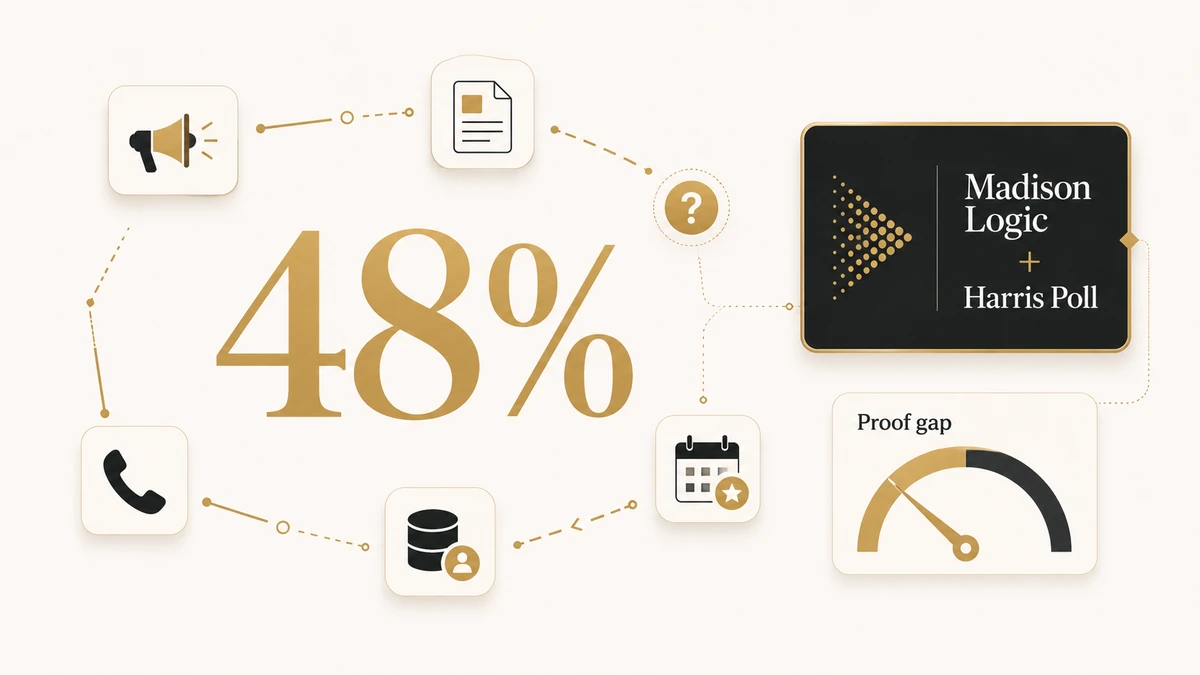
Madison Logic released a Harris Poll survey on July 6, 2026, finding that 48% of U.S. marketing decision-makers still feel they are guessing which activities drive purchasing decisions.
The same survey says 84% of respondents believe modern marketing is now focused on proving ROI, 79% say marketing is moving in a more performance-focused direction, and 90% believe marketers who cannot show business impact will struggle to justify budgets. The survey covered 313 director-level or higher U.S. decision-makers from May 1 to May 11, 2026.
For B2B teams, the stat matters because the problem is not another missing dashboard. It is that buying groups move across ads, content, sales calls, AI assistants, events, and dark channels faster than most attribution models can explain. When we covered the martech ROI activation gap, the lesson was similar: insight does not help until it changes a decision.
Key Takeaways
- Madison Logic and The Harris Poll surveyed 313 U.S. marketing decision-makers.
- Forty-eight percent said they still guess what drives purchasing decisions.
- Eighty-four percent said modern marketing is focused on proving ROI.
- Ninety percent said marketers who cannot show business impact will struggle to defend budgets.
- The ranking gap is an operating playbook, not another recap of the stat.
What The Madison Logic Survey Found
The headline number is blunt: nearly half of marketers still do not feel confident about which activities influence purchases. That is happening while finance pressure is rising, AI is increasing content volume, and buying committees are becoming harder to track.
Madison Logic CEO Keith Turco framed the shift around data, intent, and pipeline impact. The company’s release also says 91% of respondents believe modern marketing success depends on balancing data precision with human storytelling, which is a useful guardrail. Performance pressure does not mean creative work disappears. It means creative work has to be connected to proof.
IAB’s State of Data 2026 report describes the same pressure from the measurement side: privacy changes, signal loss, platform-embedded optimization, and fragmented data make it harder to connect media exposure to outcomes. Madison Logic’s survey gives that measurement problem a sharper B2B headline.
Why 48% Still Guessing Is a Strategy Problem
A team can have attribution software and still guess. The issue is usually not whether data exists. It is whether the organization trusts the model enough to make a budget, channel, or sales handoff decision.
That is why B2B attribution software should be evaluated by decision quality, not dashboard polish. Can it explain why one campaign influenced pipeline, where the sales team saw the same account, and which buying-committee touch actually changed urgency? If not, the team will still fall back to opinions.
Deloitte Digital’s 2026 marketing trends make the finance pressure explicit, arguing that CMOs need to speak the language of ROI, customer value, and revenue attribution. The Madison Logic number suggests many teams know the language but still lack the operating rhythm.
The Hidden Catch: ROI Is Not One Metric
ROI pressure often pushes teams toward a single master number. That can backfire in B2B. A webinar, analyst report, LinkedIn ad, comparison page, sales sequence, and customer story may all influence the same deal at different times. Forcing one channel to carry all credit can hide the work that created demand before the buyer was ready.
The better response is a tiered measurement model. Use leading indicators for demand creation, pipeline indicators for demand capture, and outcome indicators for revenue. That is the same structure behind our B2B marketing metrics guide: not every metric deserves weekly attention, but every core metric needs a decision attached to it.
Our read: the 48% stat should not trigger a tool-buying sprint. It should trigger a decision audit. If the team cannot name the last five insights that changed budget, targeting, creative, or sales follow-up, the measurement system is not operational yet.
What B2B Teams Should Do Now
Start with one buying decision, not the full customer journey. Pick a high-value segment, one campaign family, and one pipeline stage. Document the signals the team currently uses to decide whether to keep spending, change the offer, or move an account to sales.
Then compare what the dashboard says with what sales remembers. If the attribution story and the field story disagree, do not hide the conflict. Use it to find missing touches, bad CRM fields, weak UTM discipline, or dark-channel influence that should be captured through self-reported attribution.
Finally, build a 30-day proof loop into the campaign strategy. Every major campaign should have one named decision it is expected to inform. If the campaign cannot change a budget, audience, offer, follow-up rule, or content priority, it is probably being measured for theater.
Madison Logic’s survey will get clicks because 48% is a sharp number. The useful takeaway is less comfortable: guessing is not a data shortage. It is a decision-design problem. Cashew’s differentiation anxiety research points to the content version of the same flaw: many teams are guessing what makes their message distinct.
Frequently Asked Questions
The survey found that 48% of U.S. marketing decision-makers still feel they are guessing which marketing activities drive purchasing decisions. It also found strong pressure around proving ROI and showing business impact.
The Harris Poll surveyed 313 U.S. adults who work full-time at director level or higher and hold decision-making responsibility for marketing, advertising, communications, public relations, or social media.
B2B purchases involve many people, long cycles, dark channels, sales conversations, and online research that attribution tools cannot always connect. The issue is not only missing data. It is whether the team trusts the measurement enough to make decisions.
Run a decision audit. Pick one campaign or segment, list the decisions measurement should support, compare dashboard data with sales evidence, and fix the handoffs that stop insights from changing budget, targeting, creative, or follow-up.