Direct answer – what is differentiation anxiety?
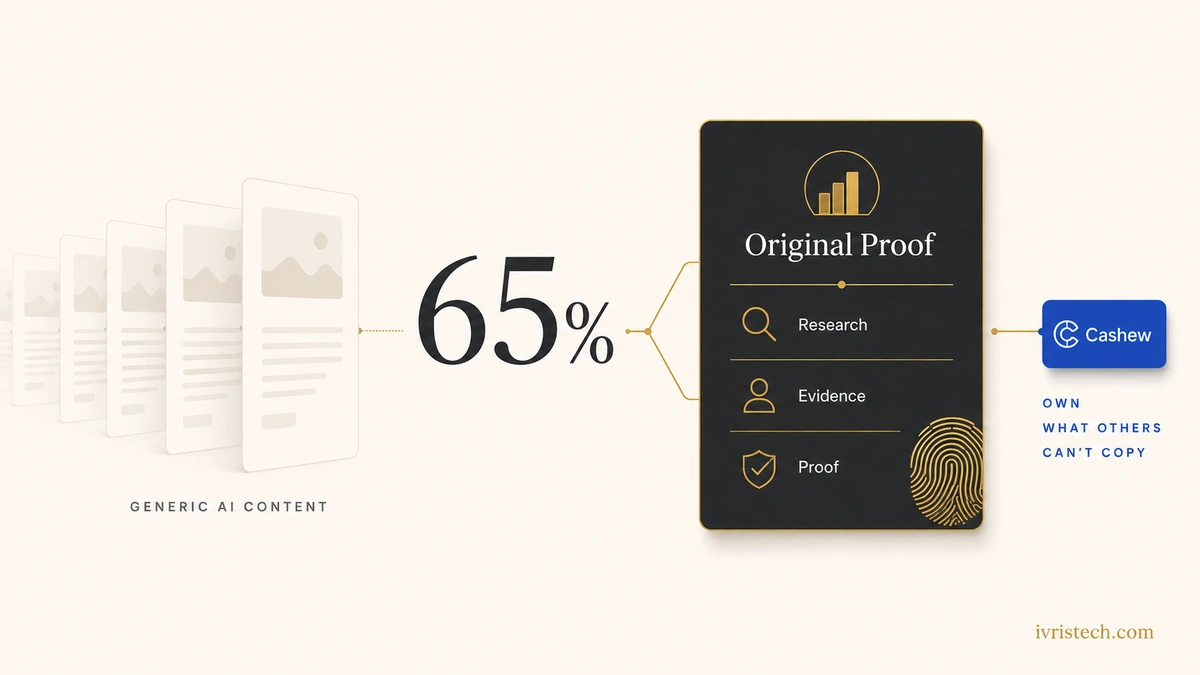
Differentiation anxiety is Cashew Research’s term for the pressure marketers feel to create content that sounds fresh, original, and distinct when AI makes similar content easy to produce. In a July 8, 2026 study, Cashew said 65% of marketers experience it. For B2B teams, the fix is not more content. It is more proprietary proof.
Cashew Research released a study on July 8, 2026, finding that 65% of marketers experience “differentiation anxiety,” or the pressure to create content that feels fresh, original, and distinct.
The study surveyed 206 senior mid-market and enterprise marketers across North America. It also found that 71% publish content at least weekly and 66% have used original research in their marketing within the past 90 days.
For B2B teams, the useful point is not the anxiety label. It is the behavior underneath it. AI has made more content easier to produce, but it has not made every company more interesting. That gap is where original data, customer evidence, and clear points of view start to matter again.
Key Takeaways
- Cashew says 65% of marketers experience differentiation anxiety.
- The study surveyed 206 senior mid-market and enterprise marketers across North America.
- Seventy-one percent publish content at least weekly.
- Sixty-six percent used original research in marketing within the past 90 days.
- The B2B response should be proprietary proof, not faster generic output.
What Cashew Found
Cashew’s report is built around a simple claim: the hardest marketing problem is no longer producing enough content. It is producing content that does not sound interchangeable.
The study says AI has made creation faster while making distinctiveness harder. Cashew CEO Addy Graves framed the competitive advantage as having something original to say, not simply producing more material. That is a sharp message in a week where many marketers are still being told to publish more with fewer people.
Cashew’s own site positions the company around real human respondents, expert-guided research, and reports delivered in days. That matters because the study’s recommended direction is not “use less AI.” It is “use better inputs.” GetWhys’ buyer-evidence validation layer turns that principle into a workflow gate by attaching moderated interview sources to AI-generated GTM content before release.
Why Differentiation Anxiety Is a Content Problem
The 65% number lands because it gives a name to a real content failure. Many teams can now produce social posts, landing pages, email drafts, and blog outlines faster. The output often still sounds like it came from the same source material as everyone else.
That is why the 66% original-research figure is more interesting than the anxiety number. Marketers are not only worried. They are looking for facts competitors cannot copy in one prompt.
We saw a related issue in Canva’s AI slop findings. Faster production can create trust risk when the output feels generic. Cashew’s study adds the strategy layer: sameness is not just a quality problem. It is a positioning problem.
The Hidden Catch: Originality Needs Evidence
Our read: “be original” is bad advice unless the team has a system for finding original evidence. A stronger point of view usually comes from customer interviews, market research, usage data, community patterns, win-loss notes, sales calls, product telemetry, or field experience.
That is why Cashew’s human-respondent positioning is relevant to the story. It is selling research as a way to give marketers fresher inputs, not just prettier outputs. TechCrunch previously described Cashew as using AI to speed research while still collecting data from people, which fits the current study’s argument.
The same logic applies to B2B teams that do not buy a research platform. If your content calendar is built only from competitor SERPs and AI summaries, it will converge with the market. If it is built from proprietary evidence, the angle has a chance to hold.
What B2B Teams Should Do Now
Start by auditing the last 20 pieces of content. Mark each one as borrowed insight, internal opinion, customer evidence, original data, or field observation. If most pieces are borrowed insight, differentiation anxiety is not a mood. It is a production system flaw.
Second, create a proof backlog. The backlog should include survey questions, customer quotes, sales objections, benchmark data, product usage facts, and support themes that can support future content. This connects directly to INFUSE’s B2B buyer trust-gap argument: buyers need claims they can validate.
Third, separate publishing frequency from originality. Weekly publishing is fine if the team has something to say. If not, a faster schedule only makes the sameness more visible.
Finally, connect research to decisions. Madison Logic’s Harris Poll finding showed that many marketers still guess what drives purchasing decisions. Cashew’s study points to a parallel issue: many teams also guess what makes their message distinct. Both are fixable only when content and data meet before the brief is written.
Frequently Asked Questions
Differentiation anxiety is the pressure to create marketing content that feels fresh, original, and distinct when competitors have access to similar AI tools, prompts, and public information.
Cashew says it surveyed 206 senior mid-market and enterprise marketers across North America. The study examined how AI, content production, and originality are changing modern marketing.
Original research gives marketers proprietary evidence that competitors cannot easily copy. Cashew found that 66% of marketers had used original research in the past 90 days, suggesting teams are searching for more defensible inputs.
Audit recent content for proof quality, build a backlog of original evidence, and require each major asset to include customer data, field insight, market research, or a specific operator point of view.