INFUSE updated its Voice of the Buyer 2026 report on May 27, framing this year’s B2B market around a trust gap rather than a simple AI adoption gap. The report draws on a survey of more than 2,300 B2B GTM leaders and says buyers now have more AI-assisted information, more peer input, and more access, but less confidence in what to believe.
The data point worth pulling into planning is the shift in technology investment goals. Operating efficiency still leads, but it fell from 41% in 2025 to 31% in 2026. Revenue growth rose from 17% to 20%, customer experience and engagement rose from 10% to 16%, business transformation rose from 7% to 12%, employee productivity rose from 7% to 11%, and risk management rose from 6% to 10%.
Our read: B2B buyers do not need more AI claims. They need proof that helps them decide. That is the same pattern we saw in Gartner’s buyer-validation survey and in our reporting on proof-led positioning for AI vendors. AI speeds up the research loop, but it also raises the burden of proof.
Key Takeaways
- INFUSE’s Voice of the Buyer 2026 report is based on 2,300+ B2B GTM leaders and centers on a widening buyer trust gap.
- Operating efficiency remains the top 2026 tech-investment outcome, but its share fell from 41% to 31% year over year.
- Revenue growth, customer experience, business transformation, productivity, and risk management all gained share in the 2026 data.
- The report says GTM teams should position AI around impact, buyer progress, and proof rather than cost reduction alone.
- For B2B content teams, the ranking opportunity is high-value buyer enablement, not another generic AI explainer.
What INFUSE Actually Found
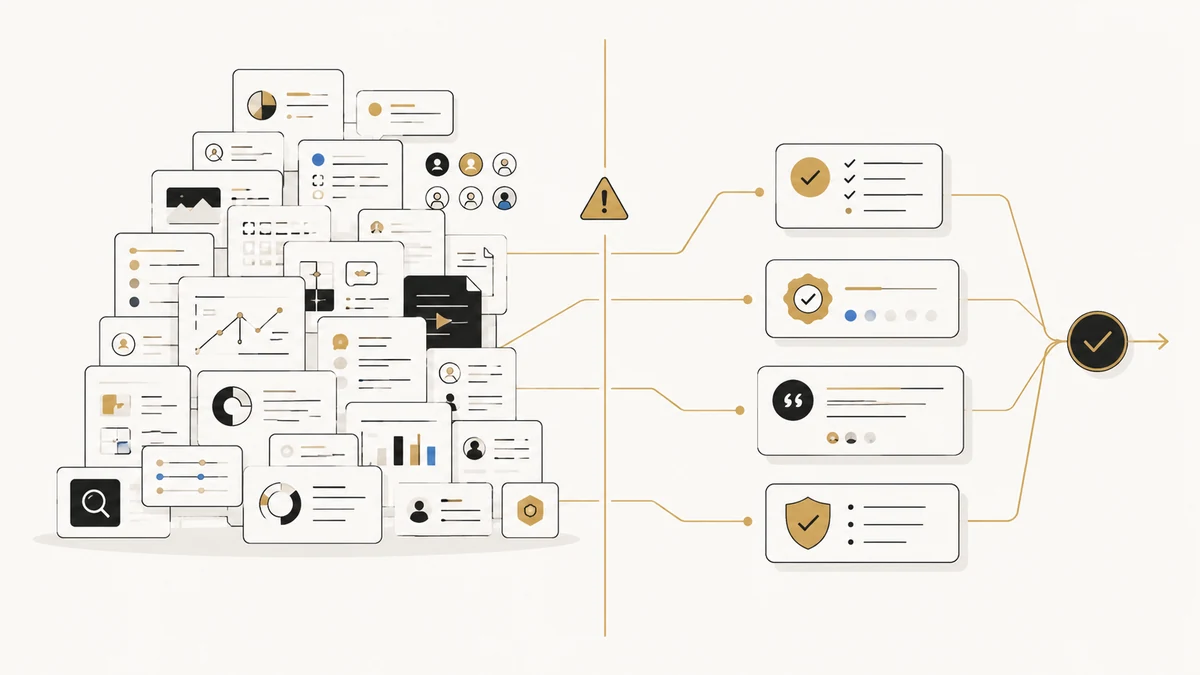
The report’s central claim is that information abundance has not created confidence. Buyers can research faster, ask AI tools for summaries, compare peers, and find vendor claims earlier than before. The problem is that those inputs do not automatically help them decide. INFUSE calls this the trust gap, and it is the most useful phrase in the report. GetWhys’ citation-backed buyer research workflow addresses the marketer side of that gap by making source evidence inspectable before the message reaches the market.
The investment-goal data backs that up. A team buying technology in 2026 is still trying to improve efficiency, but the center of gravity is moving toward revenue, customer experience, business transformation, productivity, and risk control. INFUSE’s own takeaway is blunt: GTM teams that position technology only around cost reduction miss the wider set of outcomes now driving buying committees.
That matters for AI positioning because “we save time” has become the default claim. It is not enough. If 70% of technology investment goals sit outside the operating-efficiency bucket, then the buyer needs to see how the tool changes revenue motion, customer quality, risk, and internal decision speed.
Why the Trust Gap Is a Ranking Opportunity
Most coverage of B2B AI buying turns into a usage story: how many buyers use AI, how many sellers use AI, and which tools they prefer. INFUSE points to a better editorial opening. The gap is not access to information. The gap is confidence.
Gartner’s May 2026 survey makes the same point from the buyer side. It found 69% of B2B buyers turn to sales reps to validate AI-generated insights, and that more than half report encountering misleading AI output during research. Buyers are using AI, but they are not treating it as the final authority.
That creates a content opening. A B2B team that publishes checkable claims, dated methodology, comparison pages, security answers, integration proof, and customer evidence gives the buyer something to validate against. A team that publishes another AI benefits page makes the trust gap wider. Cashew’s originality pressure data adds the content-production angle: the claims buyers can validate are the claims competitors cannot easily copy.
The Content Test: Proof Beats Generic Education
When we covered The B2B CMO Imperative, the operator-level lesson was that marketing teams need separate measurement for brand, AI visibility, and C-suite credibility. INFUSE adds the buyer-side reason: the buyer is not rewarding more volume. The buyer is rewarding proof that reduces risk.
That same logic also applies to signal quality. DemandScience’s false-positive data showed what happens when B2B teams mistake activity for intent. INFUSE shows the parallel mistake on the content side: mistaking information for confidence. More information can make the buyer less confident if it creates conflicting claims and no way to resolve them.
McKinsey’s 2026 B2B Pulse reinforces the point with a different frame. Buyers now use more channels, expect consistency across them, and cite inconsistent information across teams as a reason to switch suppliers. The message is simple: trust is not a landing-page copy problem. It is an operating problem that shows up in content.
What B2B Teams Should Do Now
- Rewrite AI claims as buyer outcomes. Replace “saves time with AI” with a dated, checkable claim tied to revenue growth, customer experience, risk reduction, or decision speed.
- Publish the proof path beside the claim. If the claim depends on a benchmark, name the sample, date, metric, and method. Buyers need something to validate.
- Build comparison pages that answer the buyer’s actual doubts. AI tools and buying committees both reward pages that name alternatives and explain tradeoffs plainly.
- Audit contradictions across channels. Sales decks, product pages, pricing pages, help docs, and review profiles should not describe the product in five different ways.
- Use buyer enablement as the content filter. If a page does not help a buying group decide, verify, compare, or de-risk, it is probably not the page that wins this SERP.
The useful move is not to write less about AI. It is to write more specifically about what buyers can verify. INFUSE’s trust-gap frame is a reminder that AI has not removed the hard part of B2B buying. It has moved that hard part earlier.
Frequently Asked Questions
Voice of the Buyer 2026 is an INFUSE Insights report updated May 27, 2026. It draws on a survey of more than 2,300 B2B GTM leaders and frames the current buying market around AI-assisted research, lower buyer confidence, and a widening trust gap.
It is the gap between what buyers can now access and what they can confidently trust. AI tools, peer networks, and vendor content give buyers more information, but that information often conflicts or lacks proof. Buyers then need clearer evidence before moving forward.
INFUSE reports operating efficiency fell from 41% of technology investment goals in 2025 to 31% in 2026. Revenue growth, customer experience, business transformation, employee productivity, and risk management all gained share, which means AI messaging focused only on efficiency is too narrow.
Lead with proof. Publish named outcomes, dated benchmarks, comparison pages, integration details, risk answers, and methodology-backed claims. The goal is to help buying committees verify what AI tools summarize, not to add more generic AI positioning to the market.