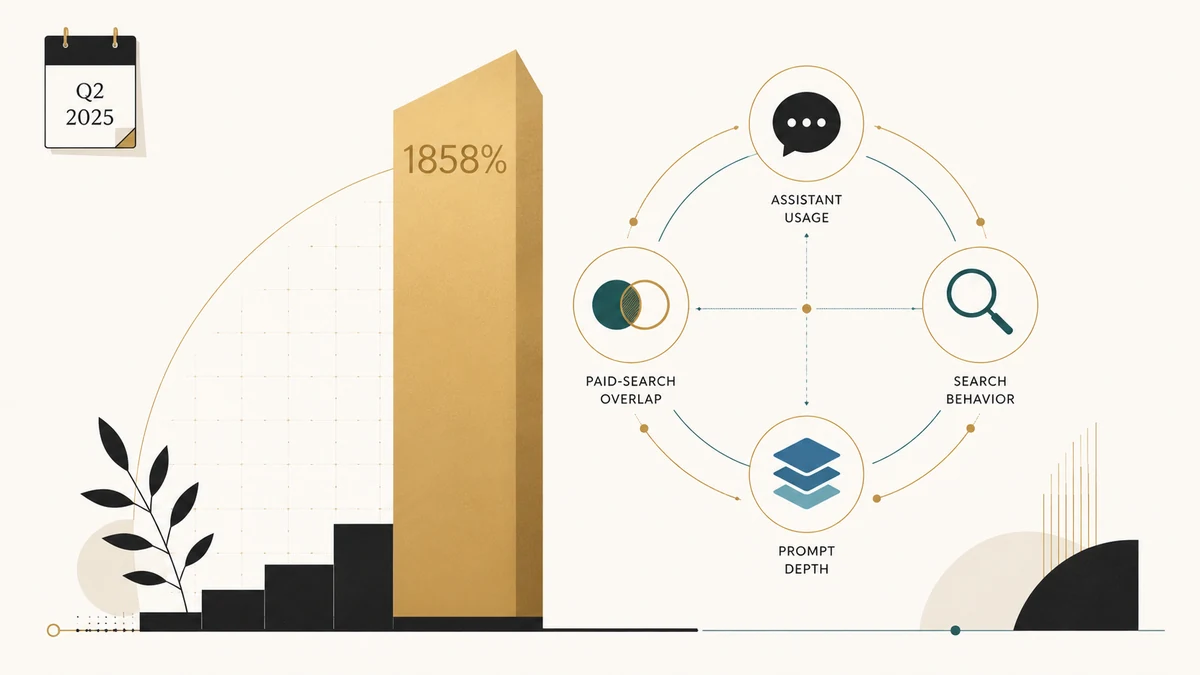
Comscore released its first AI Intelligence Report for 2026 on June 2, and the headline number is hard to ignore: Claude recorded 1,858% growth in desktop conversations between October 2025 and March 2026. ChatGPT still leads the category, with 244 million desktop conversations and 87 million desktop visitors in March, but Comscore’s data says AI attention is no longer concentrated in one assistant.
The report also says AI assistant tools reached 36% of desktop users and 23% of mobile users in Q1 2026. U.S. desktop searches reached 76 billion in Q1, up 10% versus Q1 2024, as AI search experiences became part of normal search behavior. In consumer credit cards, Comscore found AI Overviews appeared alongside 46% of paid search ads in Q4 2025, up from 21% in Q2 2025.
Our read: this is not only an AI assistant adoption story. It is a measurement story. When we covered Google’s AI Performance Insights, the useful part was that Google had started turning AI visibility into a reportable metric. Comscore is doing the same from the market side, linking assistants, search, prompts, citations, and purchase journeys into one data frame.
Key Takeaways
- Comscore’s Q1 2026 AI Intelligence Report says Claude desktop conversations grew 1,858% from October 2025 to March 2026.
- ChatGPT still led in March with 244 million desktop conversations and 87 million desktop visitors.
- AI assistant tools reached 36% of desktop users and 23% of mobile users in Q1 2026.
- U.S. desktop searches reached 76 billion in Q1, up 10% versus Q1 2024, as AI search became part of normal search behavior.
- B2B teams should treat AI visibility as a standing measurement layer, not a quarterly experiment.
What Comscore Actually Measured
The report page frames the release around AI search, AI-led citation, assistant usage, chatbot prompts, and the evolution of the consumer journey. That matters because most AI coverage still treats those as separate problems: SEO teams talk about AI Overviews, product teams talk about assistants, and paid teams talk about ad placement.
Comscore’s panel data pulls those behaviors into the same field of view. Claude’s 1,858% growth is the easy headline, but the more operational point is that users averaged 4.9 prompts per ChatGPT conversation, 4.6 on Gemini, and 7.1 on Copilot in March 2026. These are multi-turn research loops, not single answer lookups.
For B2B marketers, that is the part to watch. A buyer researching attribution software, AI SEO tools, or CRM alternatives will not only ask one keyword-style query. They will refine the use case, compare vendors, check implementation fit, and test claims across several prompts. The brand that only measures rank misses where the evaluation is actually happening. Goodwater’s AI-first search finding adds the starting-point evidence: among daily AI users, more now begin with an assistant than a traditional search engine.
Why B2B Search Teams Should Care
Comscore’s data is not a B2B software buyer survey, so it should not be overread. But it lands beside B2B-specific research pointing the same way. Gartner’s May 2026 buyer survey found 45% of B2B buyers use GenAI primarily to gather vendor and product information, while 69% still turn to sales reps to validate AI-generated insights.
That is the pattern: AI compresses research, then buyers look for validation. The search team owns the first part. The sales and proof layers own the second. If those teams measure different realities, the buyer sees the gap. McKinsey’s 2026 B2B Pulse makes the same point from another angle, noting that gen AI has moved into the top five channels for supplier discovery and evaluation.
This is why the collapse between Google’s top 10 and AI-cited sources is no longer a side note. If AI engines draw from a different source pool, and Comscore is now measuring AI-assisted behavior as part of the consumer journey, then the B2B reporting stack needs a second visibility layer next to organic rank.
The Catch: Comscore Is Measuring the Market, Not Your Category
The useful warning is that Comscore’s numbers are broad. A 36% desktop reach figure does not tell a cybersecurity vendor, accounting platform, or B2B agency whether its category buyers use Claude, ChatGPT, Gemini, or Copilot most often. It does not tell the team which prompts create the shortlist or which citations become visible brand mentions.
So the report should not become a lazy “AI is growing” budget slide. The better use is as a baseline for category-specific measurement: which assistants matter, which prompts buyers ask, which domains get cited, which brands get named, and which claims the buyer later validates with humans.
There is also a paid-search implication. Comscore found AI Overviews appearing beside 46% of paid search ads in consumer credit cards. B2B paid search teams should not copy the credit-card number, but they should copy the question: where are AI summaries now sitting next to paid placements, and are those summaries changing the click, the claim, or the buyer’s next prompt?
What B2B Teams Should Do This Week
- Add AI assistant reach to the search dashboard. Do not wait for a perfect tool. Track category prompts across ChatGPT, Claude, Gemini, Copilot, Perplexity, AI Mode, and AI Overviews on a fixed cadence.
- Separate citation from mention. A source link is not the same as a named brand in the answer. The ghost citation problem means a team can get cited and still be invisible to the buyer.
- Map prompt depth, not only prompt count. Comscore’s multi-turn prompt data is the clue. Track first prompt, refinement prompt, comparison prompt, and validation prompt separately.
- Brief paid search and content together. If AI Overviews sit beside ads, paid search cannot stay separate from AI-search reporting. The claim in the answer may shape the paid click.
- Use the 48-hour freshness window. If more Comscore data or a vertical cut publishes this week, update the article and the dashboard at the same time.
The practical takeaway is simple: AI search is now measurable enough to budget against. It is still messy, but the mess is no longer an excuse. Once Comscore, Google, and specialist AEO tools all report the surface, leadership will ask for the number. Better to define it before someone else does.
Frequently Asked Questions
It is Comscore’s first AI Intelligence Report for 2026, released June 2. The report uses Comscore panel data to track AI assistant usage, AI search, AI-led citation, chatbot prompt behavior, and the role AI now plays in discovery and purchase decisions.
Comscore says Claude recorded 1,858% growth in desktop conversations between October 2025 and March 2026. ChatGPT still led the category in March, with 244 million desktop conversations and 87 million desktop visitors.
It shows that AI assistant behavior, search behavior, and purchase research are starting to be measured together. B2B teams that only report organic rank will miss how buyers refine vendor questions, compare options, and validate claims inside AI tools.
Not blindly. The 1,858% growth figure makes Claude worth measuring, but category behavior matters more than market-wide growth. Run your own buyer prompts across Claude, ChatGPT, Gemini, Copilot, Perplexity, AI Mode, and AI Overviews before shifting content or paid-search budget.