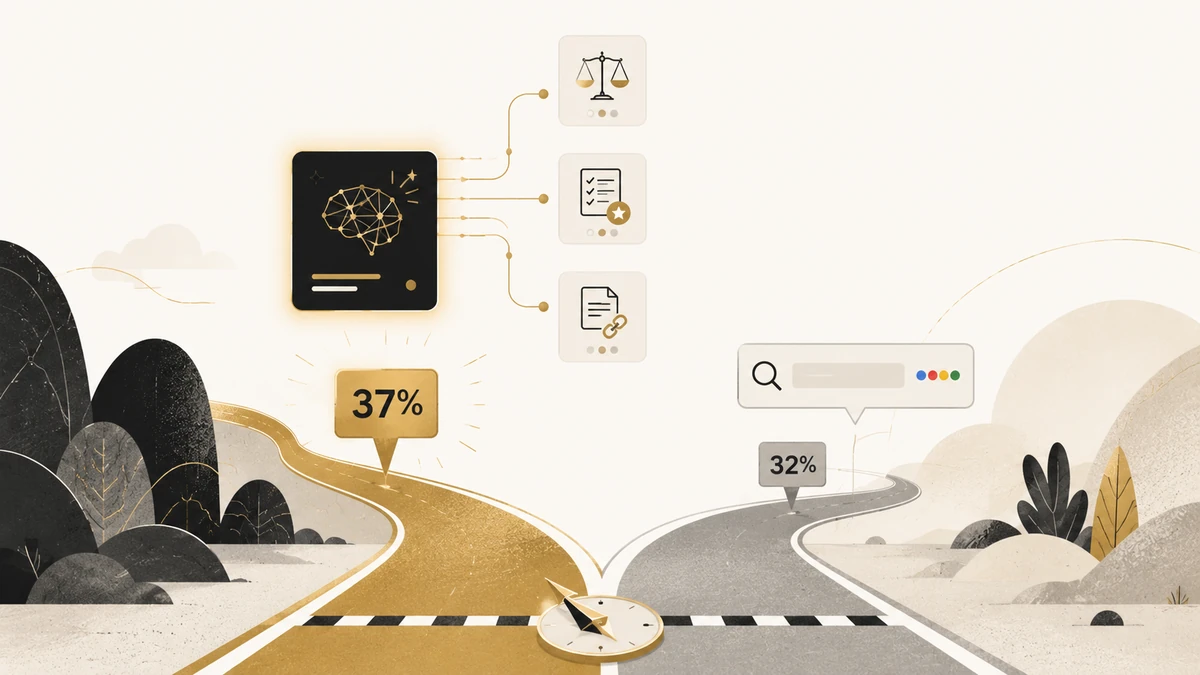
Among Americans who use AI daily, 37% now start an information search with an AI assistant, compared with 32% who begin with a traditional search engine, according to Goodwater Capital’s 2026 U.S. Consumer Survey.
Traditional search still leads across the full population: 53% start with a search engine and 19% start with AI. But daily AI usage rose to 24%, up 10 percentage points year over year, which means the AI-first group is no longer a small behavior test.
For B2B search teams, the change is bigger than referral traffic. A growing group of buyers now begins research inside a system that can summarize options, compare vendors, and shape the next question before a conventional search result appears.
Key Takeaways
- 37% of daily AI users start with AI, while 32% start with a traditional search engine.
- Across all U.S. consumers, search still leads 53% to 19%.
- Daily AI use reached 24%, an increase of 10 percentage points year over year.
- ChatGPT leads primary usage at 43% and consumer trust at 46%.
- 57% of daily AI users pay for at least one AI subscription.
What the Goodwater Survey Found
Goodwater surveyed 1,554 U.S. consumers in early 2026 and normalized the demographics to the U.S. Census. A subset of AI-platform questions was fielded again in March 2026 with 1,452 respondents to reflect changes in the category.
The full Goodwater report shows a market where usage, concern, and willingness to pay are all rising. Two-thirds of Americans express concern about AI’s impact, yet 46% of AI users already pay for at least one AI subscription.
The search behavior is the clearest marketing signal. Our earlier coverage of Comscore’s Q1 2026 AI Intelligence Report showed AI assistants spreading across more users and more multi-turn conversations. Goodwater now shows what that adoption changes at the first moment of discovery.
AI-First Research Changes the Starting Question
Traditional search usually begins with a query and a page of links. AI-first research can begin with a goal, a problem, or a comparison request. The assistant then frames the category, names options, and guides the next prompt.
That difference matters for B2B brands because the first answer can define the shortlist before the buyer visits a website. A company may still earn an organic click later, but it enters that click with a position already assigned by the assistant.
Google’s own guidance for AI features in Search says AI Mode and AI Overviews can use query fan-out, issuing multiple related searches across subtopics and sources. Search behavior is not simply moving from one box to another. One AI prompt can replace several separate searches and expose the buyer to a different source set.
The Measurement Gap Is Now the Risk
Goodwater’s headline does not mean SEO is dead. Search still leads across the full population, and Google remains a major discovery layer. The problem is that most reporting systems can measure the search journey more clearly than the AI-first journey.
Google still includes AI Mode and AI Overview activity inside the overall Web search type in Search Console, but it now also provides a dedicated generative AI report for impressions. That report does not include click data, so a search team still cannot isolate which AI experience produced a click. The dedicated Search Console AI report explains what the dedicated view now adds and what it still withholds. Optimizely’s log-based AEO approach addresses a different blind spot by showing which AI agents request owned content and why they may be visiting.
This is why the B2B GEO ownership gap matters. If nobody owns prompt tracking, citation checks, referral-source detail, and brand accuracy, the company can lose visibility at the start of research while its organic dashboard still looks stable.
The click itself is also changing. Google’s Further Exploration update created more places for in-depth sources to appear after an AI answer. Goodwater’s data explains why those secondary surfaces matter: for daily AI users, the answer experience increasingly arrives before the link decision.
What B2B Search Teams Should Do Now
- Track a fixed set of buyer prompts weekly. Record which brands, claims, and sources appear across ChatGPT, Gemini, Claude, and Google AI features.
- Keep SEO and AI visibility in one review. Compare organic rank, citations, brand mentions, referral traffic, and assisted conversions instead of creating isolated reports.
- Write for comparison and validation. Publish clear product fit, limitations, proof, and category language that an assistant can use when building a shortlist.
- Preserve referral-source detail. Google’s Search Console and Analytics guidance supports combining pre-click and post-click data to understand discovery quality.
- Measure the second question. Ask what a buyer is likely to prompt after seeing the first answer, then build the evidence that earns inclusion in that next comparison.
The 37% versus 32% split is not a forecast. It is a current behavior among daily AI users. B2B search teams still need organic rankings, but they also need to know whether an assistant introduces the brand before the buyer decides which link is worth opening.
Frequently Asked Questions
AI has overtaken search as the starting point among daily AI users in Goodwater’s survey: 37% start with AI and 32% with search. Across all U.S. consumers, traditional search still leads by a wide margin, 53% to 19%.
Goodwater Capital found that 24% of Americans use AI daily in 2026. That is an increase of 10 percentage points from the prior year. The survey covered 1,554 U.S. consumers with demographics normalized to the U.S. Census.
AI-first search means an assistant may define the category, compare vendors, and shape a shortlist before the buyer visits a website. B2B teams therefore need to measure citations, mentions, and brand accuracy alongside organic rankings and referral traffic. Zeta’s agentic commerce research shows the same pattern in shopping: AI can influence the choice before the brand-owned visit begins.
No. Traditional search remains the starting point for most consumers, and Google uses normal SEO foundations for its AI features. The practical change is to extend SEO measurement into AI answers, citations, prompts, and assisted discovery rather than treating them as separate channels.