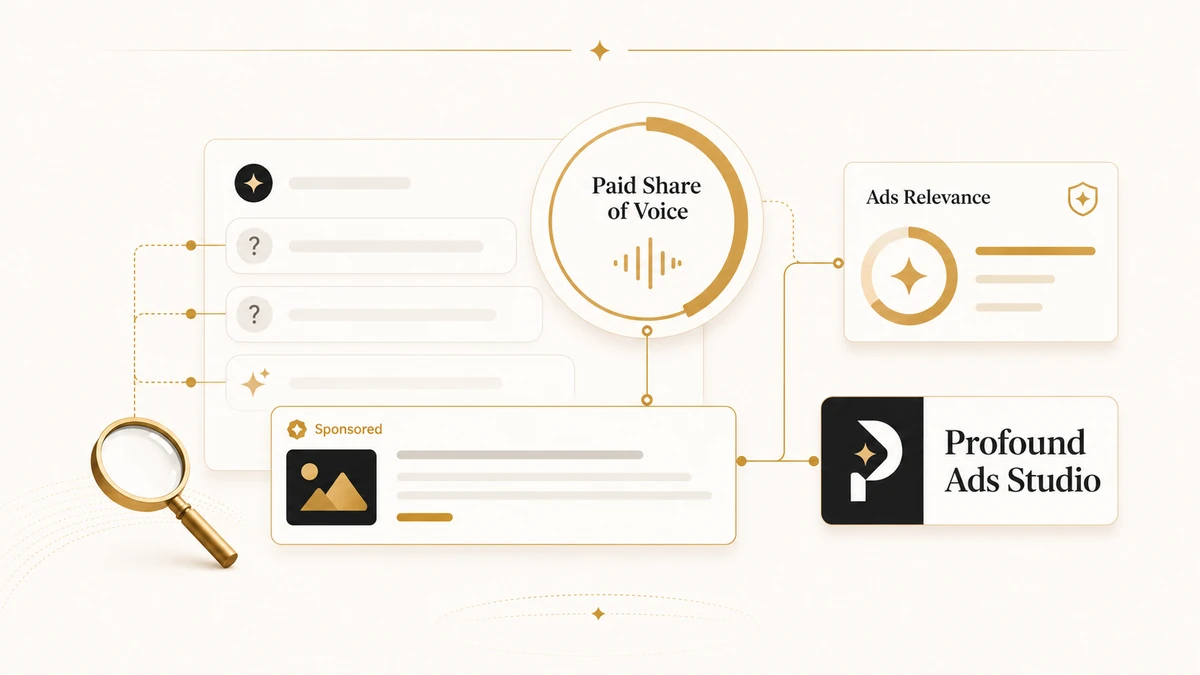
Profound announced Ads Studio on July 7, 2026, adding paid campaign measurement and ad generation to its AI Search marketing platform.
The launch introduces two AI-search ad metrics: Paid Share of Voice, which measures how often a brand’s ad appears against competitors in AI conversations with sponsored results, and Ads Relevance, which scores whether an ad belongs in the conversation it is entering. Profound says Ads Studio uses more than 1.9 billion real-user prompts to find topics and generate candidate ads.
For B2B marketers, the important part is not that another ad product exists. It is that AI search is starting to look like a measurable paid channel, not only an earned visibility problem. When we covered Adobe Brand Visibility and Bluefish Agentic Campaigns, the open question was how teams would prove which AI-search action changed a buyer-facing answer. Profound is now asking the same question on the paid side.
Key Takeaways
- Profound Ads Studio launched on July 7, 2026, after Zero Click New York.
- The product introduces Paid Share of Voice for sponsored AI-search conversations.
- Ads Relevance scores whether an ad fits the prompt context before launch.
- Profound says the system draws on more than 1.9 billion real-user prompts.
- The beta is invite-only for existing Profound customers at launch.
What Profound Ads Studio Actually Adds
Profound has been selling AI-search visibility as a monitoring and action category. Ads Studio extends that into paid media. Instead of only asking whether a brand appears in ChatGPT, Perplexity, AI Mode, or another answer surface, the new workflow asks where paid visibility appears, how competitors show up, and whether a proposed ad is relevant to the prompt. Profound FactCheck adds a separate accuracy layer for testing whether the brand claims inside those answers are true.
That is a meaningful change because AI-search ads do not behave like classic keyword ads. A buyer is not typing one short keyword and scanning ten blue links. They are asking a conversational question, comparing options, or asking an assistant to narrow a shortlist. Paid Share of Voice is Profound’s attempt to measure the sponsored part of that interaction.
eMarketer framed the launch as an early measurement framework for AI-search advertising. That is the right lens. The product matters less as a standalone ad builder and more as a signal that AI-search advertising needs its own metrics instead of borrowed PPC dashboards.
Why Paid Share of Voice Matters for B2B
B2B paid search has always depended on intent. The tighter the query, the more valuable the click. AI search changes the shape of that intent. A buyer might ask, “Which customer data platform fits a mid-market B2B SaaS team with complex consent rules?” The answer is not a keyword list. It is a recommendation context.
That makes relevance harder and more valuable. If a brand buys its way into the wrong AI conversation, the ad may look intrusive or simply be ignored. If it appears in the right comparison, procurement, or problem-diagnosis conversation, it may influence the shortlist before the buyer ever visits a site.
This is where Optimizely’s agent visibility work and Profound’s paid metric point toward the same future. Organic AI visibility, agent retrieval, and paid AI placement will not stay separate in planning decks for long. B2B teams will need one view of where buyers ask, what answers they receive, where competitors appear, and which paid placements actually change pipeline.
The Catch: New Metrics Can Still Mislead
Paid Share of Voice sounds cleaner than it will feel in practice. B2B teams will need to know which prompt sets define the category, which assistants are included, how sponsored results are counted, and how competitor names are matched. A high paid share on weak prompts is still a weak media plan.
Ads Relevance has the same issue. A score can tell the media team that an ad fits a conversation, but it cannot decide whether the claim is sales-approved, legally safe, or aligned with current positioning. Our read: Ads Studio should sit beside marketing ops and sales enablement, not only inside the paid media team. Multiply’s account-ad production layer makes that approval path even more important because it moves from one ad to many account-specific variants.
The useful test is whether the metric changes a decision. If Paid Share of Voice shows a competitor dominating one prompt cluster, the next action might be a paid ad, an organic content update, a partner citation push, or a sales-deck change. The score is only useful if the team can map it to the next move. Zappi’s launch adds the creative version of that problem: predictive ad-testing scores only help when they change what a media team funds, edits, or cuts.
What B2B Teams Should Test Now
Start by separating discovery prompts from buying prompts. Discovery prompts ask what a category is or which problems matter. Buying prompts ask which vendors fit a constraint. Profound’s paid metrics will be more useful if those groups are reported separately.
Second, compare paid visibility with organic AI visibility. A paid result that appears where the brand is already cited may be less valuable than a paid result that fills a genuine absence. The same logic applies to AI Overview optimization: visibility is useful only when the source, answer, and next action all make sense together.
Third, measure downstream behavior. Do not stop at prompt coverage or ad generation volume. Track assisted demo requests, branded search lift, sales mentions, and influenced pipeline for the prompt groups where paid AI placements appear.
Profound Ads Studio is early, but the direction is clear. AI-search advertising is becoming a channel with its own measurement vocabulary. The teams that win will define the prompts, approvals, and pipeline tests before paid AI search turns into another dashboard nobody trusts.
Frequently Asked Questions
Profound Ads Studio is a new AI-search advertising product from Profound. It helps marketers measure paid visibility in sponsored AI conversations, score ad relevance, and generate candidate ads using Profound’s prompt and visibility data.
Paid Share of Voice measures how often a brand’s ad appears compared with competitors inside AI conversations that include sponsored results. In B2B, it should be evaluated by prompt cluster and buying stage, not as one blended visibility number.
Profound says Ads Studio is available through an invite-only beta for existing customers. Non-customers can join the waitlist, but the company has not announced broad public availability yet.
Start with one product line, a fixed prompt set, named competitors, and approved claims. Compare paid visibility with organic AI visibility, then measure assisted pipeline, branded search, sales feedback, and whether the placement changed the buyer conversation.