Direct answer – what is Multiply 10 Minute ABM?
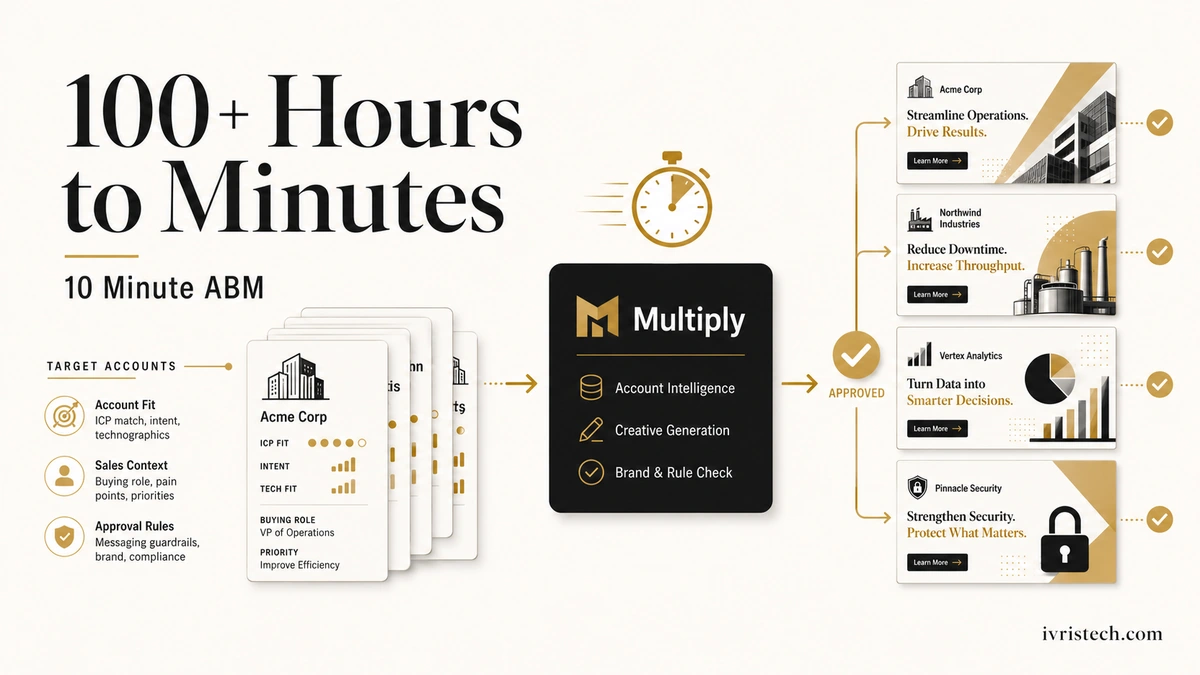
Multiply 10 Minute ABM is a new account-based advertising offering from Multiply that uses AI to turn target-account lists, CRM context, sales-call insight, and brand rules into personalized ads. Multiply says the workflow compresses more than 100 hours of manual ABM setup into a few minutes. The B2B test is whether speed improves account quality, not only ad volume.
Multiply launched 10 Minute ABM on July 9, 2026, positioning the service as a way for B2B marketers to launch hundreds of personalized account-based ads without rebuilding each campaign by hand.
The headline claim is compression. Multiply says 10 Minute ABM can reduce more than 100 hours of campaign preparation to a few minutes by using AI to generate account-specific messaging and creative for top accounts. A Yahoo Finance syndication of the announcement puts the same launch in the paid-media category rather than the broader ABM strategy bucket.
For B2B teams, the useful part is not “more ads.” It is whether ABM can move from a small set of hand-built enterprise accounts to a wider list without turning personalization into template spam. We made a similar point in our coverage of 6sense’s AI-Recommended Leads: account engagement only matters if the next action is specific, trusted, and usable by sales.
Key Takeaways
- Multiply launched 10 Minute ABM on July 9, 2026.
- The service targets personalized account-based ads for top B2B accounts.
- Multiply says the workflow compresses more than 100 hours of setup into minutes.
- The launch uses sales-call recordings, CRM data, and brand guidelines as inputs.
- B2B teams should test account quality and sales acceptance before scaling ad volume.
What Multiply 10 Minute ABM Adds
10 Minute ABM is aimed at the execution layer of account-based marketing. The strategy work still starts with target accounts, buyer pain points, and sales priorities. Multiply is trying to automate the slow middle: turning that input into many account-specific ads across paid channels.
The company describes itself as an AI-native paid media agency for B2B companies. In the new workflow, the team provides account lists and supporting context. The system then translates that material into personalized copy and creative variations aligned to each target account.
The practical appeal is obvious. Many ABM programs stall because the first 10 accounts receive thoughtful work and the next 90 receive a lighter version of the same message. If AI can make the second group more specific, the cost curve changes. SpotsNow AI Search applies the same compression logic to media planning by ranking podcast inventory before a buyer starts manual outreach.
Why 100 Hours Matters For ABM
ABM has always had a math problem. The more specific the campaign, the harder it is to scale. A marketer can manually tailor a message for a strategic account, but that approach breaks when the sales team wants personalized ads for 200 named companies.
Multiply is attacking that gap by treating personalization as a production system, not only a planning idea. That fits the wider ad-tech pattern IVRIS has been tracking. Zappi Amplify AI is trying to predict which creative deserves review. Profound Ads Studio is trying to measure paid visibility inside AI-search conversations. Multiply is focused on the setup burden before those ads even run.
Our read: the strong claim is not that AI can write account-specific ads. That is now table stakes. The strong claim is that a B2B team can shorten campaign setup enough to test more accounts while keeping the sales story intact.
The Catch: Personalization Still Needs Rules
The risk is that “personalized” becomes a formatting label rather than a buyer insight. A company name in the headline, a swapped industry reference, and a generic pain point do not make an ABM campaign good. They make a template look busier.
The real control layer is upstream. Teams need a clean account list, approved value propositions, sales-call themes, vertical rules, exclusion logic, and a definition of what counts as too specific or too speculative. Without those boundaries, fast creative production can create fast brand drift.
There is also a sales-alignment test. If the campaign says an account is seeing one problem and the account executive knows the real problem is different, the ad can make the outreach feel less credible. The fastest workflow in the world still needs account-owner review for high-value targets.
What B2B Teams Should Test Now
Start with a controlled account set. Pick 25 to 50 accounts where sales has good notes and marketing already knows the buying committee, industry context, and current objection. Do not begin with a messy export.
Second, grade the outputs before launch. Score each ad for account relevance, claim accuracy, sales usefulness, and brand risk. The goal is not to approve every variant. The goal is to find out whether the workflow saves meaningful review time.
Third, connect ad performance to sales movement. Clicks and impressions are not enough for ABM. Measure account engagement, accepted follow-up, meetings, opportunity creation, and whether sales used the ad theme in outreach.
Finally, keep a non-AI control group. Run a small manually built ABM set beside the AI-built set. If 10 Minute ABM cannot beat or match the manual group on account movement, the time savings may not be worth the quality tradeoff.
Frequently Asked Questions
Multiply 10 Minute ABM is a B2B account-based advertising offering that uses AI to create personalized ads for target accounts. Multiply says it can reduce more than 100 hours of manual setup to a few minutes.
It is aimed at B2B marketing teams running account-based campaigns where manual personalization limits scale. The best fit is a team with a defined account list, good sales context, and clear approval rules.
No. It targets campaign production, not account selection or positioning strategy. Teams still need to choose the right accounts, define buyer pain points, approve claims, and measure whether sales accepts the output.
Use a small account set first. Compare AI-built ads with manually built ads, review accuracy before launch, and measure sales acceptance, meetings, opportunity creation, and account movement instead of ad volume alone.