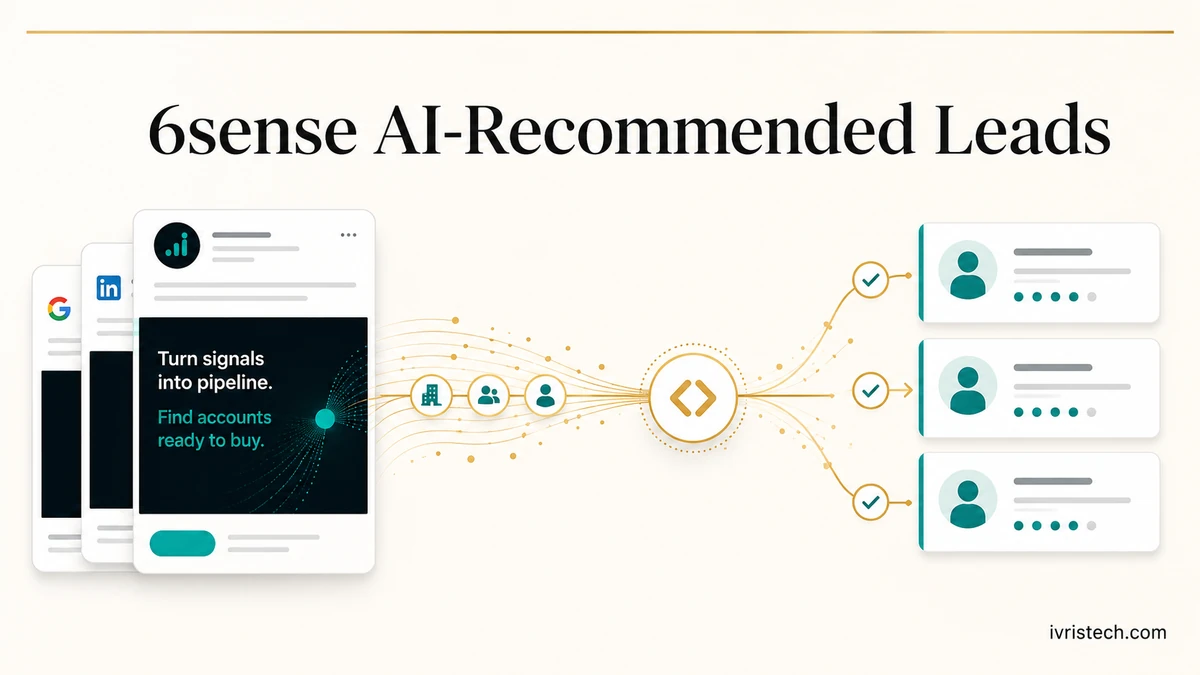
6sense introduced AI-Recommended Leads on June 22, 2026, an AI-driven capability that turns engaged accounts from 6sense advertising campaigns into CRM-ready contact recommendations. The feature is scheduled to become available to all customers using 6sense advertising campaigns in August 2026.
6sense says the capability uses people intelligence, persona targeting logic, and campaign engagement signals to surface a short list of high-confidence contacts per qualified account. Those contacts can be sent to AI Email, a BDR team, or a sales representative without waiting for a form fill.
The important part for B2B marketers is not another lead list. It is a pressure test for paid media accountability: if an account engages, marketing now has to explain which person should get the next move and why. Multiply’s 10 Minute ABM setup claim pushes that pressure one step earlier by asking whether the ad work itself can become specific before the handoff begins.
Key Takeaways
- 6sense announced AI-Recommended Leads at the Cannes Lions B2B Summit on June 22, 2026.
- The feature recommends CRM-ready contacts for engaged accounts inside 6sense advertising campaigns.
- 6sense says the recommendations draw on people intelligence, persona targeting logic, and campaign engagement signals.
- Availability is planned for all 6sense advertising customers in August 2026.
- The buyer-side test is whether named contacts improve sales handoff quality, not only campaign reporting.
What 6sense Launched
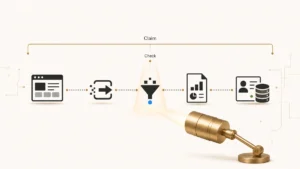
AI-Recommended Leads is built for on-platform 6sense advertising campaigns where persona targeting and account qualification are already in place. Instead of stopping at an engaged account list, the system recommends the most relevant people at that account for sales follow-up.
That distinction matters. 6sense says the tool is not limited to the individual who clicked an ad. It can recommend a relevant contact at the engaged account even if that person did not appear in the campaign activity. The operating claim is that account engagement, intent data, and people data can produce a better next action than a rep searching LinkedIn after the campaign report lands.
Kimberly Bloomston, Chief Product Officer at 6sense, put the thesis bluntly: “Account engagement without a contact recommendation is an incomplete answer.” The line is useful because it names the gap many ABM programs quietly accept. Marketing can identify a company, but sales still has to translate that company into a person, a message, and a reason to act now.
Why The Ad-To-Pipeline Claim Matters
B2B advertising has always had a measurement problem. Impressions, clicks, account engagement, and influenced pipeline can all be defended, but they often do not satisfy a sales leader who wants a cleaner handoff. 6sense is trying to make the ad output more operational: a named, CRM-ready contact list rather than another account score. Creative testing now belongs in that handoff design too, because Zappi Amplify AI’s 84% validation claim is useful only if better ads become better accepted leads.
This sits beside a broader market shift from signal collection to GTM action. IVRIS has tracked the same pattern in 2X’s human-agentic GTM services model and ZoomInfo’s GTM AI data layer, where the revenue promise depends on turning intelligence into a workflow someone owns.
Our read: the launch is less about replacing lead generation and more about redefining what paid media must return. A demand-gen team can no longer celebrate account engagement alone if the next step is still manual prospecting. That is the hidden pressure in the announcement.
The Catch: Named Contacts Are Not Buyer Consent
The sharper handoff also creates a sharper governance burden. A recommended contact is not the same as a buyer raising a hand. It is a machine-assisted guess about who matters at a company that has shown account-level activity.
That guess may be useful, but it needs rules. RevOps teams should know how the recommendation was generated, which persona assumptions were used, how stale the contact data is, and whether sales activity will respect regional consent, routing, and suppression policies. Without that control layer, AI-recommended contacts can become faster spam with better reporting.
This is where the product will be judged by operators rather than launch copy. The same issue appeared in IVRIS coverage of Apollo and Perplexity’s workflow push: the value is not the agentic handoff itself, but the audit trail behind it. A rep needs context, and a marketing leader needs evidence that the motion created pipeline without weakening trust.
What This Means For B2B Marketers
Demand-gen teams should treat AI-Recommended Leads as a handoff design question, not only a 6sense feature to switch on in August. The first job is to define what a qualified account means inside each advertising campaign. The second is to define which personas sales should accept as worth calling.
For RevOps, the work is more specific. Map where the downloadable contacts enter CRM, how they are labeled, which team receives them, and how they are measured against opportunity creation. If the contacts go into AI Email, BDR queues, and sales rep tasks at the same time, ownership will blur quickly.
Marketing leaders should also keep the metric honest. The launch makes ad spend easier to defend only if the contact recommendations are tied to follow-up rates, meetings, sourced opportunities, and accepted pipeline. Otherwise, the team has swapped an account-engagement report for a contact-export report.
The strongest version of this model would connect advertising, buyer-group intelligence, outreach, and attribution without hiding the decision path. That is the same standard IVRIS applied to Pega’s governance model for marketing agents: automation is useful when the evidence stays visible and accountable people still own the call.
Frequently Asked Questions
6sense AI-Recommended Leads is an AI-driven capability for 6sense advertising campaigns. It recommends CRM-ready contacts at engaged accounts so marketing can hand a named person to AI Email, a BDR team, or a sales representative.
6sense says AI-Recommended Leads will be available in August 2026 to all customers using 6sense advertising campaigns. Teams should use the time before rollout to define campaign qualification, contact routing, CRM labels, and sales acceptance rules.
Ad click reporting shows campaign activity. AI-Recommended Leads tries to translate account engagement into specific people for follow-up. 6sense says the recommended contact does not have to be the person who clicked the ad if another buyer persona is more relevant.
Teams should measure follow-up rate, sales acceptance, meetings booked, sourced opportunities, and pipeline tied to recommended contacts. Contact volume alone is a weak success metric because it does not prove the advertising program created useful sales action.