
Every page ranking for predictive lead scoring today was published by a company that sells it. Microsoft, ActiveCampaign, HubSpot, Salesforce, Adobe, 6sense, ZoomInfo. That is not a conspiracy, it is just who bothers to write about the category. It does mean nobody on page one has a commercial reason to tell you the thing that decides whether any of it works: you may not have enough data to run it.
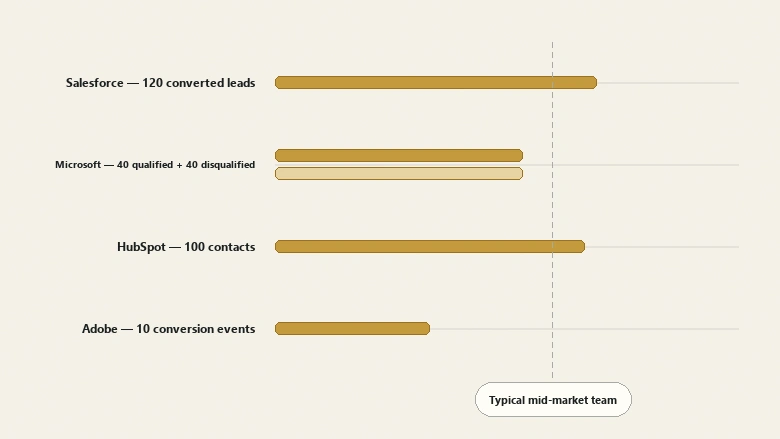
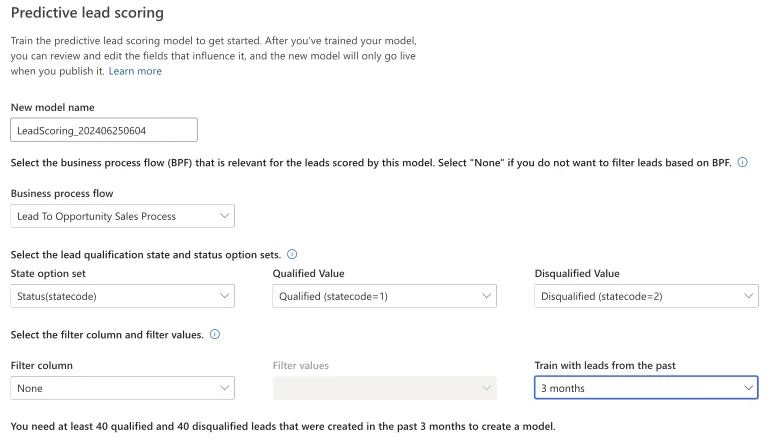
The threshold is not a matter of opinion. Every major platform publishes a minimum in its own documentation, and the numbers disagree with each other by an order of magnitude. Salesforce wants 120 converted leads. Microsoft wants 40 qualified and 40 disqualified. HubSpot shows nothing until 100 contacts. Adobe will train on 10 conversion events. Those gaps tell you more about what you are actually buying than any feature grid will.
Direct answer — What is predictive lead scoring?
Predictive lead scoring trains a machine learning model on your closed-won and closed-lost history, then scores each open lead by its statistical probability of converting. It replaces a hand-built point table with weights the model learns. Every major platform sets a published minimum before it will score: Salesforce needs 120 converted leads, Microsoft needs 40 qualified plus 40 disqualified, HubSpot needs 100 contacts. Below that floor, a rules model is the more reliable instrument.
Key Takeaways
- Predictive lead scoring is a trained model, not a smarter point table. It needs labelled outcomes, and the label is a closed deal.
- Every platform publishes a data floor. Salesforce: 1,000 leads in 200 days, 120 of them converted. Microsoft: 40 qualified and 40 disqualified, created and closed inside the training window. HubSpot: 100 contacts. Adobe: 10 qualified conversion events plus six months of history.
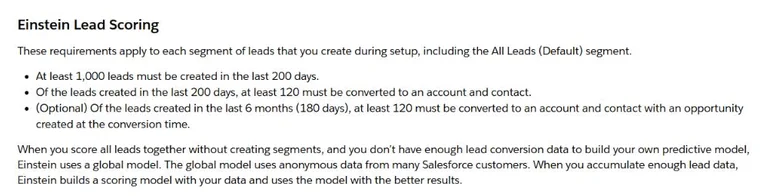
- Below the Salesforce floor, Einstein scores your pipeline using a global model built from other companies’ anonymous data. You get the market’s average buyer, not yours.
- Rules win when your conversion count is small, your sales cycle outruns the training window, your ICP has just changed, or sales will not act on a score it cannot interrogate.
- The fastest route to predictive scoring is a disciplined rules model, because a rules model is what produces the clean qualified and disqualified labels the model later trains on.
| Approach | What it is | Use when | Avoid when |
|---|---|---|---|
| Rules-based | Points you assign by hand to fit and behavior signals | You are under a few hundred conversions, your ICP recently moved, or sales needs to see why a lead scored | Signal count has grown past what one person can weight, and the table no longer matches outcomes |
| Predictive | A model that learns its own weights from closed-won and closed-lost history | You clear the platform’s published floor and your ICP held steady across the training window | You are under the floor, or your sales cycle is longer than the window the model trains on |
| Hybrid | Rules set the hard gates, the model ranks inside them | You clear the floor but still need auditable disqualification | Nobody owns the rules layer, so the two systems quietly drift apart |
What Is Predictive Lead Scoring?
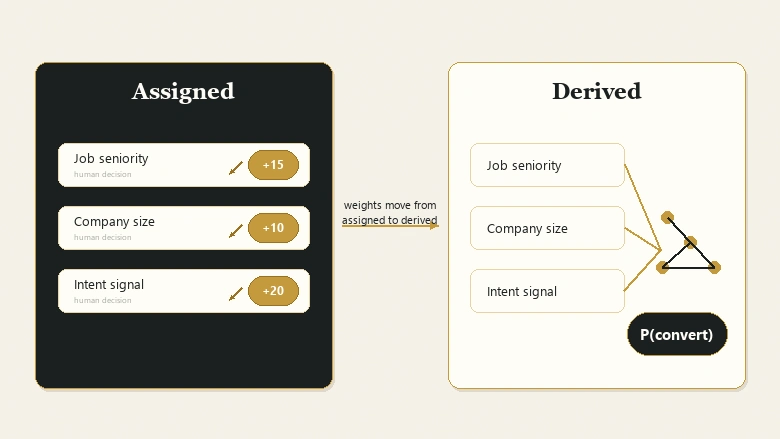
Predictive lead scoring is a method that trains a machine learning model on a company’s historical closed-won and closed-lost records, then assigns each open lead a score representing its statistical probability of converting. The model derives its own weights from outcomes rather than accepting weights a marketer assigned by hand.
That is the whole difference. In a rules-based model you decide that a demo request is worth 25 points and a pricing-page visit is worth 10, and you defend those numbers in a meeting. In a predictive model, nobody decides. The model reads which combinations of attributes preceded a closed deal and weights them accordingly, including combinations no human would have proposed.
The catch sits in the phrase “preceded a closed deal.” A predictive model is a supervised learner, which means it needs examples with known answers. Those answers are your closed deals. If you have not closed many, or if you closed them under a positioning you have since abandoned, the model has nothing honest to learn from.
How a Predictive Model Actually Scores a Lead
A predictive scoring engine takes three inputs: features, labels, and a time window. Features are the attributes it can see about a lead. Labels are the outcomes it is trying to predict. The window defines how far back it looks.
Features come from wherever your stack already collects them. Firmographics such as employee count and industry. Behavior such as page views, email clicks, and form fills. Product telemetry, if you have it, which is why product-qualified lead signals from trials and free tiers make unusually strong features. Third-party signals too, if you buy them, since intent data gives the model evidence about research happening off your site.
The algorithm underneath is usually less exotic than the marketing suggests. Adobe states plainly that its Real-Time CDP B2B service uses a tree-based (random forest/gradient boosting) machine learning method and reruns scoring jobs daily. That is a well-understood family of models, not a black art.
Why the label count matters more than the lead count
Most teams count leads when they should be counting conversions. A model learns from the positive cases, and if 3,000 leads produced 22 closed deals, the model has 22 examples of success to generalize from. The ratio that governs everything is simple.
Conversion base rate = Converted leads ÷ Total leads created in windowA low base rate is not automatically a problem, but a low base rate combined with a low absolute count is. Twenty-two positives spread across forty features is a model that will find patterns in noise and report them with confidence. That failure mode is worse than a crude point table, because the point table never claimed to know.
The Data Floor Every Platform Publishes
To find your own floor, read the requirement your platform documents rather than the number a blog post rounds off. Four of the major vendors publish theirs, and the spread between them is the most useful comparison in this article.
| Platform | Published minimum | Training window | What it does if you fall short |
|---|---|---|---|
| Salesforce Einstein Lead Scoring | 1,000 leads created in the last 200 days, of which at least 120 converted to an account and contact | Rolling 200 days | Falls back to a global model built from anonymous data across many Salesforce customers |
| Microsoft Dynamics 365 Sales | At least 40 qualified and 40 disqualified leads, created and closed inside the window | Selectable, three months to two years | The Get started button is disabled. No model is created |
| HubSpot Likelihood to Close | 100 contacts before Contact priority returns any value; Enterprise tier only | Predicts a 90-day close probability | The property stays empty until the threshold is reached |
| Adobe Real-Time CDP B2B | At least 10 qualified conversion events per prediction goal | Minimum six months plus the prediction window; two years preferred | Insufficient data blocks training for that goal |
Read the second column again. Salesforce asks for twelve times as many conversions as Microsoft and Adobe combined. That is not because Salesforce is stricter about quality. It is because the four products are solving different shapes of the problem: Microsoft is training one binary classifier on a single organization’s qualification decisions, while Salesforce is building a ranking model it intends to hold to a higher accuracy bar before it will trust your data over its own.
Workflow · 30 min
How to check whether your CRM clears the predictive scoring floor
Five CRM reports that tell you, before any sales call or trial, whether a predictive model has enough labelled history to train on.
Find your platform’s published number
Open the vendor documentation, not a blog summary. The four current thresholds are in the table above; confirm yours has not moved since this was written.
Count leads created in the window
Build a report filtered on created date inside the exact window your platform uses. Use the platform’s window, not your fiscal quarter.
Count converted leads in the same window
Filter on the conversion event the vendor names. Salesforce counts conversion to an account and contact, which is stricter than a stage change on the lead record.
Count closed-lost and disqualified leads
Run the same report against your disqualified status values. Most teams discover this number is far smaller than the won number, because nobody closes bad leads out.
Compare and decide
If either count sits under the published minimum, stay on rules and fix the labelling gap first. Retest in one quarter rather than buying the tier now.
PRO TIP
Count your disqualified leads before your won ones. Microsoft needs 40 disqualified leads that were actually closed, and most CRMs are full of leads that were quietly abandoned instead. A working negative scoring policy that forces disqualification is the cheapest way to manufacture the labels a model needs.
What Happens When You Are Below the Floor
Falling short of the threshold produces three different behaviors depending on the vendor, and only one of them is honest about what is happening.
Microsoft simply refuses. If your organization lacks 40 qualified and 40 disqualified closed leads inside the chosen period, the Get started button is disabled and no model is created. Microsoft goes further and gates publication on model quality too: if accuracy falls below an area-under-curve threshold, the page reports the model is not ready to publish, and the documentation warns that pushing it live anyway means “it will perform poorly.”
HubSpot leaves the field blank until you reach 100 contacts, then starts scoring. Its own marketing blog states the threshold plainly: you will not begin seeing values for Contact priority until you have reached 100 contacts. What the product will not do is show its work. HubSpot’s documentation states that the feature uses blackbox machine learning, where the inputs and outputs are known but “it is unknown how the input is transformed into the output”. That is a fair disclosure, and it is also the reason some sales teams never adopt the number.
IMPORTANT
Salesforce does something different, and it is easy to miss. When you have not accumulated enough conversion data, Einstein uses a global model that draws on anonymous data from many Salesforce customers until your own data catches up. Your leads still get scored. The scores just describe the average Salesforce customer’s buyer rather than yours.
That last case is the argument for rules stated better than I could state it. A hand-built point table encodes what your team knows about your market. A global model encodes what is true on average across tens of thousands of unrelated businesses. If you sell something unusual, the borrowed model is not a head start, it is a systematically wrong prior applied to every lead you own.
When Predictive Lead Scoring Underperforms Rules
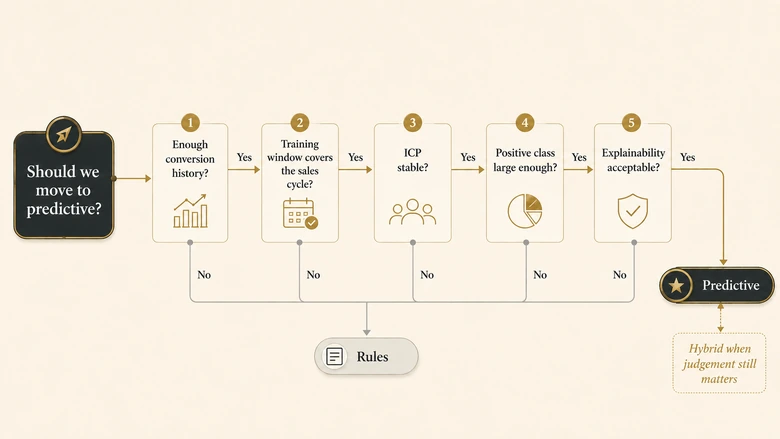
Predictive scoring loses to a rules model in five specific conditions, and four of the five have nothing to do with how good the algorithm is.
- You are under the floor. Either the model refuses to train, or it trains on too few positives and overfits, or it substitutes someone else’s data for yours. All three are worse than a point table you understand.
- Your sales cycle is longer than the training window. A model learning from leads created in the last 200 days cannot see the outcome of a deal that takes nine months to close. The labels arrive after the window has already moved on, so the model trains disproportionately on fast, small deals and quietly learns to devalue enterprise.
- Your ICP just changed. Moving upmarket, entering a new vertical, or launching a second product invalidates the history. The model is a very confident description of the customer you used to want. Rules can be rewritten in an afternoon; a model has to wait for new outcomes to accumulate.
- Your positive class is tiny. Low base rates are normal in B2B, but a model with a two percent conversion rate and a few dozen wins is fitting noise. It will produce a score with two decimal places and no information behind it.
- Sales will not act on a score they cannot interrogate. This is the adoption failure, and it is the most common one. A rep who cannot see why a lead scored 91 treats the number as decoration. A model nobody acts on has an effective accuracy of zero.
None of that is an argument against predictive scoring. It is an argument for sequencing. Most B2B teams that “tried predictive and it did not work” tried it while sitting in one of these five conditions.
Rules or Predictive: How to Decide
Use this as the decision rule rather than a maturity narrative, because “predictive is the advanced version” is the framing that gets teams into trouble.
Use rules when you are below your platform’s published floor, your ICP moved in the last two quarters, your sales cycle is longer than the vendor’s training window, or your reps need to defend prioritization to a manager. Rules are also the right answer when the scoring model is doing routing rather than ranking, because routing needs deterministic behavior.
Use predictive when you clear the floor with room to spare, your ICP has been stable across the whole training window, you have enough features that hand-weighting has become guesswork, and someone owns model monitoring. That last condition is the one teams skip. A model that is never retrained decays as your market moves.
Run both when you clear the floor but still need auditable gates. In practice this is the most defensible design for mid-market B2B: hard rules disqualify students, competitors, and out-of-territory leads, and the model ranks whatever survives. The gate stays explainable, the ranking gets the benefit of learned weights, and no rep has to trust a black box to reject anyone. What neither half decides is what happens to the records that clear the rules and still rank low: they are a fit and not ready, so they belong in a stage-branched track with a defined exit rather than an open-ended drip that never reports whether it worked.
How to Get to the Floor If You Are Under It
Build the rules model first, and build it as a label-generating machine rather than as a stopgap. This reframing matters: the thing standing between you and a working predictive model is not budget or tooling, it is clean labelled history, and a disciplined rules process is what produces it.
Start with the fit dimension, because that is the part a model cannot infer from a thin dataset. Writing down an explicit ICP rubric your sales team actually trusts forces the definitional work that later becomes the model’s most predictive features. A model trained on a company that never agreed what a good-fit account looks like will learn that ambiguity too.
Then fix disqualification. Every lead that gets abandoned instead of closed-lost is a missing training example, and Microsoft’s requirement makes the cost explicit: 40 disqualified leads is a hard gate, not a nice-to-have. Enforce a closure discipline and the negative class fills in on its own.
Third, stabilize your signal definitions. Rotating which behaviors you track means the feature history is inconsistent across the window. A stable catalog of scoring criteria with fixed point values gives the model a consistent view of the past, which is worth more than adding another data source.
Retest quarterly. The floor is a count, and counts move. A team adding 60 conversions a quarter crosses the Salesforce threshold in about half a year of disciplined labelling, and arrives with a clean dataset rather than a messy one.
Treat the data work as the project rather than as a prerequisite to the project. The vendors have already told you what they need, in numbers, in their own documentation. Everything else in the predictive category is a claim about accuracy you cannot verify until you have handed over enough history for the model to be tested against. The counting is the part you control.
Frequently Asked Questions
In a rules-based model, a lead score is the sum of point values you assigned to fit and behavior signals, minus any negative points. In a predictive model, the score is a probability produced by an algorithm that learned its weights from your closed-won and closed-lost records rather than from a point table.
HubSpot’s Likelihood to Close property is a working example. It returns the percentage probability that an open contact becomes a customer within 90 days, sorts contacts into four priority tiers of 25% each, and needs 100 contacts before it shows any value at all.
It depends entirely on the platform. Salesforce needs 1,000 leads created in 200 days with 120 converted. Microsoft needs 40 qualified and 40 disqualified closed leads. HubSpot needs 100 contacts. Adobe needs 10 qualified conversion events per goal plus six months of history.
Not automatically. Predictive wins when you clear the data floor and your ICP has been stable. Rules win when conversion counts are low, the sales cycle outruns the training window, the ICP recently changed, or reps need an explainable number they can defend to a manager.