Direct answer – What did OpenAI and ZoomInfo announce with GTM.AI in Codex for Work, and what does it mean?
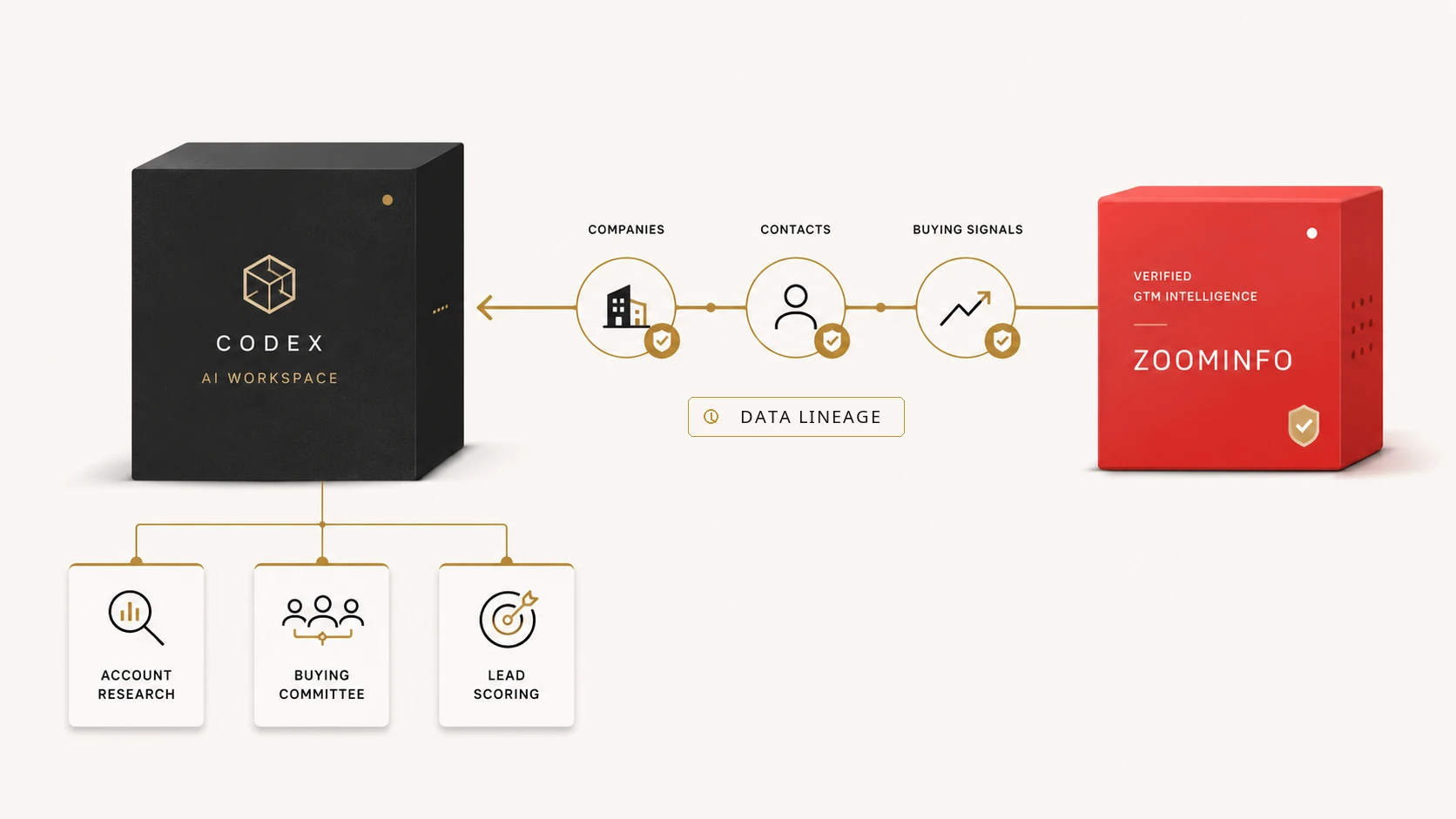
On June 2, 2026, OpenAI made ZoomInfo natively available inside Codex for Work as a B2B data app powered by ZoomInfo’s GTM.AI context graph. Codex users can run ZoomInfo skills like account research, buying committee mapping, enrichment, and scoring. GTM.AI is a headless context layer exposing verified data via APIs and Model Context Protocol. The shift moves GTM data into the agent workspace, making data freshness, permissioning, and source-of-truth control the real RevOps challenge.
OpenAI announced on June 2, 2026 that ZoomInfo is now natively available inside Codex for Work as a B2B data and go-to-market intelligence app, powered by ZoomInfo’s GTM.AI context graph.
The integration brings named ZoomInfo skills into Codex, including Account Research, Buying Committee, Enrich Company, Enrich Contact, Meeting Prep, Score Accounts, Score Leads, TAM Sizer, Tech Stack Snapshot, and Competitor Analysis. ZoomInfo says the underlying GTM.AI graph covers more than 100 million companies, 500 million contacts, and billions of buying signals.
For B2B RevOps, the story is not “Codex can prospect now.” It is that GTM data is moving into the AI workspace as an execution layer. That turns data freshness, permissioning, and source-of-truth control into the real ranking gap behind the release.
Key Takeaways
- OpenAI made ZoomInfo natively available in Codex for Work on June 2, 2026.
- The Codex app includes ZoomInfo skills for account research, buying committees, enrichment, scoring, TAM sizing, and competitive analysis.
- ZoomInfo’s GTM.AI graph includes 100M+ companies, 500M+ contacts, and billions of buying signals.
- GTM.AI exposes ZoomInfo data through APIs and Model Context Protocol for AI agents across Codex, ChatGPT, Claude, Agentforce, Breeze, Copilot, and other tools.
- The B2B risk is stale or over-permissioned data moving faster inside agent workflows.
What OpenAI and ZoomInfo Launched
The new ZoomInfo app lets a Codex for Work user ask for GTM tasks in natural language. The examples in the announcement are practical: find target accounts in a region with buying signals, build a list of decision makers at those accounts, research a company, or identify outreach hooks before a meeting.
That matters because Codex is being positioned by OpenAI as a work surface for multiple roles, not only developers. The ZoomInfo app is one of the clearer signals that Codex is moving into revenue-team workflows, where the output is not code but account selection, contact mapping, and pipeline prioritization.
The timing is tight. One day earlier, ZoomInfo launched GTM.AI as a headless GTM context layer for AI agents. The Codex integration is the first major proof point of that positioning.
Why GTM.AI Is a Context Layer, Not a Dashboard
ZoomInfo’s pitch is that GTM.AI is the API and MCP home for its verified go-to-market data. In other words, the user does not need to live inside ZoomInfo’s UI for the data to matter. Codex, Claude, ChatGPT, HubSpot Breeze, Microsoft Copilot, Salesforce Agentforce, and other agent surfaces can call the same data layer.
That is the same pattern we saw when Apollo moved GTM workflows into Perplexity Computer. The database is no longer only a place a rep searches. It becomes a callable layer behind the AI workspace. ZoomInfo is making the stronger enterprise argument: the callable layer should be verified, identity-resolved, permissioned, and auditable. The 2X-Knownwell human-agentic GTM model extends that argument by placing service delivery and operating accountability around the data and agent layer.
For RevOps teams, that changes the renewal question. A ZoomInfo seat used to be evaluated by how often humans opened it and exported data. A GTM.AI deployment should be evaluated by how often trusted agent workflows call the graph, what they change downstream, and whether the results beat the team’s current research and enrichment process. ZoomInfo’s Amazon Quick Suite integration extends that renewal question into AWS’s agentic workspace, where the same graph can be called outside Codex.
The Data Quality Claim Is the Whole Point
The release points to a familiar B2B failure mode: contact data decays quickly, and a prospecting agent using stale information can scale the wrong list. A human researcher may make the same mistake slowly. An agent makes it at workflow speed.
This is why the ZoomInfo integration has to be read alongside HubSpot’s rebuilt Prospecting Agent. HubSpot uses customer-purchased Apollo, ZoomInfo, or Surfe seats as input for its agent. OpenAI and ZoomInfo are moving the same concept into Codex, but with a broader app and skill set.
The supply-side question is whether the vendor API is ready for agent use. SaaStr’s API report card made that problem visible across B2B software: the product a human buys and the API an agent operates are now two different procurement surfaces. GTM.AI is ZoomInfo’s answer to that split. RainFocus’ event-data MCP launch adds the live-operations version of the same test, because the agent is not only reading data but may change event records.
What RevOps Should Pilot First
- Start with account research briefs. Ask Codex to use ZoomInfo for a narrow ICP list, then compare account fit, signal quality, and missing fields against your current workflow.
- Keep enrichment separate from activation. Let the app enrich and recommend. Do not let it push contacts into sequences or campaigns until false positives are known.
- Match permissions to role and workflow. A seller, SDR, RevOps analyst, and marketer should not receive the same ZoomInfo skill access inside Codex.
- Track data lineage through the CRM. If Codex enriches a contact or scores an account, the CRM should show that the source was ZoomInfo GTM.AI and preserve the timestamp.
- Measure quality, not prompt volume. OpenAI’s B2B Signals research shows frontier firms win through deeper delegated workflows. The ZoomInfo test should measure accepted accounts, corrected fields, meetings created, and bad records avoided.
The practical win is a cleaner handoff between research and action. The practical risk is the same thing: a cleaner handoff can move a bad assumption faster. Treat GTM.AI inside Codex as a controlled data pilot first, and a prospecting acceleration tool second. Pipefy Process-as-Tool extends that warning from data access to process authority, where a bad assumption can trigger a governed business action. 6sense’s AI-recommended-leads handoff sharpens the same RevOps test for advertising: a contact recommendation is useful only when routing, consent, and sales acceptance rules travel with it.
Frequently Asked Questions
OpenAI announced native availability of ZoomInfo inside Codex for Work on June 2, 2026. The app lets Codex users run ZoomInfo-powered GTM skills such as account research, contact enrichment, buying committee mapping, lead scoring, TAM sizing, and meeting prep.
GTM.AI is ZoomInfo’s headless go-to-market context layer. It exposes ZoomInfo’s verified company, contact, intent, and buying-signal data through APIs and Model Context Protocol, so AI agents can call the data from tools such as Codex, ChatGPT, Claude, Agentforce, Breeze, and Copilot.
RevOps teams now have to govern GTM data inside the AI workspace, not only inside the CRM or database UI. The useful questions are permission scope, data lineage, freshness, CRM write rules, and whether agent-generated account or contact recommendations outperform the current research process.
Start with read-only account research, buying committee mapping, and contact enrichment. Inspect the first outputs manually, compare them with CRM data, and keep sequence enrollment or campaign activation human-approved until the team understands duplicate rates, bad-fit accounts, and stale-contact risk.