Direct answer – What is Salesforce Agentforce Marketing?
Salesforce Agentforce Marketing is an agentic marketing layer that puts an “AI marketing team” inside Agentforce. Announced June 3, 2026, it lets agents build pipeline, create content, run campaigns, and optimize experiences against Salesforce data via Marketing Cloud Next, Data 360, and the Marketing Cloud Engagement MCP Server. The practical shift is prompt-to-campaign execution, so scoped MCP permissions, auditability, and human approval become the real control plane for B2B marketing ops.
Salesforce said on June 3, 2026 that it is putting an “AI marketing team” inside Agentforce Marketing, with agents that can help build pipeline, create content, run campaigns, and optimize customer experiences across Salesforce data.
The launch sits on Marketing Cloud Next, Data 360, and Salesforce’s Marketing Cloud Engagement MCP Server. Salesforce says Rawlings is seeing 75% faster campaign creation, while the new MCP layer lets external AI assistants work with Marketing Cloud content, journeys, automations, and data extensions through scoped permissions.
For B2B marketing ops, the story is not whether AI can draft another email. It is whether a prompt can now move from brief to campaign object without the old handoff chain. That makes governance, permissions, and production review the ranking angle the vendor pages and SERP recaps largely miss. BCG’s 8% multi-agent campaign benchmark now gives that governance gap a useful maturity measure.
Key Takeaways
- Salesforce announced new Agentforce Marketing capabilities at Connections on June 3, 2026.
- The launch ties Agentforce Marketing to Marketing Cloud Next, Data 360, and Marketing Cloud Engagement MCP.
- Salesforce says Rawlings reduced campaign creation time by 75% using Agentforce Marketing.
- The MCP Server for Marketing Cloud Engagement can expose journeys, automations, data extensions, and content tasks to authorized AI assistants.
- The B2B issue is permission scope: agents can accelerate campaign setup only inside the boundaries marketing ops defines.
What Salesforce Actually Announced
Salesforce framed the launch as an AI team for marketers, not a single assistant. The agents are meant to validate ideas, qualify leads, create campaign assets, and optimize experiences as customer behavior changes. The practical hook is that the agent is working against Salesforce’s own customer, business, content, and workflow data instead of a disconnected prompt window. Gradial’s cross-tool system-of-work bet tests whether that agentic workflow can span several suites instead of living only inside Salesforce. ActiveCampaign’s memory-first campaign update shows the same pattern moving down-market, where the operating layer is less about enterprise agents and more about reusable brand rules.
That is why the announcement belongs in the same product arc as Salesforce Headless 360. Headless 360 made Salesforce capabilities callable from external tools. Agentforce Marketing applies that idea to the marketer’s day: the brief, segment, journey, message, and optimization loop can all become agent-addressable work.
The public Marketing Cloud Next page says marketers can describe campaign goals in natural language and receive a brief, suggested journeys, and drafts across email, SMS, and WhatsApp. It also names paid media optimization, personalization decisioning, and loyalty promotion creation as Agentforce Marketing use cases.
The MCP Layer Is the Practical Shift
The most useful technical detail is not the “AI team” label. It is Salesforce’s first-party Marketing Cloud Engagement MCP Server, which Salesforce’s developer docs describe as a bridge between an AI assistant and Marketing Cloud APIs. The server lets an assistant view content and contact data, then interact with journeys and automations when an authorized user grants access.
Salesforce’s developer blog says the MCP server is generally available and can create data extensions, build welcome journeys, add Einstein Send Time Optimization, and propagate data-field changes across dependent objects. That turns campaign setup into a prompt-driven workflow, but it also makes the permission model the control plane.
This is where the Salesforce announcement lines up with Adobe’s Marketo MCP move. Both vendors are making core marketing platforms callable from AI assistants. The difference is that Salesforce is packaging the marketing agent, the data foundation, and the execution layer together under Agentforce Marketing. CustomerLake’s lakehouse-native CDP launch widens that pattern from callable campaign objects to the customer-data layer agents act on.
The Governance Catch
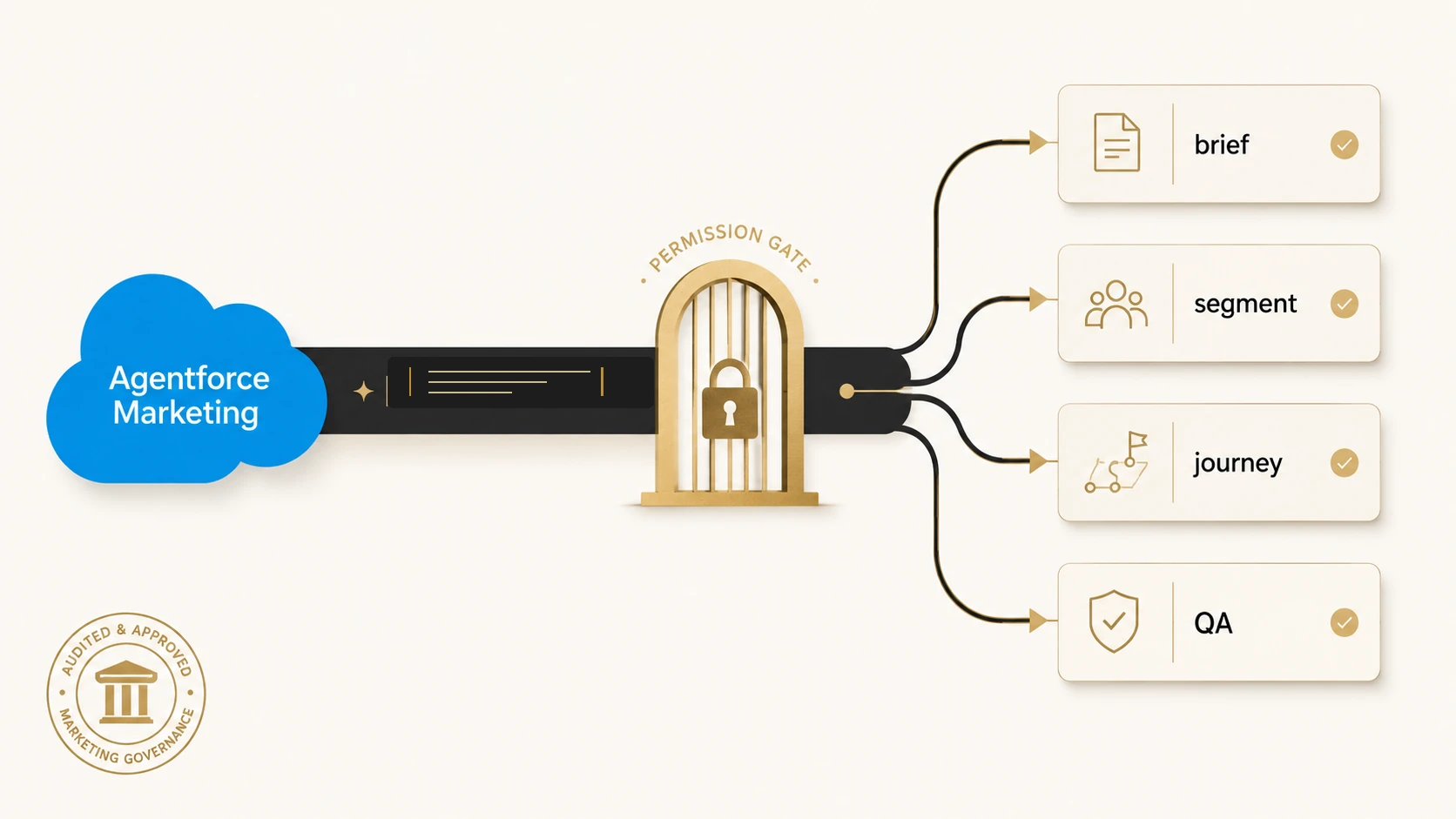
Salesforce’s own MCP guidance is clear that AI assistants can produce inaccurate or harmful results, and that admins should assign only the permission scopes required for the task. That is the sentence B2B teams should highlight before anyone asks an agent to build a live journey. Pega’s governance-first Customer Engagement Studio makes the same control problem the center of the product, with human review and audited workflows positioned before live customer actions.
The core risk is not bad copy. It is a valid-looking campaign launched against the wrong audience, a data extension changed in the wrong business unit, or an automation updated without a rollback path. A marketer may ask for a three-email lifecycle series, but the system has to know which list, consent state, suppression rule, language version, owner, and approval step apply.
The earnings backdrop matters too. Salesforce’s Q1 FY27 Agentforce ARR showed strong enterprise spend but uneven paid adoption across the customer base. Agentforce Marketing gives Salesforce another expansion path inside existing Marketing Cloud accounts. It also gives customers another reason to ask whether the data and permission foundations are ready before buying more agentic capacity.
What B2B Marketing Ops Should Do Now
- Start with read-only campaign analysis. Let the assistant summarize journey performance, over-targeted contacts, and data-extension structure before it creates or edits anything.
- Scope MCP permissions by job, not by user seniority. A senior marketer should not automatically grant an agent send rights, delete rights, or broad data-extension write access.
- Use a sandbox for the first build workflow. Test brief-to-journey creation with dummy lists, staged assets, and a required human approval before activation.
- Log every agent action in marketing ops language. Track prompt, tool, object touched, requester, approval owner, and rollback route. A technical audit log is not enough for campaign accountability.
- Compare agent work to the cost-per-workflow model. The same question from Agentforce Operations applies here: what did the agent complete, what did it cost, and what human review cost remained?
The upside is real. A well-scoped Agentforce Marketing workflow can compress brief, segmentation, draft, QA, and journey setup into hours. The team that gets the value first will be the one that treats the launch as a production-governance project, not a creative shortcut. NIVO AI’s up-to-90% setup claim makes that governance test measurable: count total review, correction, and rollback time before calling the speed gain real.
Frequently Asked Questions
Agentforce Marketing is Salesforce’s agentic marketing layer for campaign creation, personalization, lead workflows, and customer engagement. The June 3, 2026 announcement added a broader “AI marketing team” framing that connects agents to Marketing Cloud Next, Data 360, and Salesforce workflow data.
Marketing Cloud Next is the Salesforce marketing platform layer where campaign briefs, journeys, channels, customer data, and AI recommendations come together. Agentforce Marketing uses that platform to turn natural-language goals into campaign plans, audience segments, draft messages, and optimization actions.
It is Salesforce’s hosted MCP interface for Marketing Cloud Engagement APIs. An authorized AI assistant can use it to inspect marketing data, create data extensions, build journeys, update assets, and run other campaign-management tasks without a user clicking through the Marketing Cloud UI.
Start with read-only analysis and sandbox campaign builds. Good first tests include journey-performance summaries, over-targeting checks, data-extension inspection, and draft journey creation that still requires human approval before activation. Avoid giving agents send or delete permissions until the audit process is proven.