Salesforce posted Q1 FY27 results after the bell on May 27, 2026, and the Agentforce number is the only one anyone is reading. Agentforce ARR crossed $1.2 billion, up 205% year-over-year, with combined Agentforce and Data 360 ARR reaching $3.4 billion and 3.8 billion Agentic Work Units delivered across the platform. Total revenue hit $11.13 billion, GAAP EPS came in at $2.42, and Salesforce raised full-year FY27 guidance to $45.9-$46.2 billion. By every public number, the Agentforce thesis just worked.
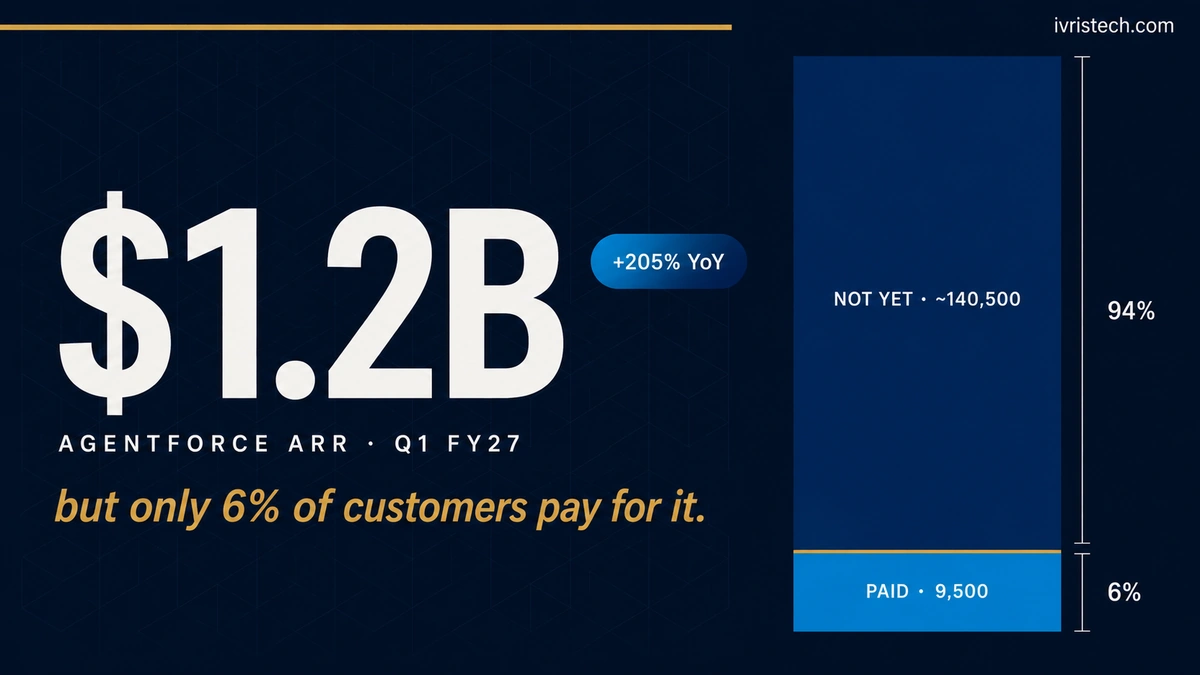
The number Salesforce did not put on a slide is the one B2B RevOps teams should be reading first. Per Salesforce Ben’s latest tracking, roughly 6% of Salesforce’s ~150,000 customer base is on a paid Agentforce plan. That means $1.2 billion in ARR is concentrated inside a small minority of high-spend accounts, and the broader customer base is still in pilot, in evaluation, or watching from the sideline. The Q1 FY27 press release confirms the concentration directly: more than 50% of Agentforce and Data 360 bookings in Q1 came from existing customers. Same accounts, deeper spend. Not a base-wide adoption story.
Key Takeaways
- Salesforce Q1 FY27 (ended April 30, 2026): Agentforce ARR $1.2B (+205% Y/Y), Agentforce + Data 360 ARR $3.4B, 3.8B Agentic Work Units delivered, revenue $11.13B (+13% Y/Y).
- Salesforce Ben tracks paid Agentforce adoption at roughly 6% of the ~150,000 customer base. 9,500 paid customers; 18,500 total activations including free.
- $1.2B ARR ÷ ~9,500 paid customers ≈ $126K average ARR per paid Agentforce customer — enterprise-tier concentration, not SMB-driven volume.
- Salesforce’s own release: “More than 50% of Agentforce and Data 360 bookings came from existing customers in Q1.” Expansion inside the installed base, not new logos.
- Gartner’s 40% agentic-AI cancellation prediction by 2027 sits alongside this number, not against it. The question is which 6% you are in.
What Salesforce Reported on May 27
The headline financial set was strong by any measure. Subscription and support revenue of $10.6 billion (up 14% Y/Y), GAAP operating margin of 21.1%, non-GAAP operating margin of 34.8%, operating cash flow of $6.7 billion, and $27.5 billion returned to shareholders including a $25 billion accelerated share repurchase with 103 million shares delivered upfront. The full-year FY27 revenue guidance moved up to $45.9-$46.2 billion, with Q2 FY27 guided to $11.27-$11.35 billion.
The AI numbers carried the call. Agentforce ARR at $1.2 billion (up 205% Y/Y) and combined Agentforce + Data 360 ARR near $3.4 billion (up over 200% Y/Y) are the figures Marc Benioff anchored his prepared remarks on: “Agentic AI is the biggest growth opportunity for our customers, and for Salesforce. We’re the #1 Agentic CRM, with Agentforce now powering every Customer 360 application and helping tens of thousands of businesses across every industry transform into Agentic Enterprises.” The 3.8 billion AWUs delivered grew 111% quarter-over-quarter, tokens processed reached 28.6 trillion (up 152% Q/Q), and Slack’s Model Context Protocol crossed 1 million active users within six weeks of launch. Salesforce’s Q2 FY27 definition change means the $1.2B Q1 figure should now be carried forward with its period-specific scope instead of treated as a mechanically comparable series.
Two more numbers from the release belong in the B2B reading: bookings from Agentforce One Edition and Agentforce for Apps (the premium SKUs anchored in Sales and Service) grew nearly 60% Y/Y, and Public Sector Industry Cloud ARR surpassed $2 billion with Public Sector AWUs up nearly 400% quarter-over-quarter. The premium-SKU growth confirms that the customers paying for Agentforce are paying for the upper-tier configurations, not the entry plan. Freshworks’ 71% Copilot attach rate on new enterprise deals shows the same enterprise-packaging motion at the point of sale, while leaving installed-base adoption and AI-specific retention undisclosed.
The Adoption Number Salesforce Did Not Highlight
Salesforce’s earnings release does not disclose paid Agentforce customer counts, only ARR. The most reliable public estimate comes from Salesforce Ben’s adoption tracking, which combines Salesforce statements, partner interviews, and Dreamforce 2025 data points: Agentforce has reached 18,500 customers, with more than 9,500 on paid plans, against a Salesforce customer base of approximately 150,000. That puts paid adoption at roughly 6% and total activation including free tiers at roughly 12%.
Customer growth is running at close to 50% quarter-over-quarter per the same tracking, with the count of customers running Agentforce in production up 70% in a single quarter. Those are real growth rates. They are not yet a base-wide adoption signal. Gartner’s prediction that over 40% of agentic AI projects will be canceled by end of 2027 is not a contradiction of the Salesforce print — it is the same data viewed from the cohort that did not make it into the 6%. The accounts that buy, deploy, and scale Agentforce into production produce the $1.2B ARR. The accounts that pilot, hit data-foundation problems, and walk away produce the 40% cancellation rate. Both are happening at the same time. Parloa’s 150% NRR and partnership expansion adds a second scaled cohort: retention economics and system integrations matter before an AI-agent headline becomes durable revenue.
The single most telling line in Salesforce’s own press release is the bookings-mix disclosure: more than 50% of Agentforce and Data 360 bookings came from existing customers in Q1. The accounts spending on Agentforce in Q1 FY27 were the same accounts already spending on Sales Cloud, Service Cloud, Data Cloud, or Marketing Cloud. The motion is land-and-expand inside a familiar installed base, not net-new buyer education across the long tail of mid-market Salesforce customers who have not yet committed to a paid Agentforce SKU. GoDaddy’s Airo disclosure shows the same measurement problem in the SMB market: a $50 million annualized bookings run rate signals commercial momentum, but not how broadly customers activate, pay, return, or expand. Palantir’s revenue-versus-customer-count gap adds a cross-vendor comparison: U.S. commercial revenue rose 149% while customer count rose 35%, evidence of scale that still does not reveal how value is distributed across accounts.
Why $1.2B Inside 6% of Customers Is the Real Story
Divide $1.2B Agentforce ARR by 9,500 paid customers and the average annualized spend per paid Agentforce customer is roughly $126,000. That is enterprise-tier consumption, not the SMB-fueled volume number a 205% growth rate might imply at first read. The concentration matters because it predicts where the next dollar of growth comes from. If 50%+ of Q1 bookings came from existing customers, and existing customers are skewed toward the high-ARR enterprise tier, then the FY27 ARR ramp is a function of how many of the ~140,000 customers who are not yet paying for Agentforce convert to paid — and at what tier.
The Agentforce One Edition and Agentforce for Apps SKUs growing nearly 60% Y/Y are a tell on the same point: the bookings are clustering on the premium configurations rather than the lighter-touch entry plans. The customers writing six-figure checks for Agentforce already have the data architecture, the partner relationship, and the executive sponsor in place. The customers who do not have those three things tend to stall in pilot, which is exactly the bottleneck the Agentforce Operations launch on April 29, 2026 was positioned to address — back-office workflows with clearer ROI math than front-office sales agents, where the cost-per-completed-workflow versus FTE-hour-replaced calculation is easier to defend to finance teams that have not yet seen value from an earlier Agentforce pilot. The Fin acquisition adds a customer-service version of the same pattern: a narrower workflow with clearer resolution math can bring Agentforce value to teams that are not ready for a full custom build.
The procurement implication for B2B RevOps teams evaluating Agentforce expansion in the next two quarters: the customers winning with Agentforce in Q1 FY27 are not the customers running a small pilot to “see what happens.” They are the customers who treated Agentforce as a serious implementation project, fixed their CRM data first, and chose a workflow with measurable before-and-after. OpenAI’s parallel finding on the frontier-firms cohort confirms the pattern from the usage side: the enterprises pulling ahead on agentic deployment are not the ones sending more prompts, they are the ones sending deeper, more delegated prompts at harder workflows. Salesforce’s Q1 numbers are the same gap measured in ARR instead of token consumption. The supply side counts too: agentic outcomes also depend on whether the vendor’s own API is built for agents, and SaaStr’s May 28 report card found most marketing platforms still scoring in the 50s and 60s. Salesforce’s Agentforce Marketing push shows the next expansion path for that ARR: campaign execution inside Marketing Cloud, where the value depends on scoped permissions as much as model quality. Salesforce’s August 2026 survey makes “fixed their CRM data first” more precise: only 31% had fully unified data before launch, but teams that prepared the relevant data first reported ROI in 7.3 months versus 8.8 months when gaps were repaired afterward.
The Pricing Model Shift That Made the Number Possible
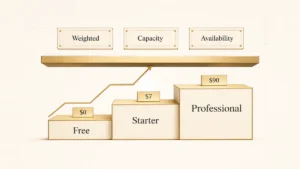
The $1.2B Agentforce ARR is partially a function of Salesforce’s move to consumption-based pricing, introduced with Headless 360 at TDX 2026 and extended to Agentforce Operations in April. Customers pay per completed workflow or per consumed token rather than per seat. That pricing change matters for the adoption math because it lowers the budget threshold for an initial Agentforce purchase, while raising the ceiling on what a successful deployment can produce in ARR as usage scales.
The model parallels the broader B2B-agent pricing reset. HubSpot moved its Breeze agents to outcome-based pricing in April ($0.50 per resolved customer-agent conversation, $1 per qualified lead from Prospecting Agent), DocuSign Iris shipped consumption-priced agreement agents at Momentum ’26 on May 21, and Adobe’s AJO B2B Edition Prime moved to a hybrid consumption model at Adobe Summit 2026. The B2B AI agent market is now pricing on outcomes by default, with per-seat licensing increasingly looking like a legacy artifact of the 2023-2024 cohort of AI add-ons that priced on access rather than on work completed.
The procurement question for finance teams is no longer “how much per seat” — it is “what does a completed agentic workflow cost, and is that less than the FTE-hour rate it replaces?” That is the same math Forrester’s GTM Singularity framework asks B2B teams to apply across their entire revenue stack: not feature comparison, but outcome economics measured against the human cost being displaced.
Three Questions B2B RevOps Should Ask Before Q2 FY27 Procurement
Are we in the 6% that is paying, or in the 12% that is activated but not yet paying? The free tier is a useful evaluation surface. It is not an adoption commitment. If your team is in the activated-but-not-paying cohort, the practical question is what would have to be true for paid conversion in the next 90 days — usually a clean workflow target, a named exception owner, and a CRM data audit that has actually closed out.
Is our intended pilot workflow in the cohort that is producing the $126K-average-ARR numbers, or in the cohort that is producing the 40% cancellation rate? The high-ARR cohort skews toward high-frequency, multi-system back-office work (vendor onboarding, invoice routing, renewal-stage CRM hygiene) and toward customer-service workflows with measurable resolution rates. The cancellation cohort skews toward quote-to-cash, commercial-judgment-heavy approval flows, and “AI for sales reps” pilots without a workflow scoped tightly enough to measure.
If 50%+ of Q1 bookings came from existing customers, what is our existing-customer-relationship status with Salesforce, and does our account team have Agentforce competency yet? Salesforce’s partner program reset in March 2026 reorganized partners around AI and Agentforce competency tiers, which means the partner who deployed Sales Cloud three years ago may not be on the current Agentforce partner roster. The same applies to direct account teams. Confirm Agentforce expertise on the SOW before signing.
Frequently Asked Questions
Salesforce reported $1.2 billion in Agentforce annual recurring revenue in its Q1 FY27 earnings on May 27, 2026, up 205% year-over-year. Combined Agentforce and Data 360 ARR reached $3.4 billion (up over 200% Y/Y), including $1.1 billion in Informatica Cloud ARR. Total Q1 FY27 revenue was $11.13 billion (up 13% Y/Y) and the company delivered 3.8 billion Agentic Work Units across Agentforce and Slack.
Salesforce’s earnings release does not disclose customer count for Agentforce. Independent tracking by Salesforce Ben puts paid Agentforce adoption at roughly 6% of the ~150,000-customer Salesforce base (about 9,500 paid customers), with another ~9,000 customers activated on free tiers for a combined activation rate near 12%. Customer growth is reportedly running near 50% quarter-over-quarter, but base-wide paid adoption remains in the single digits.
Salesforce’s Q1 FY27 press release disclosed that more than 50% of Agentforce and Data 360 bookings in Q1 came from existing customers. The accounts buying Agentforce are typically already on Sales Cloud, Service Cloud, Data Cloud, or Marketing Cloud, with the partner relationship, data infrastructure, and executive sponsor already in place to deploy agentic workflows at scale. The motion is land-and-expand inside the installed base rather than net-new buyer education at the mid-market end of the customer list.
Both numbers are accurate and they describe different cohorts. Gartner’s June 2025 prediction that over 40% of agentic AI projects will be canceled by end of 2027 reflects pilots that stall on data-foundation issues, unclear business value, or inadequate risk controls. Salesforce’s $1.2B Agentforce ARR reflects the cohort that did not stall — accounts with clean data, premium SKUs, and named workflow targets. The two figures describe the same agentic-AI market measured from opposite ends, and B2B RevOps teams should diagnose which cohort their own pilot is currently in before approving Q2 procurement.