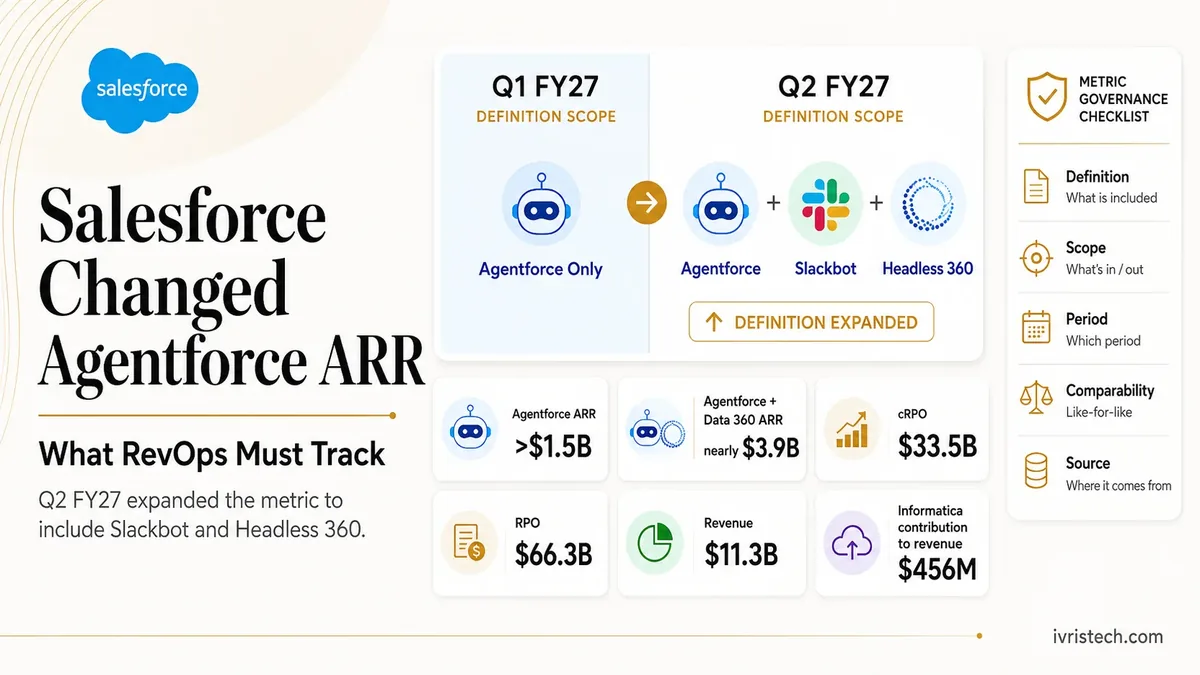
Salesforce reported Q2 FY27 results on August 26, 2026, with revenue of $11.3 billion, current remaining performance obligation of $33.5 billion, total remaining performance obligation of $66.3 billion, Agentforce ARR above $1.5 billion, and Agentforce + Data 360 ARR near $3.9 billion.
The Agentforce headline needs a definition beside it. Salesforce said Agentforce ARR grew more than 240% year-over-year, then disclosed that effective Q2 FY27 the metric includes its AI offerings, Slackbot, and Headless 360. The same release says Salesforce may update the metric as new products, features, or acquired technologies meet its definition.
When we covered Salesforce’s Q1 Agentforce ARR, the question was adoption concentration: $1.2 billion of ARR sat inside a relatively small paid-customer cohort. Q2 creates a different RevOps problem. If a vendor changes what a KPI includes, the definition has to travel with the number before it enters a board deck, AI business case, vendor evaluation, renewal model, or forecast.
Direct answer — Can Salesforce’s Q2 Agentforce ARR be compared directly with Q1?
Salesforce reported more than $1.5 billion of Agentforce ARR in Q2 FY27, up more than 240% year-over-year, but beginning in Q2 the metric includes Slackbot and Headless 360. Salesforce disclosed the change, but the Q2 materials do not state that the historical Agentforce ARR comparator was recast to the same scope. RevOps teams should therefore carry the definition and comparability status with the number.
Key Takeaways
- Q2 FY27 revenue was $11.3B, including $456M from Informatica; cRPO was $33.5B and total RPO was $66.3B.
- Agentforce ARR exceeded $1.5B (+240%+ Y/Y), while Agentforce + Data 360 ARR reached nearly $3.9B (+210%+ Y/Y).
- Effective Q2 FY27, Salesforce says Agentforce ARR includes Slackbot and Headless 360, expanding the disclosed scope of the metric.
- The public Q2 materials do not provide a restated historical Agentforce ARR series, so internal reporting should record the definition version and comparability status.
What Salesforce Reported in Q2 FY27
The first control is to keep different measures separate. Revenue is recognized accounting revenue. cRPO and total RPO describe contracted revenue that has not yet been recognized. ARR is a vendor-defined annualized measure of qualifying active subscription agreements at period end. They are related signals, but they are not interchangeable.
Salesforce reported $11.345 billion of Q2 revenue, including a $456 million Informatica contribution. Subscription and support revenue was $10.820 billion, including $440 million from Informatica. cRPO was $33.5 billion and total RPO was $66.3 billion. Separately, Salesforce reported Agentforce ARR above $1.5 billion and combined Agentforce + Data 360 ARR near $3.9 billion. That separation matters because an acquisition contribution to reported revenue is a different comparability issue from a scope change inside a vendor-defined ARR metric.
What Changed in the Agentforce ARR Definition
In Salesforce’s Q1 FY27 filing, Agentforce and Data 360 ARR was defined around active Data 360 and certain generative-AI subscription agreements, including Agentforce and generative-AI products and features. The Q2 definition adds Headless 360 to that wording, and Salesforce separately states that beginning in Q2 FY27 Agentforce ARR includes Slackbot and Headless 360.
This is not evidence that Salesforce hid or manipulated the metric. The company disclosed the change in the release. The governance issue begins downstream, when a team copies “+240% Y/Y” into its own reporting and strips away the definition note that explains what is being measured.
The Q1-to-Q2 Bridge Needs a Comparability Label
The reported Agentforce ARR headline moved from $1.2 billion in Q1 to more than $1.5 billion in Q2. Public materials do not let an outside reader decompose that movement into like-for-like expansion versus the effect of adding Slackbot and Headless 360 to the scope. The Q2 release also does not say that the historical Agentforce ARR series was recast on the new definition.
That absence is worth recording because Salesforce handles comparability explicitly elsewhere. In May, when the company changed its disaggregated revenue reporting structure, it published recast FY25 and FY26 revenue figures to preserve year-over-year comparability. No equivalent historical Agentforce ARR table appears in the Q2 earnings materials checked for this article.
Our read: the defensible statement is that Salesforce reported Agentforce ARR above $1.5 billion and growth above 240% under its Q2 disclosure. The stronger claim that the same underlying Agentforce scope grew 240% is not established by the public materials. That distinction is small in an earnings recap and large in a forecast or board pack.
What RevOps Should Version-Control Before Reusing the Metric
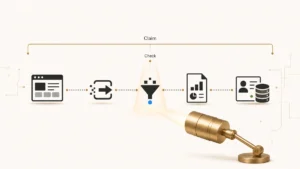
A vendor KPI should enter internal reporting with a small lineage record, not as a naked number. At minimum, record:
- Metric name and period: Agentforce ARR, Q2 FY27.
- Definition version: the exact source wording and effective date.
- Scope: products and features included, plus additions or removals such as Slackbot and Headless 360.
- Comparability: whether prior periods were restated or confirmed on the same basis.
- Transformation: any internal calculation, chart, growth rate, or forecast assumption built from the source number.
- Owner and qualification: who approved the use and the sentence that must travel with the metric downstream.
This is the same broader measurement-lineage problem visible in recent AI business-impact reporting: activity can be measured long before teams can defend how a number maps to a decision. For Salesforce’s Q2 Agentforce ARR, the control is simple. Preserve the definition with the value, and do not silently convert a vendor-reported growth rate into a same-scope organic-growth claim.
Frequently Asked Questions
Salesforce reported Agentforce ARR above $1.5 billion in Q2 FY27, up more than 240% year-over-year. The company also reported combined Agentforce + Data 360 ARR of nearly $3.9 billion, up more than 210%. These are Salesforce-defined annualized recurring revenue measures, not separate GAAP revenue lines.
Beginning in Q2 FY27, Salesforce says Agentforce ARR includes its AI offerings, Slackbot, and Headless 360. Its broader Agentforce and Data 360 ARR definition also names Headless 360. Salesforce disclosed the change directly and says it may update the metric as qualifying new products, features, or acquired technologies are added.
Salesforce reports growth above 240%, but its Q2 materials also show that the metric’s scope changed. The public release does not state that the historical comparator was recast to the same scope. That means teams should use the reported growth rate with the definition change attached rather than relabeling it as same-scope organic growth.
Store the metric name, reporting period, exact definition, included scope, source, comparability status, any internal transformation, and an owner or reviewer. If the definition changes, preserve the prior version and carry a qualification into downstream decks, forecasts, and business cases instead of presenting the series as automatically comparable.