Google said on August 27, 2026 that it is testing ways for viewers to start conversations with brands on messaging apps directly from Demand Gen ads on YouTube. The announcement does not call the feature generally available or an open beta, and it does not extend the test to every surface where Demand Gen can run.
Google does not name the messaging apps, eligible countries or accounts, exact YouTube placements, or any conversation identifier. Separate Message Assets documentation names WhatsApp, SMS, Facebook Messenger and Zalo for Search and Performance Max, but Google has not said those rules apply to this Demand Gen test.
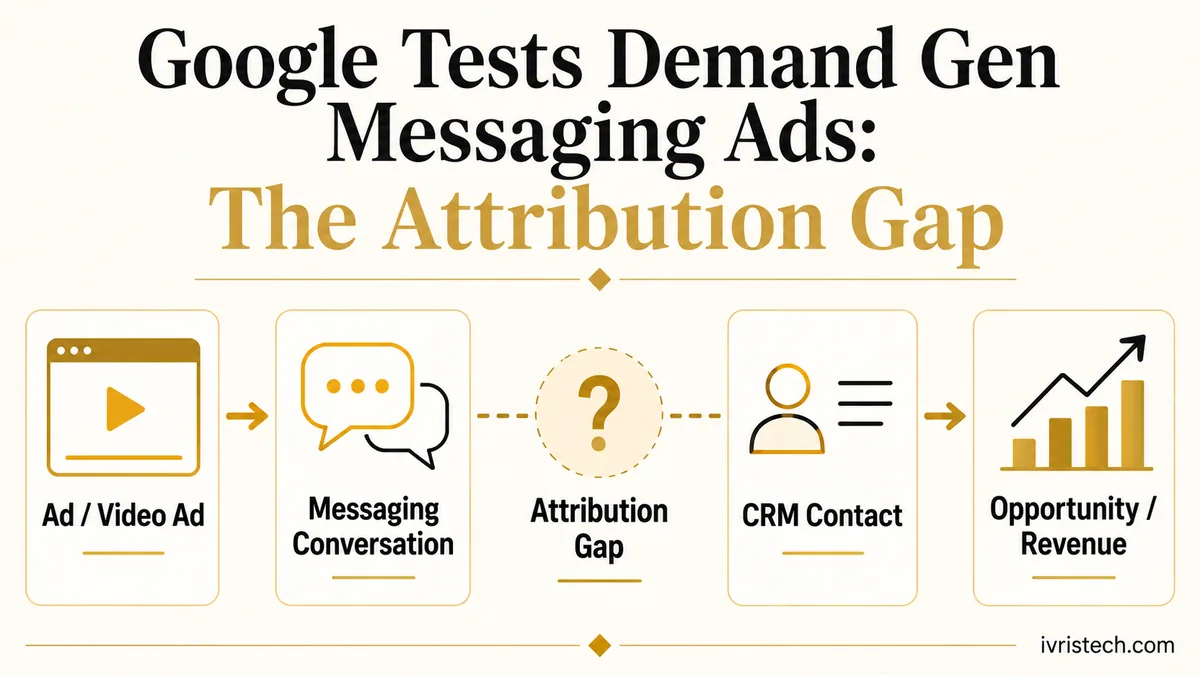
For B2B teams, the measurement question comes first. A messaging conversation introduces another handoff between the paid interaction and the known person who eventually appears in the CRM. Unless that handoff is observable, a team can report Demand Gen performance without proving which conversation became pipeline.
Direct answer — Does Google document end-to-end attribution for Demand Gen messaging?
Not in the August 27 announcement. Google documents conversion attribution for Demand Gen generally, but it does not document how this messaging test carries a conversation into a known contact, CRM record, opportunity or revenue event. Those are separate evidence steps advertisers would need to verify, including the identity bridge between a messaging conversation and the downstream CRM record.
Key Takeaways
- Google announced the Demand Gen messaging test on August 27, 2026 and described it only as a test on YouTube.
- Google has not documented the messaging apps, geography, account eligibility, conversation identifier, CRM payload or transcript behavior for this test.
- Google separately documents Demand Gen conversion attribution, but campaign attribution is not proof that a specific messaging conversation became a specific CRM contact or opportunity.
- IVRIS recommends treating the ad-to-message-to-CRM chain as an evidence requirement until Google publishes test-specific measurement documentation.
What Google Actually Changed on August 27
The verified change is narrow: Google is testing a way to start a brand conversation on a messaging app from a Demand Gen ad on YouTube. The announcement does not identify in-stream, in-feed, Shorts or any other sub-placement, so those should not be inferred.
It is also not the same product as Google’s other conversational ad formats. Message Ads with RCS for Business move a Search ad into a verified text thread. Business Agent for Leads is a separate conversational qualification experience on Search. Message Assets are documented for Search and Performance Max. The August Demand Gen test is a new YouTube state, not evidence that those products have been merged.
Google’s Message Assets help pages contain app and device-availability rules, but the August Demand Gen post does not say the same eligibility applies. For this test, supported apps, regions and advertiser access remain undocumented.
What Existing Google Attribution Does — and Does Not — Prove
Google does have a measurement layer for Demand Gen. Its Campaign Type Attribution says Demand Gen can receive credit for immediate and downstream conversions. That establishes conversion credit, not the identity lineage of a messaging conversation.
| Evidence layer | Google documents it for the Aug. 27 test? | What a B2B team can conclude |
|---|---|---|
| Demand Gen conversion attribution | Generic Demand Gen capability, not test-specific | Google can credit qualifying conversions to Demand Gen interactions. |
| Messaging destination or app | No | Do not assume the Search/PMax Message Assets app list applies. |
| Conversation or session identifier | No | You cannot yet claim a documented key links the ad interaction to one chat. |
| Known person and CRM record | No | You cannot infer that Google sends a contact, transcript or conversation record to the CRM. |
| Opportunity and revenue lineage | No test-specific mapping documented | Downstream revenue attribution needs evidence beyond the existence of Demand Gen attribution. |
The contrast with Google’s lead-form product is useful. Google explicitly documents CSV, email, Google Ads API, webhook and Zapier delivery for lead form assets, including direct CRM delivery options. No equivalent handoff specification is published in the August Demand Gen messaging announcement.
The Evidence Chain B2B Teams Should Require
The following is an IVRIS operating recommendation, not a Google requirement. Before treating a messaging conversation as attributable pipeline, preserve enough evidence to reconcile each handoff: the campaign/ad reference available to the advertiser; the ad interaction or session reference if one is exposed; the messaging conversation identifier if the destination supplies one; timestamp; known contact or account association; consent/source context where relevant; CRM Lead or Contact ID; opportunity association; offline conversion or revenue event; and an owner or reconciliation rule.
The purpose is to make each transition testable. Our form-attribution validation shows the earlier boundary: campaign data in a submission payload does not prove the CRM stored or reported it. The form-to-CRM reconciliation procedure checks whether the record survived into the CRM. Messaging adds one more checkpoint.
What to verify before spending against the test
- Access: confirm the feature is enabled and record the market, app and YouTube inventory shown in-product.
- Interaction: determine which Google Ads event is recorded when the messaging action is used and how that event is classified.
- Identity: test whether any ad or session reference survives into the messaging destination and how the conversation is matched to a known person.
- CRM: prove that the known person becomes the intended Lead or Contact record and that the source evidence survives the write.
- Revenue: prove the CRM record can be associated with an opportunity and eventual revenue event before reporting conversation-sourced pipeline.
A Demand Gen attribution report and a CRM revenue record can both be correct while the bridge between them remains unproven. Google can attribute Demand Gen conversions under its existing models; it has not documented an end-to-end conversation-to-revenue lineage for this messaging test.
Frequently Asked Questions
No. Google’s August 27, 2026 announcement says it is testing the capability. The post does not call it general availability, an open beta or a global rollout, and it does not publish account or regional eligibility for the test as of August 29.
Google has not named them for this test. Separate Message Assets documentation lists WhatsApp, SMS, Facebook Messenger and Zalo for Search and Performance Max, but Google has not said that list or its regional rules apply to Demand Gen messaging on YouTube.
Google can attribute conversions to Demand Gen under its existing attribution system, including downstream conversions. What is not documented is the test-specific chain from one messaging conversation to a known person, CRM record, opportunity and revenue event. Those are separate claims that need separate evidence.
No. Business Agent for Leads is a Search conversational qualification experience, while Google’s RCS Message Ads move a Search ad into a verified text thread. The August 27 development is a separate test that starts messaging-app conversations from Demand Gen ads on YouTube.