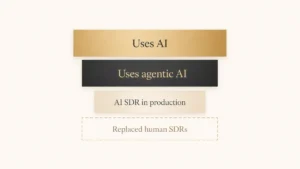
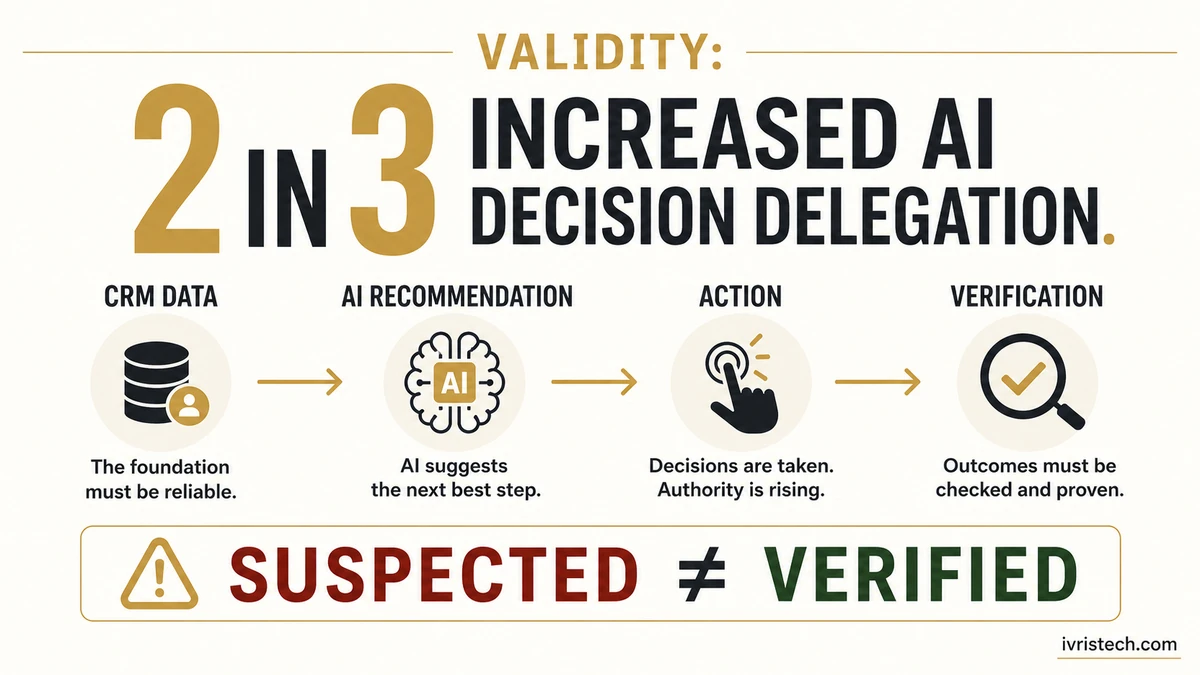
Validity released its State of CRM Data Management in 2026 research on August 25 with a finding that deserves more precision than its headline treatment: two out of three organizations surveyed increased the number of marketing decisions delegated to autonomous AI agents over the past year.
The same 500-person survey says only 21% of marketers consider their CRM data “very well prepared” to support AI. MarTech’s review of the gated report adds that 19% of respondents said they frequently presented or acted on an AI-generated recommendation they later suspected was wrong due to poor underlying data, while another 43% said this happened occasionally.
That is an authority problem, but not a proven AI-error chain. The survey records self-reported delegation, readiness and suspicion. It does not establish that a recommendation was independently verified as wrong, that CRM data caused the error, that the action was autonomous, or that a separate business loss came from that recommendation. RevOps teams need to preserve those distinctions as AI gets more permission to act.
Direct answer — What did Validity’s 2026 CRM study show about AI decision-making?
Validity’s survey of 500 B2B and B2C marketers supports a gap between growing AI decision authority and confidence in CRM readiness: two-thirds reported more decisions delegated to autonomous agents, while 21% called their CRM data very well prepared for AI. It does not prove those systems caused bad outcomes. “Later suspected wrong” is not the same as independently verified wrong.
Key Takeaways
- Validity surveyed 500 B2B and B2C marketing professionals across the U.S., U.K., Brazil, Australia and New Zealand.
- Two-thirds said their organizations increased marketing decisions delegated to autonomous AI agents; only 21% called CRM data very well prepared for AI.
- MarTech reports that 19% frequently and 43% occasionally presented or acted on an AI recommendation they later suspected was wrong due to poor underlying data.
- The 92% SVP/VP figure is a subgroup percentage, but accessible public materials reviewed by IVRIS do not disclose that subgroup’s respondent count.
What the Validity survey actually measured
Validity’s announcement identifies 500 B2B and B2C marketing professionals in five countries. MarTech, which reviewed the registration-gated report, says fieldwork took place in July 2026 at organizations with at least 100 employees. Accessible Validity materials do not publish the B2B/B2C split, country quotas, weighting, panel recruitment method or role-level sample counts.
The strongest figures come from different questions. Two-thirds concerns whether organizations increased marketing decisions delegated to autonomous agents. The 21% figure is a self-assessment of CRM readiness. The 19% and 43% figures describe how often respondents said they had presented or acted on an AI recommendation they later suspected was wrong because of poor underlying data.
Together they show a reported readiness gap. They do not turn a self-assessment into a CRM audit or a respondent’s suspicion into an incident investigation.
The 92% headline has a denominator problem
Validity says nearly 78% of C-suite and 92% of SVP/VP respondents had acted on an AI recommendation they later suspected was wrong because of bad underlying data, compared with 41% of individual contributors. The overall survey has 500 respondents, but 500 is not the denominator for each subgroup.
IVRIS could not verify those role-level respondent counts from the accessible announcement, resource listing or current coverage. That matters most for the 92% figure: a percentage can look decisive while representing a much smaller subgroup. The same provenance rule applies to CRM data-quality benchmarks: population, denominator and method should travel with the number.
Until the subgroup base is disclosed, the citation-safe wording is “92% of surveyed SVP/VP respondents,” not “92% of marketers.”
Suspected wrong is not verified wrong
The reported item describes someone who presented or acted on an AI-generated recommendation and later suspected it was wrong due to poor underlying data. Accessible public materials do not describe an independent source-record check, recommendation replay, model or agent audit, or verification outcome that classified the recommendation as wrong.
So the study does not establish a full chain from bad CRM data to AI error to autonomous action to business loss. Validity separately reports that 62% of respondents said poor CRM data probably or definitely cost their organizations revenue. That result cannot be joined to the AI-recommendation question and rewritten as “bad AI recommendations caused revenue loss.”
Our read: the most important missing number is how many suspected recommendations were actually verified. The defensible conclusion is narrower: organizations report giving AI more decision authority while many respondents lack confidence in the data foundation, and a substantial share report acting on recommendations they later questioned. Verification remains unresolved.
What RevOps should record before AI gets more authority
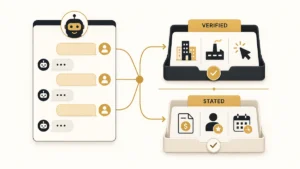
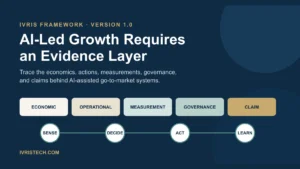
RevOps needs a small verification record that survives after a recommendation becomes an action. This is an IVRIS operating recommendation, not a control described by Validity. It is narrower than the broader IVRIS Evidence Layer, which covers traceability across actions, measurement, governance and claims.
- Input state: source system, record version or date, material fields and known data-quality status.
- Recommendation: model or agent identifier, output, timestamp and relevant rule or context version.
- Authority: human-approved or autonomous, plus the person or system that acted.
- Result: action taken, expected outcome and observed outcome.
- Verification: not reviewed, suspected, verified or cleared, plus the evidence used.
- Correction: rollback or remediation, owner, reviewer and closure date.
The useful metric is not simply how many recommendations were questioned. It is how many moved from “suspected” to verified or cleared, how long that took, and whether the same input failure recurred. More autonomous authority without that record makes later attribution easy to assert and hard to prove.
Frequently Asked Questions
MarTech’s review of the report says 19% of respondents frequently and 43% occasionally presented or acted on an AI-generated recommendation they later suspected was wrong due to poor underlying data. Validity also reports higher subgroup percentages among senior respondents. These are self-reported suspicions, not independently verified model errors.
No. The survey reports delegation, data readiness, suspected questionable recommendations and separate business impacts from poor CRM data. The accessible materials do not establish that the same CRM record caused a specific AI error, that an autonomous action followed, or that the action produced the separately reported revenue loss.
IVRIS could not verify the SVP/VP subgroup denominator from the publicly accessible Validity announcement, resource listing or current coverage. The overall survey included 500 marketers, but that is not the denominator for the SVP/VP result. Cite it as “92% of surveyed SVP/VP respondents” unless Validity publishes the subgroup base.
Keep the source-record state, material inputs, model or agent version, recommendation, approval or autonomy state, action, expected and observed outcome, verification status, verification evidence, correction and owner. The key distinction is whether a questioned recommendation remained suspected, was verified as wrong, or was cleared after review.