Google announced on August 20, 2026 that a new Search experiment will let advertisers test different budgets and ROI targets across multiple Search campaigns in one A/B test. The company says the capability will start rolling out in September. The same announcement adds brand and location controls to AI Max experiments and lets Performance Planner apply suggested budget or bid-target changes directly.
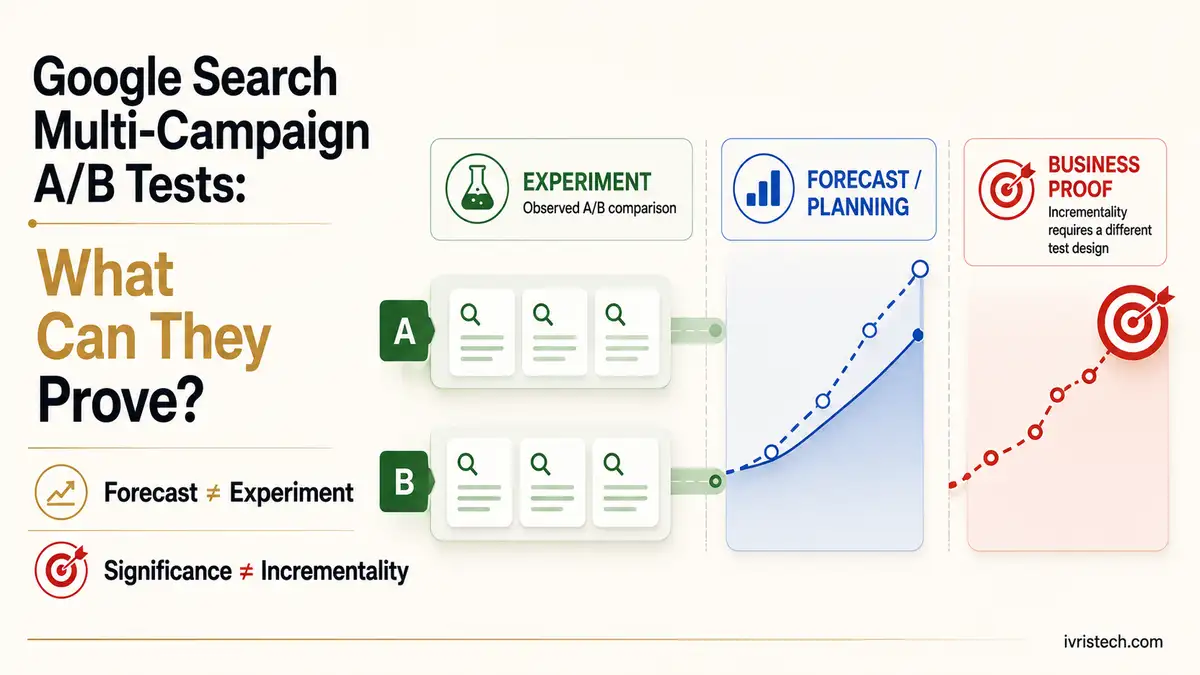
Three evidence types now sit next to each other: a multi-campaign Search A/B test, an AI Max feature test, and a Performance Planner forecast. They answer different questions. Treating them as interchangeable can turn a platform result into a claim it never proved.
Our read: before a B2B paid-media team puts a result into a pipeline forecast or executive deck, it should show what changed, what stayed comparable, which conversion definition was used, and what Google measured. Statistical significance is not automatically incrementality.
Direct answer: what can Google’s new multi-campaign Search test actually prove?
It can compare the measured performance of the budget or ROI-target configurations assigned to its experiment arms across multiple Search campaigns. It does not, by itself, prove advertising’s incremental value versus no advertising. Google has not yet published the September feature’s maximum campaign count, exact allocation mechanics or full eligibility rules.
Key Takeaways
- Google announced the capability August 20; rollout starts in September 2026, with no exact start day published.
- Multiple Search campaigns can test different budgets and ROI targets. Google has not published a maximum campaign count.
- Do not import the “up to five arms” rule from Google’s separate Campaign Mix experiments into this feature.
- Performance Planner is a forecast, not an observed experiment result.
- B2B teams should keep conversion actions, value rules and offline CRM imports comparable while testing.
Google’s New Search Test Is Not the Same as Its Existing Experiments
The September feature is broader Search experimentation, not simply a larger AI Max one-click test. Google’s announcement says it will compare budgets and ROI targets across multiple Search campaigns. It does not state a maximum campaign count, traffic split, randomization method, account eligibility, or beta/GA label.
Other Google experiments differ. The current AI Max experiment splits one Search campaign 50/50: AI Max is off in control and on in treatment. Brand settings added during setup apply to both arms. A separate Multi-campaign experiments beta for value-based bidding is available by request and uses 50% cookie splits; shared budgets are incompatible and Shopping is not supported.
Google’s allowlisted Campaign Mix API workflow supports up to five arms and mixed campaign types. That is where the five-arm number visible in the current SERP comes from. Google has not said it applies to September’s multi-Search test.
Performance Planner Is a Forecast, Not the Experiment
Performance Planner models how budget and bid-target changes might affect performance; Google’s update now lets advertisers apply suggested changes directly. But modeled performance is not an observed A/B result. Google also lists campaigns that are part of an experiment as ineligible for Performance Planner. Use a forecast to form a hypothesis, then keep it separate from the experiment result.
A Winning Arm Does Not Automatically Prove Incrementality
Google’s experiment scorecard can report estimated differences, confidence intervals and statistical significance. That describes a measured difference between configurations. It does not make every A/B test an incrementality study.
If both arms advertise and the variable is budget or an ROI target, the result can support a decision between those tested configurations. It does not answer, “How much business happened because we advertised at all?” Google documents lift and uplift studies separately for incremental-impact questions. Google’s September 10 measurement update makes that boundary more explicit: Data Strength Uplift measures recovered conversion signal, while Meridian GeoX is the causal layer.
Comparability also depends on measurement. Google’s value-bidding guidance says to test one variable at a time and warns against testing different conversion actions against one another. That makes stable conversion and offline-data plumbing part of experiment design, not cleanup after the test.
The IVRIS Experiment Record for B2B Paid Media
This is an IVRIS operating record, not an official Google checklist. Its job is to make the result auditable after the account and CRM have changed.
Before
- Write the business question and decision the result will inform.
- Record campaigns, budgets and CPA/ROAS targets.
- Record the primary conversion action, value definition, attribution setting and offline conversion feedback.
- Record brand, location and URL controls, plus material creative or landing-page changes.
- Save the start window and expected conversion lag.
During
- Log unplanned campaign, budget, bidding, creative and landing-page changes.
- Record promotions, seasonality, tracking outages and CRM/offline-import changes.
After
- Record the metric, denominator, absolute result and relative difference.
- Capture the confidence/statistical output Google actually shows.
- Check cross-campaign consistency and name the decision the result supports.
A test winner can still fail when generalized. In our earlier reporting on GrowthLoop’s 2026 index, 77% of surveyed marketers said winning A/B tests fail at scale at least some of the time. Broader tests do not remove the need to preserve the measurement basis and limit the claim to the design.
What to Do When the September Feature Reaches Your Account
Verify eligibility, traffic allocation, campaign limits and reporting when Google’s dedicated documentation appears. Do not copy Campaign Mix or beta mechanics unless Google says they carry over.
Then choose one decision question and pre-agree what would justify action. Google’s current AI Max experiment can auto-apply favorable results, but the August announcement does not say whether the new multi-campaign Search test can. Treat auto-application as unverified until Google documents it.
Frequently Asked Questions
Google announced a September rollout for an A/B test comparing different budgets and ROI targets across multiple Search campaigns. Separately, AI Max experiments gained brand and location controls, while Performance Planner gained a faster path from forecasted changes to implementation.
Yes. Google’s August 20 announcement says the new A/B test covers multiple Search campaigns. Google has not published a maximum campaign count for the September feature. The five-arm limit visible in some search results belongs to a separate, allowlisted Campaign Mix workflow and should not be transferred to this test.
No. Performance Planner forecasts how budget or bid-target changes may affect performance. An experiment compares observed performance between configured arms. Google lists campaigns currently in an experiment as ineligible for Performance Planner, reinforcing that the tools serve different jobs and should not be treated as the same evidence source.
Not automatically. A result compares the advertising configurations assigned to the experiment arms. It does not by itself measure advertising versus no advertising. Google documents separate lift and uplift experiment types for incremental-impact questions, so the conclusion should match the test that was run.