
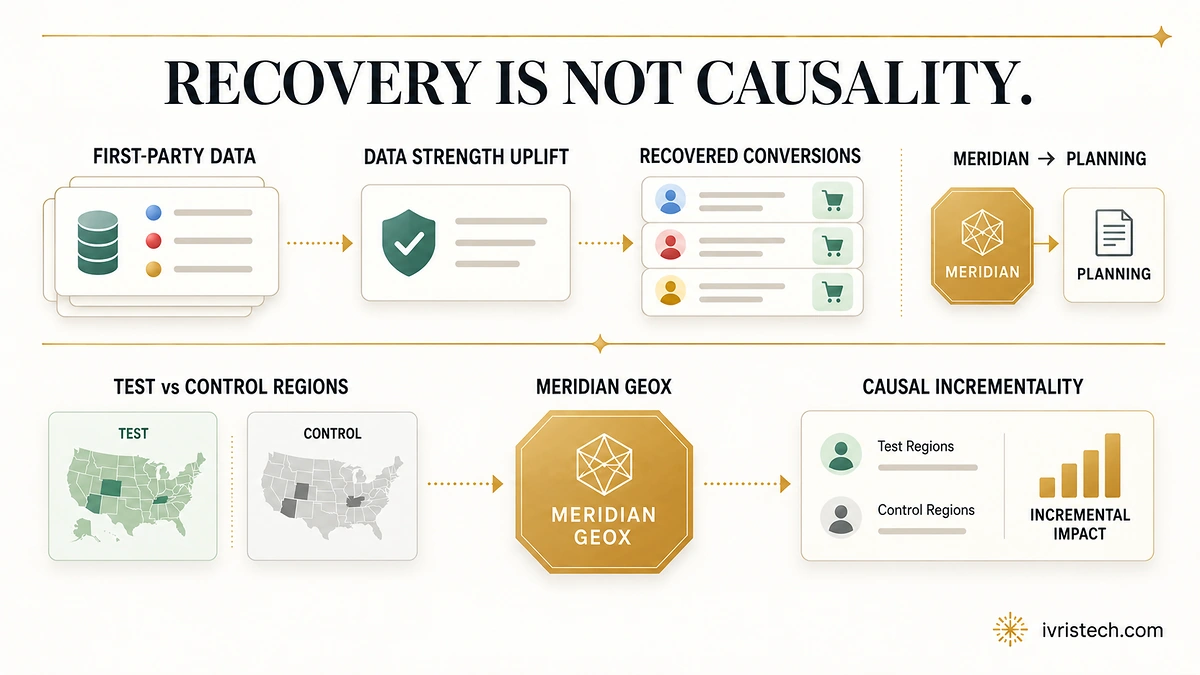
Google’s September 10 measurement update introduced a new Data Strength Uplift Metric in Google Ads and changed Meridian GeoX from an earlier beta into global general availability. The two launches sit in the same measurement stack, but they do not answer the same question.
Data Strength Uplift calculates the additional conversions Google says are recovered by an advertiser’s first-party data setup. Google also reports average conversion uplift of 14% for Google tag gateway and more than 20% for Demand Gen, but both figures come from Google-controlled datasets with defined scopes and periods. They are not account-level forecasts.
Our read: Data Strength Uplift is a signal-recovery metric. Meridian GeoX is the causal-experiment layer. A B2B team can use the first to diagnose whether measurement infrastructure is recovering more conversions, but it should not turn that number into a claim that advertising created the same amount of incremental revenue.
Direct answer — Is Google’s Data Strength Uplift Metric an incrementality metric?
No. Google says Data Strength Uplift calculates additional conversions recovered by a first-party data setup. That is measurement recovery, not proof that advertising caused those conversions. Meridian GeoX is the causal layer: it runs geographic experiments and can feed incrementality results into Meridian so the MMM is calibrated with experimental evidence.
Key Takeaways
- Google introduced Data Strength Uplift in Google Ads on September 10, 2026 to quantify additional conversions recovered by first-party measurement infrastructure.
- Google did not label the new Uplift Metric beta or GA in the announcement, so the safest status is simply introduced.
- Meridian GeoX moved from beta to general availability globally in Meridian and is built for causal geo experiments across advertising platforms.
- Google’s 14% and 20%+ figures are vendor-reported averages from scoped datasets, not performance promises for an individual advertiser.
Data Strength Uplift Measures Recovery, Not Causality
Better tagging, enhanced conversions, offline data and stronger identity signals can recover conversions that would otherwise be missed. Google says Data Strength Uplift calculates that recovered amount inside Google Ads.
That leaves two questions unanswered. Are the recovered conversions the outcomes the business values? A larger count can still be low-quality if the account optimizes to form fills rather than qualified pipeline or closed-won revenue. Our earlier coverage of Google’s enhanced-conversions consolidation treated CRM outcome data as part of the measurement system for exactly that reason.
And did the advertising cause the outcome? Google does not describe Data Strength Uplift as a randomized experiment, holdout study or causal estimate. Its stated job is conversion recovery. That supports a measurement-infrastructure claim, not an incrementality claim.
Meridian GeoX Is the Causal Layer
Google makes the next step explicit in the same announcement: after strengthening the data foundation, the problem becomes evaluating what actually creates incremental demand. Meridian GeoX is the tool Google places at that layer.
GeoX uses geographic experiments to compare treatment and control regions and estimate incremental media impact. Google says it can run across advertising platforms, and the resulting incrementality evidence can be incorporated into Meridian. On September 10, Google changed GeoX’s status from an earlier beta to general availability globally.
The distinction matters for Meridian itself. A marketing mix model is a modeling layer; GeoX supplies causal experimental evidence that can help calibrate it. That matches the boundary in our B2B marketing attribution methodology: observed relationships and causal proof are different evidence classes.
The B2B Evidence Ladder Is Now Easier to Name
- Capture and recovery: use Data Strength diagnostics and Uplift to see whether first-party infrastructure is recovering additional measurable conversions.
- Business outcome quality: reconcile those conversions to CRM stages, revenue and profit.
- Causal proof: when the question is “did this media create additional demand?”, use a valid incrementality design such as GeoX.
- Cross-channel planning: use Meridian for the broader media mix and calibrate it with experimental evidence where the design supports it.
In our earlier reporting on Google’s multi-campaign Search A/B tests, the same boundary appeared in another form: statistical significance between two advertising configurations is not automatically proof of incremental demand. Data Strength Uplift sharpens that warning because the word “uplift” can sound causal even when the metric’s stated job is recovery.
What B2B Teams Should Do Now
Baseline the metric before changing the stack. Record the current Uplift reading, conversion definitions and data-source configuration before adding a new gateway, CRM feed or enhanced-conversions path.
Attach downstream quality to recovered volume. If recovered conversions rise, check whether qualified-lead rate, opportunity creation and closed-won value move with them. Recovery matters when it restores missing business outcomes, not merely when the platform reports a larger count.
Keep Google’s averages in their proper box. The 14% tag-gateway figure is footnoted to Google Internal Data covering the finance vertical across two six-month periods. The 20%+ Demand Gen figure is Google data from a defined June 2026 window. Treat them as vendor evidence, not planning assumptions.
Escalate to GeoX when the decision is causal. If the CFO question is whether a channel or campaign created incremental sales, a recovery metric is the wrong instrument. Use a causal experiment where the geography, spend, outcome volume and test design make one feasible, then use that evidence to inform Meridian.
Frequently Asked Questions
Data Strength Uplift is a new Google Ads metric introduced September 10, 2026. Google says it calculates the additional conversions recovered by an advertiser’s first-party data setup. The announcement does not label the metric beta or general availability, and it does not publish a causal-study methodology for the metric.
No. Data Strength Uplift is described as recovered conversion measurement. Incrementality asks whether an outcome happened because of the advertising rather than whether the conversion was captured. Google positions Meridian GeoX, not the Uplift Metric, as the causal geo-experiment layer for answering that second question.
Yes. Google’s September 10 announcement says Meridian GeoX is now generally available globally in Meridian after an earlier beta. GeoX is an open-source geographic experimentation library designed to estimate incremental media impact across advertising platforms and to provide causal evidence that can be used alongside Meridian.
Yes. Google says marketers can incorporate GeoX incrementality results into Meridian to help calibrate the marketing mix model. GeoX supplies experimental causal evidence, while Meridian remains the broader modeling and planning layer that can combine that evidence with other signals.