Klaviyo announced Klaviyo Headless on September 9, 2026 at K:BOS, opening its CRM platform to external AI systems through more than 260 MCP tools and capabilities and more than 490 APIs. Klaviyo says an agent can read, write, and go live without a marketer opening the Klaviyo interface.
The tool count needs context. Klaviyo’s own August 11 product update had already introduced 260+ new MCP tools for reading data, building segments, running campaigns, authoring flows, and managing catalogs. September 9 is therefore the Headless platform announcement, not the first appearance of all 260+ tools.
When we covered Klaviyo’s Composer and Customer Agent public beta in July, the governance question still sat mostly inside Klaviyo’s own agent layer. Headless moves that question outward. The operator may now be a listed ChatGPT app, Claude, or a custom MCP client, and those surfaces do not expose the same practical action boundary.
Direct answer — what does Klaviyo Headless actually change?
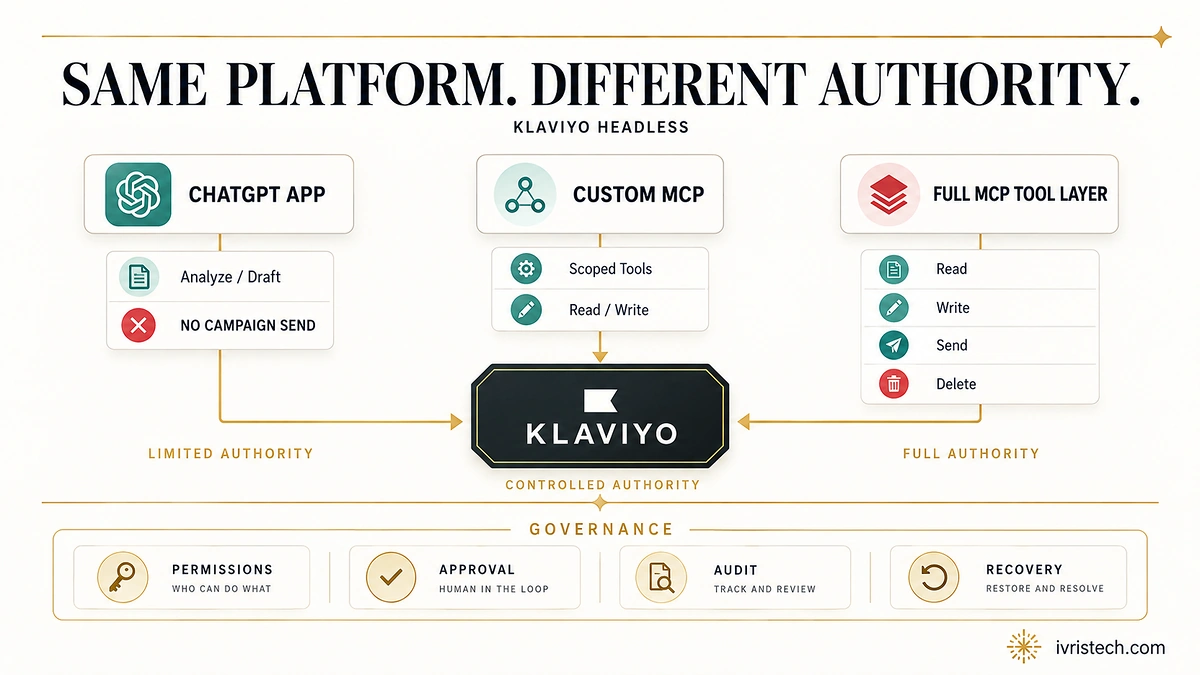
Klaviyo Headless lets external AI systems operate against Klaviyo data and tools without using the Klaviyo UI. The important caveat is that access is not uniform: Klaviyo’s listed ChatGPT app cannot send campaigns or edit flows, while the full MCP tool catalog includes write, send, status-change, and delete actions that custom connections can expose.
Key Takeaways
- Klaviyo announced Headless on September 9 with 260+ MCP tools and capabilities and 490+ APIs available to external AI systems.
- The 260+ MCP-tool expansion was already listed by Klaviyo on August 11, so it should not be framed as entirely new on September 9.
- The full MCP catalog includes campaign sends, flow status changes, deletions, profile updates, and subscription or suppression actions.
- The listed Klaviyo app for ChatGPT cannot send campaigns, build or edit flows, or modify segments and lists.
- Klaviyo documents scope controls and API logging, but the official materials reviewed do not describe one universal approval or rollback layer across every Headless action.
What Klaviyo Headless Actually Changes
The September announcement makes the external operating model explicit. Klaviyo’s MCP tool catalog includes send_campaign and cancel_campaign_send, along with tools to create campaigns, update a flow’s status, delete flows, change profiles, and manage subscriptions. This is not only an analytics connection. Some configurations can reach customer-facing actions.
Other K:BOS updates have different states. SQL in the Klaviyo Data Platform and the new Personalization layer are in preview. Customer Agent now supports more than 100 languages, while voice is explicitly coming soon. Customer Hub is live; Clicks to Bricks and the Klaviyo Mobile App are in preview; Compliance Hub is coming soon.
The Control Model Changes by Client
Klaviyo restricts its remote-hosted MCP server to Owner, Admin, and Manager roles. Custom connections can use read-only=true to disable writes, toolsets to narrow scopes, a roughly 40-tool core set, or a switch that removes tools reading user-generated content. The listed Claude connector and ChatGPT app cannot control those URL parameters; a custom connector is required.
The practical boundary is even clearer in Klaviyo’s ChatGPT app documentation. Its FAQ lists broad read/write scopes across campaigns, flows, segments, profiles, and other resources, yet the listed app cannot send campaigns, build or edit flows, create or send SMS campaigns, or modify segments or lists. The broader MCP catalog contains a campaign-send tool. Built-in Composer presents another pattern: Klaviyo says it queues campaigns for marketer review and approval before anything goes live.
That is the operational distinction the head-term coverage mostly misses. “Klaviyo Headless” is one platform idea, but the effective authority of an agent depends on the client, authentication path, enabled tools, and configuration. A procurement checklist that asks only whether Klaviyo “supports MCP” is too coarse.
The Hidden Catch: Auditability Is Not Approval or Rollback
Klaviyo does provide a useful audit trail. Its ChatGPT FAQ says API Logs can show which MCP tools were called, whether data was read or written, and the API calls and payloads involved. Its Claude FAQ adds an important limitation: the Klaviyo UI does not currently surface which user authorized the MCP app.
Our read: teams should not collapse logging, approval, and recovery into one control. Klaviyo recommends keeping a human in the loop, but the reviewed Headless documentation does not describe a platform-wide approval gate that every external write must cross. The MCP catalog documents a specific cancel-or-revert action for campaign sends, while also exposing destructive actions such as deleting a flow. That is not the same thing as universal rollback.
The same buying question showed up when we covered MoEngage’s marketer-defined MCP guardrails: an agent that can act on customer data needs a clearer control contract than an assistant that only summarizes a report. Headless makes that contract more important because the requesting agent can originate outside the marketing platform.
What B2B Martech Teams Should Test Now
- Map authority by client. Separate what listed ChatGPT or Claude experiences can do from what a custom MCP connection can expose.
- Start with the smallest tool surface. Use read-only access and narrow toolsets first, then add writes only when needed.
- Set approval rules by action class. Drafts, profile changes, sends, suppressions, and deletions should not receive the same autonomy.
- Test the audit trail. Confirm operators can reconstruct the tool call and payload, then account for the missing authorizing-user detail.
- Test recovery per action. A campaign cancellation tool does not mean every write can be rolled back. Define recovery before granting the tool.
This is the practical next step in moving marketing agents from copilot to controlled autonomy. Klaviyo Headless expands where the work can happen. Teams still have to decide where authority stops.
Frequently Asked Questions
Klaviyo Headless is Klaviyo’s September 9, 2026 platform announcement for letting external AI systems work with Klaviyo through MCP tools and APIs without requiring the Klaviyo UI. Klaviyo says the platform exposes 260+ MCP tools and capabilities plus 490+ APIs to Claude, ChatGPT, and custom agents.
Not through Klaviyo’s listed ChatGPT app, according to its current help page: that app cannot send campaigns. The broader MCP server catalog does include a send_campaign tool, so a custom MCP setup can expose a more powerful action surface depending on its scopes and configuration.
No. Klaviyo’s What’s New page dated August 11, 2026 already listed 260+ new MCP tools for reading data, building segments, running campaigns, authoring flows, and managing catalogs. The September 9 announcement packages that expanded access under Klaviyo Headless and pairs it with the wider K:BOS platform story.
No. Klaviyo’s September 9 newsroom announcement says voice is coming soon. Customer Agent’s support for more than 100 languages is current, but voice should not be described as live. Klaviyo separately labels Customer Hub live, Clicks to Bricks and its Mobile App preview, and Compliance Hub coming soon.