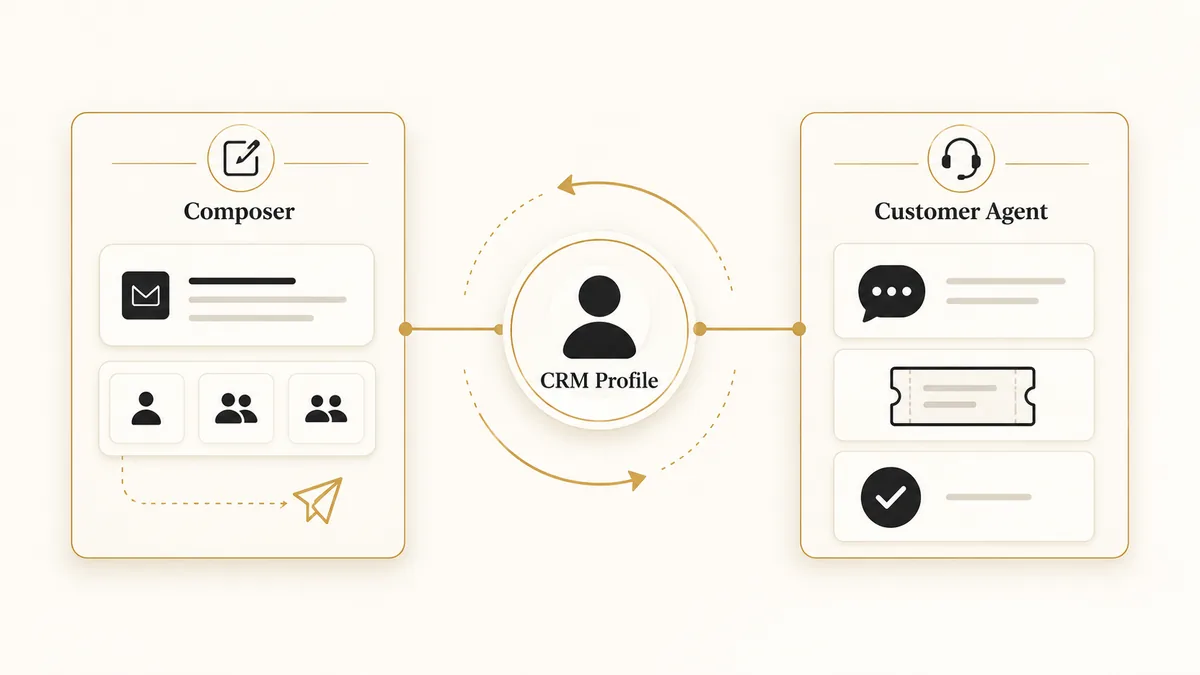
Klaviyo announced on June 30 that Composer, its AI marketing agent, is moving to public beta alongside major updates to Customer Agent. The pitch is not one more prompt box. Klaviyo says both agents run on the same CRM platform and use the same real-time customer profile.
That shared profile is the fact to watch. Digital Commerce 360 reported that retailers in its Top 2000 database using Klaviyo generated more than $9 billion in 2025 ecommerce sales. If service signals and marketing actions begin sharing one agent layer, the effect will show up first in high-volume commerce teams.
For B2B marketers, the angle is broader than consumer ecommerce. When we covered Mailchimp’s Analytics AI release and MoEngage’s governed agents, the pattern was already clear: customer data is moving from reporting into action. Klaviyo’s beta makes the next loop explicit: a service conversation can change what a campaign agent knows.
Key takeaways:
- Klaviyo moved Composer, its AI marketing agent, into public beta on June 30, 2026.
- Customer Agent also received major updates and now shares intelligence with Composer inside Klaviyo’s CRM platform.
- Digital Commerce 360 says Top 2000 retailers using Klaviyo produced more than $9 billion in ecommerce sales in 2025.
- The operational story is the data loop between service interactions and campaign creation.
- B2B ecommerce teams should test permissions, suppression rules, and campaign QA before letting shared agent data drive customer-facing work.
What Klaviyo Actually Put Into Public Beta
Composer is Klaviyo’s marketing agent. Klaviyo describes it as a system that helps marketers identify growth opportunities, decide what to do next, and turn those opportunities into campaigns. Its Composer page positions the agent around campaign building, on-brand outputs, and marketing actions grounded in customer data. That same data-to-action pressure is why SAS 360 Marketing AI’s governed model layer matters: campaign builders need to know which customer fields can influence a predictive score.
Customer Agent handles service interactions. Klaviyo’s Customer Agent page frames it as support plus selling, powered by a brand’s own customer data. The new public-beta story is that the two agents are not isolated. When Customer Agent resolves a conversation, Klaviyo says preferences, product interests, and intent signals can enrich the customer record that Composer uses.
That is why the public beta matters. A campaign agent that only knows past campaign performance is useful. A campaign agent that also knows recent service issues, purchase intent, returns, subscriptions, loyalty status, and product preferences is a different operating model.
Why Shared Service Data Matters
Most marketing automation systems treat customer service as a downstream function. Marketing sends; service reacts. Klaviyo is trying to collapse that order. If a shopper asks about sizing, warranty, shipping timing, upgrade paths, or subscription changes, the service interaction becomes a signal the marketing agent can use later.
Our read: the strongest use case is not faster campaign drafting. It is fewer tone-deaf campaigns. A customer who just opened a refund ticket should not receive an upsell message. A buyer who asked about a product category twice in support should not be treated like a cold subscriber. A customer who received a service recovery offer should not be hit with a conflicting promotion three hours later.
That same logic applies to B2B ecommerce and product-led teams. If a buyer asks support about integration limits, billing scope, renewal timing, or seat expansion, marketing should not wait for a manual note to update the follow-up path. The question is whether the agent can use that signal without breaking consent, frequency, or sales handoff rules.
The Governance Catch
Shared intelligence creates shared risk. A service agent may collect sensitive context that is useful for support but wrong for campaign targeting. A campaign agent may overreact to one conversation and change messaging too quickly. A profile that gets smarter with every interaction also preserves weak assumptions if nobody audits what is being written back.
This is where the beta should be tested against the governance bar Pega set for customer-engagement agents. Who can approve a campaign built from service data? Which service fields are allowed to influence marketing? Are refund, complaint, or accessibility signals excluded from promotional segmentation? Can a marketer see why Composer chose an audience? accessiBe’s review-gap finding adds a separate control: the customer-facing content produced from that loop still needs accessibility approval before publication.
Klaviyo’s advantage is that the agents sit in one CRM platform. The risk is the same: centralizing the loop makes both good judgment and bad defaults travel faster. The September Headless release makes that control question operational: the effective agent permissions now depend on the client and MCP configuration a team uses.
What B2B Ecommerce Teams Should Test
Start with one service-to-campaign workflow. Pick a narrow path such as product-interest follow-up after a support chat, subscription-save campaigns after a cancellation conversation, or review requests after a resolved ticket.
Keep suppression rules visible. Exclude active complaints, open returns, recent refund requests, and sensitive support tags from promotional campaigns unless a human approves the exception.
Measure lift and complaints together. A campaign can increase revenue and still hurt trust if it fires too soon after a support issue. Track conversion, unsubscribe rate, complaint rate, and support reopen rate together.
Audit the profile writeback. Before judging campaign output, inspect what Customer Agent writes to the customer profile. The quality of that writeback determines whether Composer receives useful signal or noisy memory. Active Intelligence 2.8 raised the same brand-memory risk: persistent context is only valuable when the defaults are worth preserving.
The public beta is worth watching because it moves marketing agents closer to live customer experience. That is exactly where B2B teams need the most restraint.
Frequently Asked Questions
Composer is Klaviyo’s AI marketing agent for finding opportunities and building campaigns. Customer Agent is Klaviyo’s AI service agent. The June 30 announcement says both work from the same CRM platform and share customer intelligence.
The beta moves Composer beyond private testing and makes the marketing-service data loop easier for more teams to test. The key change is not AI copy generation; it is whether service intent can safely improve campaign timing, audience selection, and message relevance.
No. Klaviyo is strongest in B2C and ecommerce, but the pattern matters for B2B ecommerce, product-led SaaS, and any team where service interactions reveal buyer intent. The same guardrails around consent, frequency, and handoff quality still apply.
Start with one low-risk workflow where service data clearly improves timing, such as post-resolution follow-up or product-interest nurturing. Keep suppression rules visible, require human approval for sensitive tags, and measure customer complaints alongside revenue lift.