Direct answer – What is Google’s Business Agent for Leads?
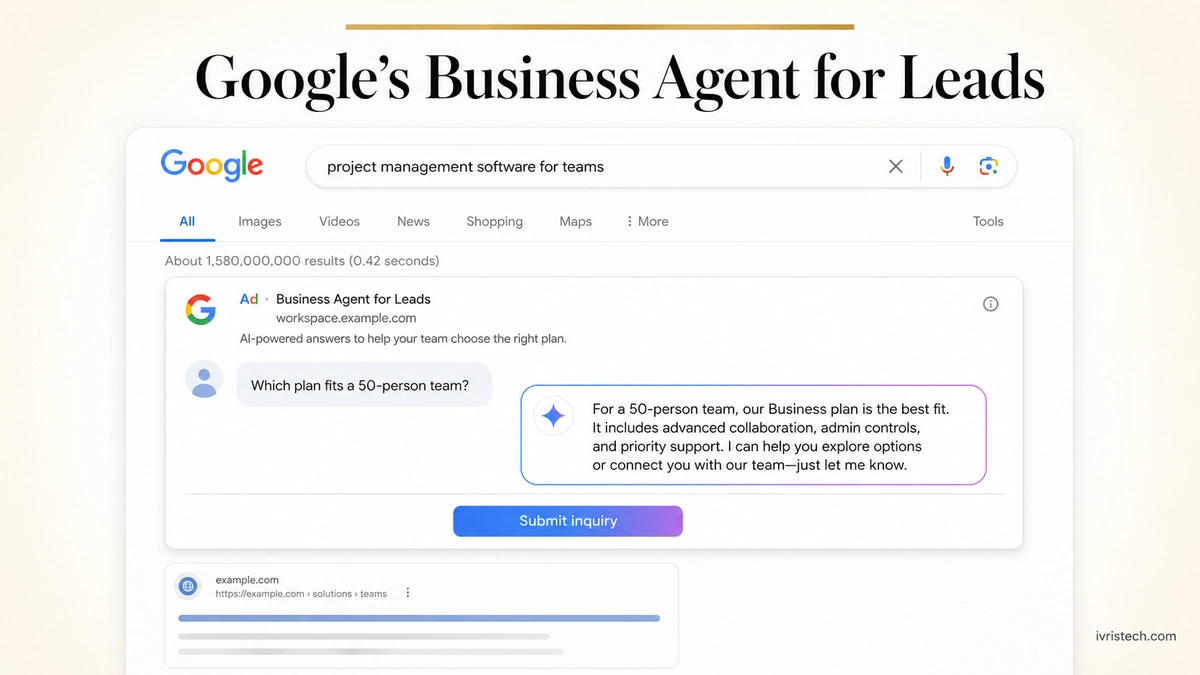
Business Agent for Leads is a Google Ads format announced at Google Marketing Live 2026 on May 20 that replaces the static lead form inside a Search ad with a Gemini-powered chat agent grounded in the advertiser’s own website. Prospects ask questions, get site-based answers, and a pre-filled form fires only after the conversation qualifies them. It runs in open US beta and requires AI Max for Search or Performance Max; Standard Search does not qualify.
Google unveiled Business Agent for Leads at Google Marketing Live 2026 on May 20, the first Google Ads format that replaces the static lead form inside a Search ad with a Gemini-powered chat agent grounded in the advertiser’s own website. The format is in open beta for US advertisers, tested first in education, automotive, and real estate. Eligibility is gated to AI Max for Search or Performance Max campaigns with text customization. Standard Search and Display campaigns do not qualify.
For the wider launch context, our Google Marketing Live 2026 prioritization analysis explains which lead-gen announcements moved pipeline first.
Vidhya Srinivasan, VP and GM of Google Ads and Commerce, framed the broader shift on stage with one line: “Now, you can ask Google anything, so the best ads must be answers.” Business Agent for Leads is the lead-gen execution of that frame. Instead of a prospect clicking a Search ad and seeing a form, they ask a question inside the ad, get an answer drawn from your site, and then submit a pre-filled inquiry only if the conversation qualifies them. Google says the goal is “better quality, high-intent prospects” handed off to sales teams. The cost of admission is that you have to be running Google’s AI-first campaign types to access the format at all.
For B2B marketing teams, this is the most consequential lead-gen change Google has shipped since lead-form extensions arrived in 2019. The static form was the floor of B2B paid-search measurement for the last six years. Replacing it with a chat agent that filters intent before the form fires has obvious upside for lead quality and obvious risk for advertisers whose ICP profile is too narrow for a Gemini model to qualify accurately. The AI Max gating means the timing also forces a campaign-type decision most B2B accounts had hoped to delay.
Key Takeaways
- Google launched Business Agent for Leads at Google Marketing Live 2026 on May 20, embedding a Gemini chat agent inside Search ads to replace the static lead form.
- The format is in open beta for US advertisers and requires AI Max for Search or Performance Max with text customization. Standard Search campaigns are not eligible.
- Initial verticals tested by Google: education, automotive, and real estate. B2B SaaS, services, and manufacturing categories will follow as the beta expands.
- The agent is grounded in the advertiser’s website to limit hallucination, captures lead data after the conversation qualifies the prospect, and runs 24/7 outside business hours.
- Dynamic Search Ads auto-upgrades to AI Max in September 2026, which means the AI Max requirement for Business Agent for Leads aligns with a forced migration B2B teams need to plan for now, not in Q3.
Business Agent for Leads vs. Lead-Form Extensions
| Dimension | Lead-form extensions (2019) | Business Agent for Leads (2026) |
|---|---|---|
| Ad interaction | Static form inside the Search ad | Gemini chat agent inside the Search ad |
| Where friction sits | None at the form; junk leads pass through | Qualifying friction before the form fires |
| Answer source | Advertiser copy only | Grounded in the advertiser’s own website |
| Form behavior | Submits for any user | Pre-filled form fires only after the conversation qualifies the prospect |
| Campaign eligibility | Standard Search and others | AI Max for Search or Performance Max with text customization only |
| Availability | General | Open US beta: education, automotive, real estate |
What Google Actually Shipped
The format itself is narrow. A user runs a Search query that triggers an eligible ad. Instead of seeing a headline plus a lead form, they see a conversational interface inside the ad unit. They ask a question, the agent answers using content pulled from the advertiser’s website, and follow-up questions stay inside the same conversation. When the agent decides the prospect is qualified, it offers a pre-filled lead form. The submitted lead lands in the advertiser’s Google Ads conversion stream the same way a traditional lead-form submission would.
Google lists four claimed benefits on the announcement page: 24/7 lead capture outside business hours, reduced sales friction from real-time answers, standardized brand messaging grounded in website content, and lead qualification before the form fires. The third item is the structural one. Hallucination risk in Gemini-drafted ad copy was the open question Google had not answered before GML; grounding the agent in the advertiser’s own site is the answer. If your site doesn’t say it, the agent shouldn’t either. Whether that constraint holds at scale across thousands of advertiser sites with inconsistent content quality is the next operational question Google is going to face.
The format is testing first in education, automotive, and real estate. Those three verticals share a common pattern: high-intent buyers, complex product or service comparisons, and a conversation step that pre-existed the agent. Education advertisers were already running chat widgets for program inquiries. Auto dealers were already running scheduling bots. Real estate agents were already qualifying leads by phone. Google is wedging the agent into ad surfaces where the conversation step was already routine, which is the lower-risk path to validating the format before B2B SaaS, financial services, and healthcare get access.
Why This Is the Most Consequential Lead-Gen Change Since Lead-Form Extensions
Lead-form extensions launched in 2019 and became the floor of B2B paid-search measurement. The mechanic was simple: surface a form inside the Search ad, let users submit without leaving the SERP, route the lead to the advertiser’s CRM. Conversion rates ran 30-50% higher than landing-page form submissions in most B2B accounts because the click-to-form friction got eliminated. The tradeoff was lead quality. A frictionless form attracts everyone, including buyers who would have self-disqualified at the landing-page stage.
Business Agent for Leads reverses that tradeoff. The agent imposes friction at the front of the funnel by requiring a conversation, but the friction is qualifying friction rather than landing-page friction. The buyer who isn’t actually ready to be a lead doesn’t get a form. The buyer who is, gets a form pre-filled with context the agent already established. For B2B teams that have spent two years complaining about junk leads from lead-form extensions, this is the structural fix Google has been promising and not shipping.
The lever that makes the new format work also makes it risky for narrow B2B ICPs. The Gemini agent decides who is qualified. If your ICP is “VP of Operations at a 5,000-employee manufacturer in North America evaluating ERP replacement,” the agent’s website-grounded model has to infer that a prospect meets all four criteria during a free-text chat. Education and automotive prospects qualify on three or four broad signals. Enterprise B2B SaaS ICPs qualify on twelve to twenty signals, most of which are firmographic and not surface-able from a chat. Our read: B2B SaaS advertisers should not assume the format will qualify ICP correctly out of the box. The early-vertical bias is real, and the qualification logic has to be tested against actual closed-won data before any budget shifts. HubSpot’s rebuilt Prospecting Agent hit the same constraint last month on the outbound side, and the resolution was outsourced ICP signals from Apollo and ZoomInfo, not chat alone.
The AI Max Gating Is the Forced Decision
To run Business Agent for Leads, you have to be on AI Max for Search or Performance Max with text customization. That gating is not incidental. It is the same gating Google is applying to every new ad format announced at GML 2026, and it sits on top of a confirmed September 2026 deadline for Dynamic Search Ads to auto-upgrade to AI Max. Advertisers still running keyword-led Search campaigns are being asked to migrate twice in 2026: once to access new formats like Business Agent, and again to keep DSA-style coverage of long-tail queries.
Srinivasan was direct about the implication during the keynote: “You can’t choose keywords anymore.” Chris Monkman, a Google director for Ads and AI experiences, said in the post-show podcast it is “very difficult to ever choose keywords manually that can match these queries.” The position is consistent, and it lines up with the same campaign-type expansion AI Mode ads have already been requiring in 2026: Performance Max and AI Max for Search are the only campaign types eligible for AI surface placements, and Standard Search, Display, and Video do not qualify. Microsoft’s AI Max for Search shipped in April with the same architectural bet on the other major engine, which means B2B paid teams running both platforms are now being asked to commit to AI-led campaign types on both sides of the duopoly within a single quarter.
The measurement side has to move at the same time. Enhanced conversions for web and leads merging into a single toggle in June 2026 is the prerequisite for getting closed-won data back into AI Max bidding cleanly. A Business Agent for Leads campaign optimized on form-fill volume without closed-won feedback will optimize for the agent’s qualification heuristic, not for revenue. That gap is the operational risk B2B teams should size up before they pilot the format. Dreamdata’s 121% LinkedIn ROAS benchmark from earlier this month rests on the same closed-won feedback loop; agencies and in-house teams that don’t have that loop wired cannot accurately compare Business Agent for Leads against LinkedIn-sourced pipeline.
What B2B Teams Should Do Before the Beta Expands
Four moves for the next 60 days.
Audit your site for chat-readiness, not just SEO-readiness. The agent is grounded in your website. If your pricing page is gated, your product comparisons live in PDFs, or your ICP qualification criteria are buried in case studies, the agent cannot answer prospect questions with the specificity B2B buyers expect. Surface the things a Gemini model needs to read: clear product tier descriptions, named ICP examples, transparent pricing ranges, and concrete deployment timelines. The same content audit that improves AI Overview citation eligibility improves Business Agent for Leads qualification.
Migrate one Search campaign to AI Max this quarter, not next. The DSA-to-AI Max deadline of September 2026 plus the Business Agent gating means B2B teams that have delayed AI Max adoption are now compressed against two reasons to migrate within six months. Run one controlled migration on a campaign with predictable conversion volume and 90 days of baseline data. Use the migration to learn the AI Max landing-page routing behavior, the gap advertisers have publicly raised on granular query routing, before the September deadline forces every campaign through at once.
Wire closed-won data back into Smart Bidding before piloting Business Agent for Leads. The agent’s qualification logic will produce a different lead distribution than lead-form extensions did. If your bidding optimizes on lead volume alone, the AI will steer toward the agent’s most easily qualified prospects, not toward the prospects that close. The unified enhanced-conversions toggle removes the configuration friction; the audit work to confirm CRM-to-Ads conversion imports actually fire is still on you.
Plan the CRM handoff before the first lead arrives. A pre-qualified lead from a chat conversation carries different context than a form fill. The agent has already exchanged messages with the prospect; that conversation transcript is the qualifying context sales-development reps need to see before the call. Confirm with your CRM team that the lead payload includes the transcript or transcript summary, not just the form fields. Without it, the rep loses the qualifying context the agent was supposed to deliver, and the conversation restarts from zero on the SDR call.
The format is narrow in scope today, US-only and three verticals deep, but the architectural pattern is what’s important. Every AI Search ad format Google ships in 2026 will require an AI Max or PMax campaign and will lean on the advertiser’s website as grounding material. The teams that get the campaign migration and the site readiness done in Q2 will pilot Business Agent for Leads cleanly when their vertical comes online. The teams that wait will pilot under deadline.
Frequently Asked Questions
Business Agent for Leads is a Google Ads format announced at Google Marketing Live 2026 on May 20. It replaces the static lead form inside a Search ad with a Gemini-powered chat agent grounded in the advertiser’s website. The agent answers prospect questions from site content, and a pre-filled form fires only once the conversation qualifies the prospect. It runs in open US beta in education, automotive, and real estate.
Only AI Max for Search and Performance Max with text customization. Standard Search, Display, and Video campaigns do not qualify. Dynamic Search Ads auto-upgrades to AI Max in September 2026, so B2B teams still on DSA-style campaigns face two reasons to migrate this year: to access Business Agent for Leads now, and to keep long-tail coverage before the deadline.
That is the open question. The Gemini agent decides who qualifies from the conversation and grounded site content. Education and automotive prospects qualify on three or four broad signals a chat can infer. Enterprise B2B SaaS ICPs typically qualify on twelve to twenty firmographic signals not visible in free text. Validate qualification accuracy against closed-won data before scaling spend.
The format changes both the volume and the composition of leads entering the conversion stream. Pre-qualified chat leads carry more context than form fills, so CRM payloads should include the transcript or summary for sales-development reps. Smart Bidding shifts too: optimizing on lead volume alone steers the AI toward the agent’s easiest qualifications, not prospects that close. Closed-won data fed back through enhanced conversions for leads is the prerequisite for revenue-based optimization.