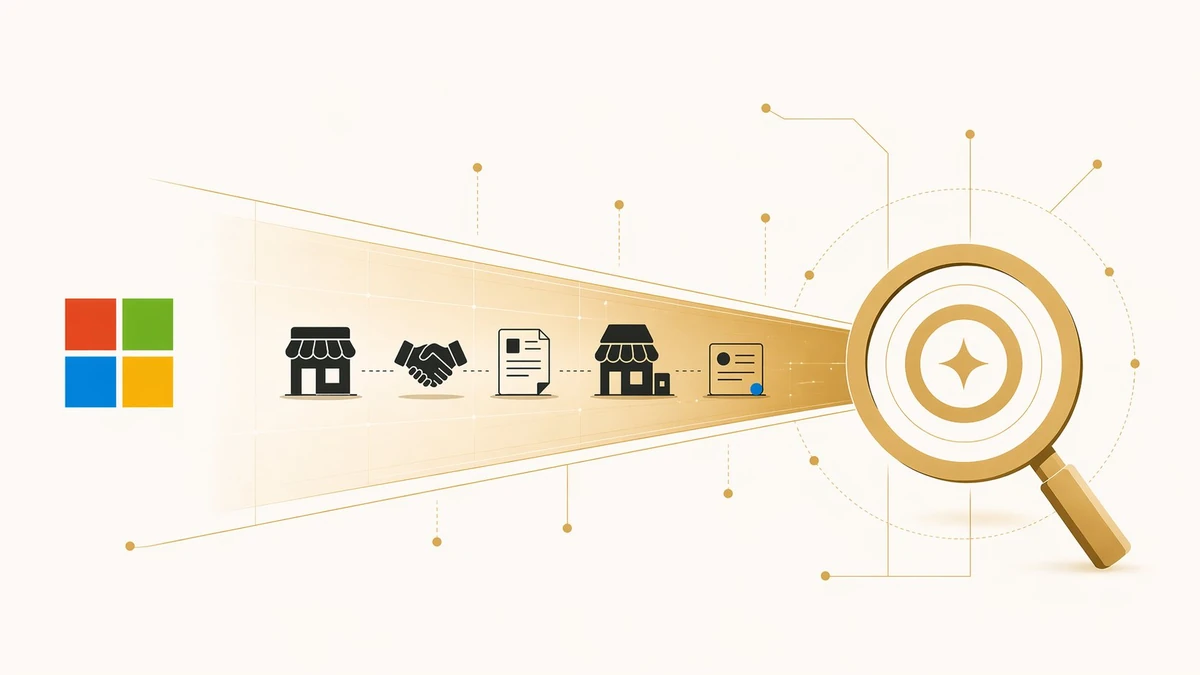
On April 21 at its online advertiser event, Microsoft introduced AI Max for Search campaigns, a pilot that expands query matching and personalizes ad delivery across Copilot Search, Copilot Answers, and Bing. A day later, the company rolled out brand-visibility controls for the agentic web: term exclusions, messaging constraints, and “Offer Highlights” that let brands surface differentiators like free shipping or in-store pickup inside Copilot conversations. Microsoft also added Universal Commerce Protocol support in Merchant Center, making product data discoverable by AI agents without custom integration work.
Most coverage framed these as retail news. MediaPost led with Copilot Checkout. MarTech emphasized shopping agents. For B2B advertisers running Microsoft Ads, the actual news is different: Microsoft just shipped the first coherent set of agentic-web ad controls usable inside a B2B media plan, at a moment when G2 data confirms 51% of B2B software buyers now start research in an AI chatbot.
Our read: Microsoft Ads has been a quiet B2B channel for years, with lower CPCs than Google and deeper LinkedIn targeting but thinner product news. April 21-22 changed that. AI Max plus term exclusions and messaging constraints is the first coherent B2B AEO-meets-paid-media toolkit from any major ad platform. Teams running Microsoft Ads for B2B should set up the new controls this quarter before competitors figure out the same thing. That same control pattern now extends to another automated campaign type: Microsoft Performance Max demographic controls add explicit age and gender eligibility boundaries alongside the platform’s algorithmic delivery.
Key Takeaways
- Microsoft launched AI Max for Search on April 21, 2026, expanding query matching and AI-driven personalization across Copilot Search, Copilot Answers, and Bing.
- Brand-visibility controls shipped April 22: term exclusions (first), messaging constraints, Offer Highlights for Copilot, and Universal Commerce Protocol support in Merchant Center.
- Microsoft Ads sees 30-40% lower CPCs than Google, with LinkedIn job/title/industry targeting integrated — a B2B advantage most advertisers under-invest in.
- Copilot advertising shows 73% higher click-through rates than traditional search ads, with customer journeys 33% shorter.
- B2B advertisers should set up term exclusions, write Copilot-ready messaging constraints, and add UCP feeds to their Microsoft Advertising Platform account before competitors do.
What Microsoft Actually Shipped
Three announcements, one direction. AI Max for Search expands query matching beyond exact keywords. The AI decides which queries your ad is eligible for based on intent. Personalization runs across Copilot Search, Copilot Answers, and Bing. This is Microsoft’s version of Google Performance Max, adapted for agentic-search surfaces.
The brand-visibility layer matters more for B2B. Term exclusions let advertisers tell the platform which words never to use in AI-generated ad copy: competitor names, deprecated products, claims your legal team blocked. Messaging constraints set rules like “never imply low cost” or “capitalize every word in a headline.” These are guardrails for when AI drafts your ad copy, not you. Mediaocean NIVO AI puts the same control question around campaign setup, where a claimed 90% speed gain still needs a visible QA and rollback path. DoubleVerify’s context-risk evidence for AI chat ads shows why the next control layer must govern placement as well as copy: relevance was the only tested scenario where positive sentiment beat negative.
Offer Highlights surface product differentiators in Copilot conversations. For retail that means shipping terms and return policy. For B2B, it maps to implementation timelines, support tiers, contract flexibility, and SLA guarantees. Microsoft also shipped Universal Commerce Protocol support in Merchant Center, the same protocol Shopify co-developed with Google, making product data natively discoverable by AI agents. Feedonomics’ Agentic Catalog Exports shipped six days later as a complementary feed-side option, syndicating B2B product data into OpenAI, Gemini, Copilot, and Perplexity through the same protocol layer.
Why This Is a Real B2B Ad Platform Moment
Microsoft Ads has always had a narrow B2B advantage most mid-market advertisers underused. CPCs run 30-40% lower than Google Ads for comparable B2B queries. LinkedIn targeting (job title, company, industry, seniority) is integrated into the Microsoft Advertising Platform since the LinkedIn acquisition, letting advertisers combine search intent with professional targeting. And Microsoft 365 Copilot has 15 million paid seats as of January 2026 (160% year-over-year), which puts B2B decision-makers inside Copilot during the workday.
The G2 Answer Economy data makes the timing concrete: 51% of B2B software buyers now start research in an AI chatbot. ChatGPT leads at 63% of AI-chatbot share, but Copilot is where enterprise buyers already are during the workday. Advertisers who show up with term exclusions and messaging constraints in place can influence shortlists the same way G2 review sites do.
The parallel to ChatGPT Ads going CPC and Google AI Mode becoming an ad platform is deliberate. Every major AI surface is now monetized. Microsoft is the third to ship, and it’s the one most B2B advertisers already have an account on. The professional-network side of the same shift is moving in parallel: LinkedIn’s Off-Platform Event Ads complete global rollout by May 6 and close the webinar-attribution gap that has dogged B2B field marketing programs for years. Google’s matching bet shipped May 20 at GML 2026, with Business Agent for Leads extending the AI-led campaign-type requirement to lead-gen ad units and locking advertisers into AI Max or PMax to access it.
What B2B Advertisers Should Do in the Next 30 Days
Three moves for teams on Microsoft Ads:
Set up term exclusions before your first AI Max campaign. Term exclusions launched first among the brand-visibility controls. Every competitor name, deprecated product name, and legally-restricted claim should go in. The upfront work takes an hour; protection applies to every AI-drafted ad variant the platform generates. Skipping this step means ads associated with language you’d never write manually.
Write messaging constraints the same week you launch AI Max. Don’t let the platform default to generic AI-ad tone for your B2B product. Specify: never use superlatives, never make claims without data, always capitalize product names correctly, always include the compliance certification. Constraints work across every auto-generated variant, so the rules compound.
Add UCP product feeds if you have self-serve signup or tiered pricing. UCP was positioned as retail, but it applies to any productized offering: SaaS plans, add-on modules, training packages, services with defined SLAs. When a B2B buyer asks Copilot “what’s the cheapest plan for a 50-person team,” UCP-fed data is what the AI pulls from. Without UCP feeds, the AI is guessing from your website.
The broader pattern: as Adobe ships MCP for Marketo and Salesforce ships Headless 360, the B2B martech stack is converging on open protocols (MCP, A2A, UCP) that make every system agent-addressable. Microsoft AI Max is the advertising-side version of that bet, and aligns with Forrester’s GTM singularity argument that buyers are now evaluating inside AI surfaces. Teams that get protocol-native in Q2 2026 will have compounding advantage through the rest of the year. The document-side bet arrived May 6: Adobe’s Acrobat Productivity Agent turns PDFs into AI-queryable workspaces, which means the inter-company document surface B2B advertisers send through (sales proposals, RFP responses, branded experiences) now ships with native agentic infrastructure.
Frequently Asked Questions
AI Max for Search is a Microsoft Advertising campaign type launched April 21, 2026, that expands query matching using AI and personalizes ad delivery across Copilot Search, Copilot Answers, and Bing. Unlike exact-match keyword campaigns, AI Max lets the platform decide which search intents your ad is eligible for, similar in concept to Google’s Performance Max but adapted for Microsoft’s agentic-search surfaces.
Term exclusions let advertisers block specific words from appearing in AI-generated ad copy: competitor names, deprecated products, or legally-restricted claims. Messaging constraints set rules for tone, capitalization, and claims (like “never imply low cost”). Both apply across every auto-generated ad variant, protecting B2B advertisers from off-brand or non-compliant AI-written copy.
Microsoft Ads CPCs run 30-40% lower than Google for comparable B2B queries, primarily because Microsoft has lower search volume and less advertiser competition. For B2B specifically, the audience skews more professional due to the Office/Windows install base, and LinkedIn targeting integration lets advertisers layer job title, company size, and industry onto search intent in ways Google Ads cannot match.
Yes. UCP was positioned in retail terms, but it structures any productized offering as machine-readable data that AI agents can interpret. For B2B, this applies to SaaS pricing tiers, add-on modules, training packages, and services with defined SLAs. When buyers ask Copilot about plan options, UCP-fed data is what the AI draws from.