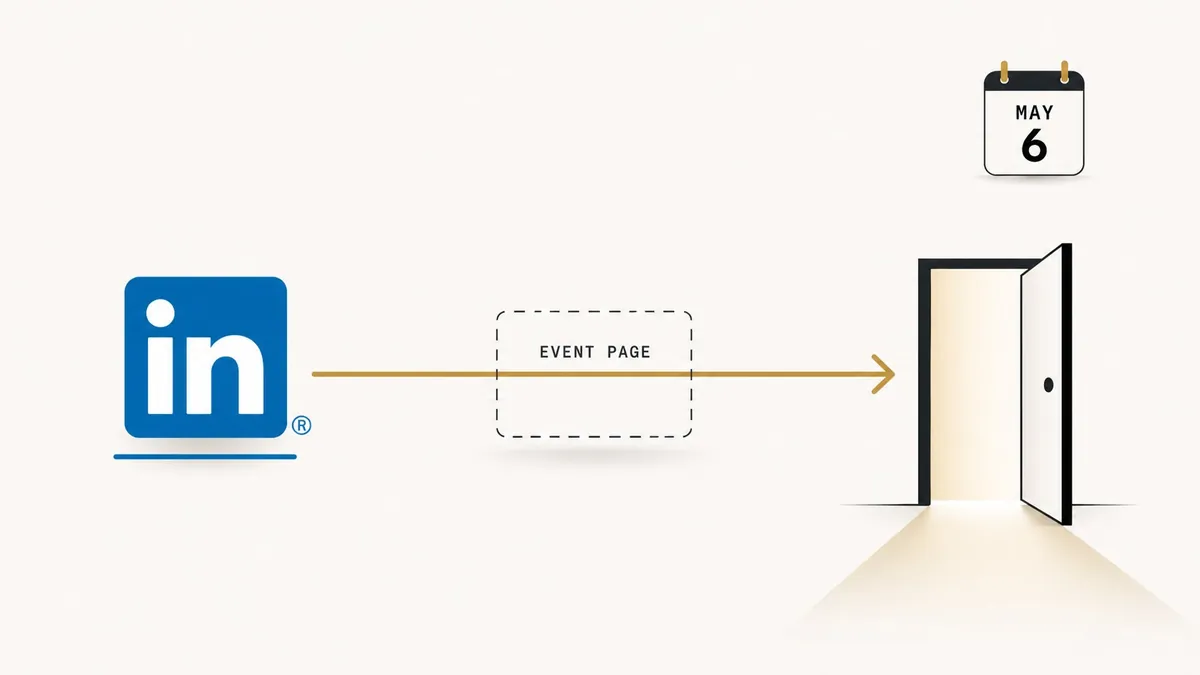
LinkedIn began rolling out Off-Platform Event Ads globally last week, with worldwide availability completing by May 6, 2026. Search Engine Land’s coverage and LinkedIn’s own help doc both confirm the date. The format lets B2B advertisers run Sponsored Content event promotions that send a click directly to the marketer’s own registration platform, instead of forcing the user through a LinkedIn-hosted Event Page first.
Before moving spend into event ads, run a LinkedIn device targeting audit so webinar and registration campaigns are not dragged down by the wrong device mix.
The format supports four campaign objectives (brand awareness, engagement, website visits, lead generation), event-specific CTAs, and accelerated delivery. LinkedIn’s own data shows 62% of B2B marketers consider events one of the most essential full-funnel tactics. Previously, every event ad had to live behind a LinkedIn Event Page intermediary, even when the webinar was on Zoom or the field event in Goldcast.
Our read: this is LinkedIn closing an attribution gap B2B field marketing teams have been working around for years. The mid-market question is not whether to use Off-Platform Event Ads but how to wire LinkedIn click attribution into your existing webinar stack before May 6, because the default setup silently breaks attribution at the registration page.
Key Takeaways
- LinkedIn began rolling out Off-Platform Event Ads globally last week; all advertisers will have access by May 6, 2026.
- The format removes the forced LinkedIn Event Page intermediary, sending clicks directly to external destinations like Zoom, ON24, Goldcast, Splash, livestream platforms, or your own landing pages.
- Four campaign objectives are supported: brand awareness, engagement, website visits, and lead generation.
- LinkedIn data: 62% of B2B marketers consider events a top full-funnel tactic; the previous Event Page detour broke attribution for off-platform programs.
- Default setup loses the LinkedIn click ID at the registration form. B2B teams need to wire URL parameters and CRM lead source fields before May 6 to capture the LinkedIn touch.
What LinkedIn Actually Shipped
Off-Platform Event Ads use the existing Event Ads creative format (square image or video, headline, event date, CTA) but let the destination URL point outside LinkedIn. Marketers add event details (date, format, time zone) in Campaign Manager, then plug in a third-party URL. The CTA can read “Register,” “Save my spot,” or “Watch live.”
The four objectives map to where event programs sit in the B2B funnel: brand awareness for top-of-funnel field events, engagement for thought-leadership webinars, website visits for resource-library replays, and lead generation for gated registrations where Lead Gen Forms pre-populate user data into your MAP.
Accelerated delivery is the other meaningful detail. Event ads are time-sensitive (a Tuesday webinar does not benefit from impressions delivered the following Friday); accelerated delivery prioritizes spend in the days leading up to the event date.
Why the Event Page Detour Was the B2B Attribution Gap
For years, B2B teams running webinars on Zoom, ON24, Goldcast, or Bizzabo had a forced choice: build a LinkedIn Event Page that mirrored the actual event (duplicate maintenance), or accept that LinkedIn-driven registrations would never appear in the webinar platform’s attendee report.
Mirroring broke at the registration step. A user clicked the LinkedIn Event Page, registered through LinkedIn, then got the webinar link by email. The webinar platform saw the registration but had no clean signal that LinkedIn was the source. Pipeline attribution relied on stitching together LinkedIn’s Campaign Manager export, the webinar attendee CSV, and the CRM lead source field, with manual reconciliation between them.
Off-Platform Event Ads short-circuit that. The webinar platform records the registration with full referrer context, UTM parameters carry through, lead source fields populate. The reconciliation step that used to take an ops analyst three hours per webinar disappears. This matters for the same reason Google’s enhanced conversions consolidation matters: every removed intermediary reduces data loss between click and closed-won.
What B2B Teams Should Wire Up Before May 6
The default setup will lose attribution. Three configuration moves close the gap.
Add LinkedIn click-ID URL parameters to event registration links. LinkedIn passes a click ID parameter on the destination URL. The webinar platform needs to capture it as a hidden field and pass it to the CRM as part of the lead record. Without that, the LinkedIn click attribution dies at the form and the registration looks like direct or organic in your CRM.
Configure event-native UTM parameters per campaign. Use source = linkedin, medium = event-ad-offplatform, campaign = the event name. Without the medium-level distinction, post-event analysis cannot separate event leads from general LinkedIn brand-awareness leads.
Map LinkedIn Lead Gen Form fields to your MAP and webinar platform. Confirm the LinkedIn-to-MAP integration handles pre-populated form fields cleanly and that the MAP-to-webinar sync triggers on the right field state. The integration breaks silently when LinkedIn’s field schema does not match a custom field your MAP expects.
The work takes an ops analyst about half a day per webinar platform. Skip it and May 6 produces ad spend without measurable attribution, the exact outcome “Cut the Bullspend” was supposed to fix.
The “Cut the Bullspend” Connection
Off-Platform Event Ads are the product side of LinkedIn’s late-March “Cut the Bullspend” positioning at NewFront. The pitch was that LinkedIn would prove ad accountability through measurable outcomes, not impressions. Event ads that connect to your webinar platform with clean attribution are the format that argument requires. The launch is the receipts. LinkedIn Creator Marketplace extends the same accountability question to creator campaigns, where brands must prove paid reach does not dilute expert credibility.
The broader 2026 context: Microsoft AI Max opened the agentic-web ad surface for Copilot. Reddit’s 82% cross-platform ROAS jump proved that high-intent audiences with clean attribution outperform channels optimized for impression volume. LinkedIn shipping a format that respects external attribution stacks is the platform reading the same room. The B2B channel-mix playbook is no longer “pick one and accept the gap”; it is wire attribution correctly across all three before the next budget review. LinkedIn’s May 6 Agency Certification launch sits on top of the same shift, adding a platform-administered competence signal for the agencies running these increasingly complex attribution stacks on behalf of mid-market and enterprise B2B teams. The newer 112% content-conversion lift extends that channel-mix argument from events into owned content pages, where post-impression exposure has to be captured before the assist disappears.
Frequently Asked Questions
LinkedIn began rolling out Off-Platform Event Ads to advertisers globally in late April 2026, and worldwide availability completes by May 6, 2026. The format is being added to LinkedIn Campaign Manager for all advertisers as part of the rollout. No application or beta enrollment is required after May 6.
Previous LinkedIn Event Ads required marketers to first create a LinkedIn Event Page that mirrored the actual event, even when the webinar was hosted on Zoom, ON24, or Goldcast. Off-Platform Event Ads remove that intermediary and let the click go directly from the LinkedIn feed to your external registration page, restoring clean attribution from click through to the webinar platform’s attendee record.
Not by default. LinkedIn passes a click ID URL parameter on the destination URL, but the registration form needs to capture that parameter as a hidden field and pass it to your CRM as part of the lead record. Without that, attribution dies at the form and the registration looks like direct or organic traffic in CRM reporting.
Four objectives: brand awareness, engagement, website visits, and lead generation. Lead generation is the most common B2B use case for gated webinar registrations because it allows LinkedIn Lead Gen Forms to pre-populate user data; the other three map to top-of-funnel field events, thought-leadership webinars, and resource-library replays.