Direct answer – what is LinkedIn’s 112% content conversion lift?
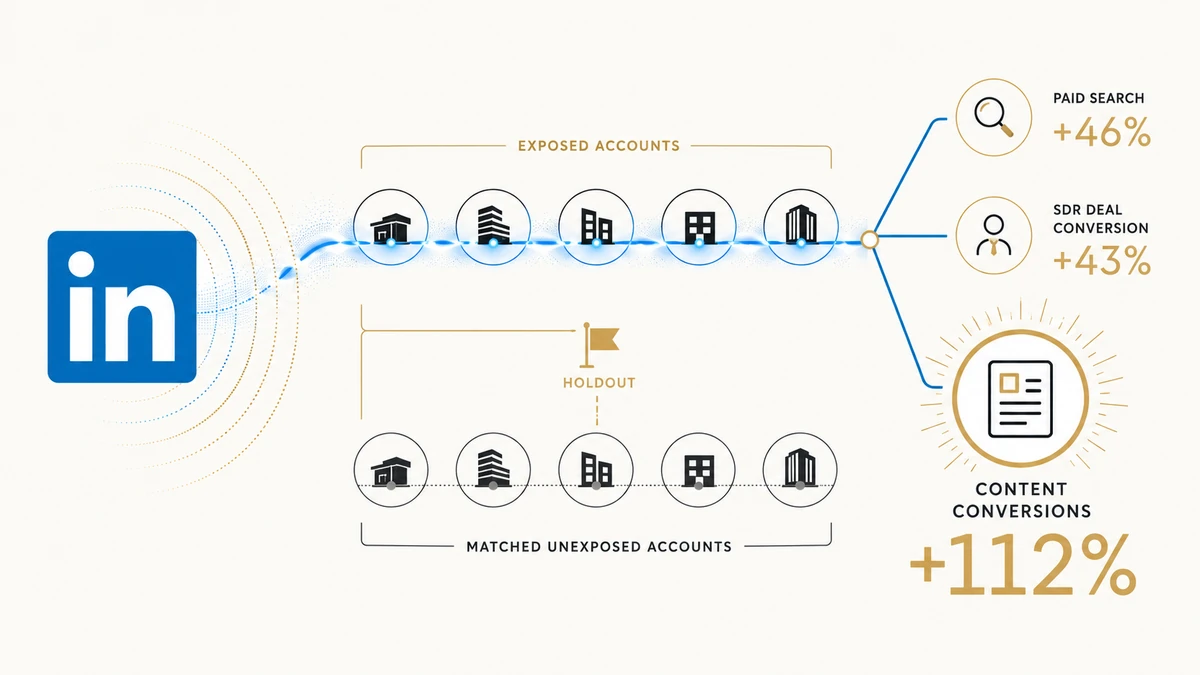
LinkedIn’s 112% content conversion lift comes from Factors.ai benchmark research cited by LinkedIn on June 17, 2026. The claim says ideal customer profile accounts that saw LinkedIn ads converted 112% better on website content pages. LinkedIn also cited a 46% paid-search conversion lift and a 43% SDR meeting-to-deal lift after LinkedIn ad exposure.
LinkedIn published new research on June 17, 2026 arguing that LinkedIn Ads create a multiplier effect across search, content, outbound, and pipeline.
The headline number is the one B2B marketers will screenshot: Factors.ai benchmark data found that ideal customer profile accounts exposed to LinkedIn ads converted 112% better on website content pages. The same research cited by LinkedIn also found a 46% lift in paid-search conversions and a 43% lift in SDR meeting-to-deal conversion after LinkedIn ad exposure.
For B2B demand teams, the useful question is not whether LinkedIn can help other channels. It is whether the account-level exposure data is wired tightly enough to prove that LinkedIn influenced the content conversion rather than simply touched an account that was already warm.
Key Takeaways
- LinkedIn published the multiplier-effect post on June 17, 2026.
- Factors.ai benchmark data says ICP accounts exposed to LinkedIn ads converted 112% better on website content pages.
- The same research cites a 46% lift in paid-search conversions and a 43% lift in SDR meeting-to-deal conversion.
- The SERP already has an AI Overview, so the ranking opportunity is the specific 112% content-conversion query and measurement angle.
- B2B teams should test account-level exposure, content-page behavior, and pipeline impact before moving budget from search or content into LinkedIn.
What LinkedIn’s Multiplier Claim Actually Says
LinkedIn’s post is based on research from Factors.ai’s B2B benchmark report, which analyzed performance data from more than 100 B2B companies and survey responses from more than 125 senior marketers.
The research argues that LinkedIn exposure improves how accounts behave elsewhere. Paid search performs better after LinkedIn exposure. SDR conversations convert better. Content pages convert better. The 112% content lift is the most striking number because it reframes content marketing as an assisted channel, not only an organic or direct-response channel.
LinkedIn also points readers to Fibbler’s full influenced-pipeline report, which pushes the same idea: LinkedIn needs to be measured through influenced account behavior, not only click-through attribution.
Why the Content Number Matters More Than the Search Lift
When we covered LinkedIn’s agency certification and 121% ROAS benchmark, the point was that LinkedIn was moving from attention to revenue proof. The 112% content-conversion claim is the sharper version of that same argument.
Paid search has obvious intent. A buyer searches, clicks, and converts. Content pages are messier. They may be reached through organic search, direct traffic, email, social, retargeting, or a sales follow-up. If LinkedIn exposure materially improves those content-page conversions, the channel is doing more than generating clicks. It is shaping account readiness before the page view.
That makes the measurement harder. The SERP screenshots you supplied already show Google’s AI Overview turning the result into a tactical answer: run content, retarget engagement, align to funnel stages. That is useful but incomplete. The real buyer question is how to prove the lift without double-counting every warm account as a LinkedIn win.
What B2B Teams Should Do Now
Our read: treat the 112% number as a test design, not a budget mandate. LinkedIn may be the assist that makes content convert. It may also be getting credit for accounts that were already moving through search, email, events, and sales.
- Build an exposed-versus-unexposed account cohort. Compare ICP accounts that saw LinkedIn ads with matched ICP accounts that did not, then inspect content-page conversion rates over the same window.
- Separate content types. Product pages, comparison pages, ungated reports, webinars, and demo-adjacent pages will not react the same way to LinkedIn exposure.
- Capture post-impression data. Click-only reporting misses the exact effect LinkedIn is claiming. Use account-level exposure logs and CRM stage movement, not only UTM sessions.
- Protect incrementality. Hold back a geography, segment, or target-account cohort where budget allows. Without a holdout, report the result as influenced lift, not causal lift.
The newest claim also strengthens the case for LinkedIn device targeting discipline and Off-Platform Event Ads. Once LinkedIn starts claiming credit for cross-channel conversion lift, every downstream capture point needs cleaner tracking.
The practical takeaway is simple: keep LinkedIn in the content measurement model, but do not let the platform grade its own homework. The 112% lift is worth testing precisely because it is large. It is also large enough that finance will ask how much of it is incremental. The TikTok Symphony Agent measurement problem is similar: creative output gets cheaper, but the budget case still depends on qualified engagement and pipeline evidence.
Frequently Asked Questions
It means Factors.ai benchmark data found that ideal customer profile accounts exposed to LinkedIn ads converted 112% better on website content pages. The claim is about account exposure lifting downstream behavior, not only clicks from LinkedIn ads.
LinkedIn published the multiplier-effect post on June 17, 2026 and cited benchmark research from Factors.ai. LinkedIn also directed readers to a Fibbler report on influenced pipeline measurement for LinkedIn Ads.
No. It is a strong influenced-conversion signal, but causality requires a holdout or matched cohort test. B2B teams should compare exposed and unexposed ICP accounts and separate influenced lift from incremental lift before reallocating budget.
Measure account-level ad exposure, content-page visits, content conversions, CRM stage movement, influenced opportunities, and closed-won revenue. Keep click-based UTMs, but add post-impression and account-level analysis so LinkedIn’s effect is not undercounted or overcounted.