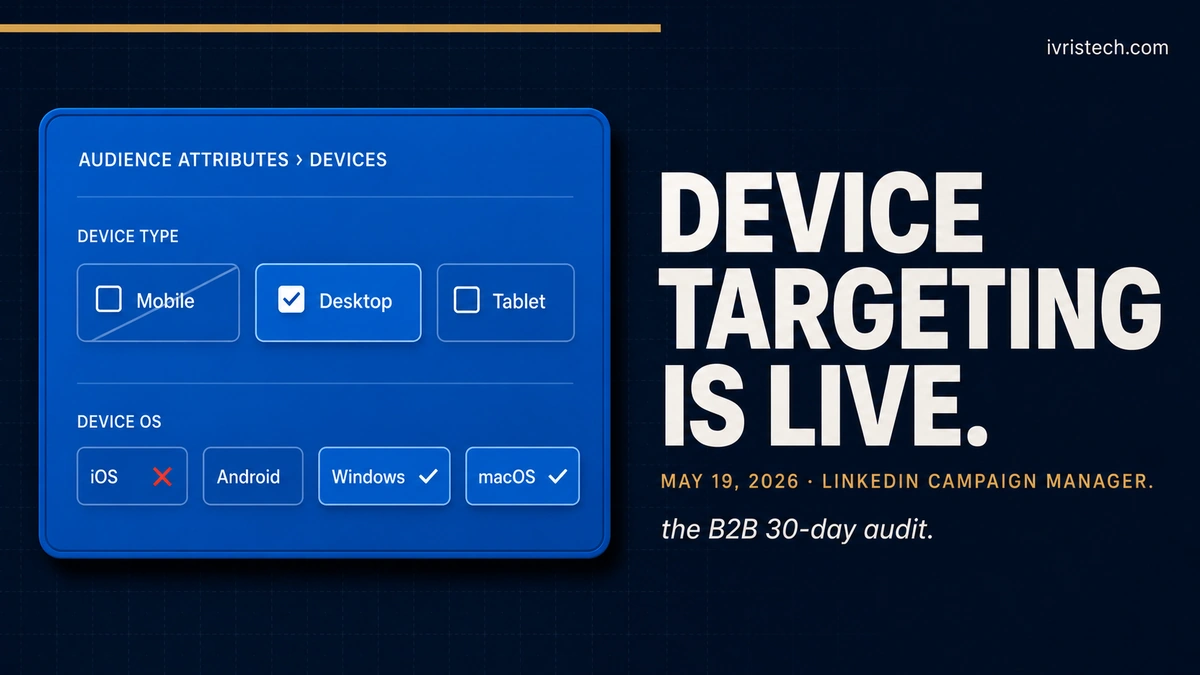
LinkedIn began rolling out device type and device OS targeting inside Campaign Manager on May 19, 2026, the first time in the platform’s advertising history that B2B advertisers can restrict ad delivery to Mobile, Desktop, or Tablet without relying on format-based workarounds. PPC Land confirmed the launch after practitioners Filip Saracevic and Alex Beddoe spotted the new Devices panel under the Audience Attributes section. The rollout is phased and expected to reach all accounts by early June.
Google’s AI Overview for “linkedin ads exclude mobile b2b” still leads with the line “LinkedIn does not provide a native setting to directly exclude mobile devices,” citing content from April 2025 and February 2026. That AI Overview is now factually wrong. The B2B advertisers who update their playbooks first will own the freshness window before Google refreshes the answer.
Key Takeaways
- LinkedIn Campaign Manager → Audience Attributes → Devices panel now exposes Device Type (Mobile/Desktop/Tablet) and Device OS (iOS, Android, Windows, macOS) checkboxes. Rollout began May 19, 2026; completion expected within two weeks.
- Per Alex Beddoe (Head of Biddable Media at Transmission, LinkedIn Certified Marketing Expert), the strategic frame is demand creation (mobile-friendly) vs demand capture (desktop-friendly), not “switch everything to desktop.”
- iOS suppression on conversion campaigns directly addresses post-iOS 17 attribution noise from URL-parameter and pixel-based tracking degradation.
- macOS targeting functions as a soft persona filter for ABM campaigns aimed at engineering and design audiences without consuming a job-title targeting slot.
- Counterargument (Mathias Skov Onsby): desktop conversions following a LinkedIn click may not be incrementally attributable to LinkedIn. Last-click measurement on desktop-only campaigns will overstate performance against true incrementality.
What LinkedIn Actually Shipped on May 19
The new Devices panel sits inside Campaign Manager’s existing Audience Attributes section. Three checkboxes for Device Type (Mobile, Desktop, Tablet) and a separate Device OS selector covering iOS, Android, Windows, and macOS now appear above the targeting save bar. Architecturally, LinkedIn integrated device targeting into the existing audience-building flow rather than launching it as a standalone tool, which means it composes with the existing job-title, seniority, company-size, and skills filters in the same campaign setup.
The workaround era is now closed. Until May 19, B2B advertisers wanting more desktop delivery had exactly one indirect lever: vertical-format creatives (which appeared predominantly on mobile, so running horizontal formats functioned as a rough desktop bias). There was no mechanism at all to restrict delivery to tablet, and no way to suppress iOS specifically on conversion campaigns. Chris Godwin, fractional demand and growth marketing lead for B2B SaaS, noted in the practitioner discussion that the previous vertical-format workaround forced creative decisions to follow targeting needs. Now the targeting can lead, and creative can return to format choices made on merit.
The rollout pattern is consistent with how LinkedIn shipped frequency capping in July 2025 and the April 28, 2026 event-advertising overhaul: phased deployment across accounts globally, completion in roughly two weeks, no formal announcement on the rollout day itself. Advertisers whose Campaign Manager does not yet show the Devices panel should expect it to appear by early June without taking any action.
Why This Is Bigger Than “Switch Everything to Desktop”
The first practitioner reaction has been to add a desktop-only filter across every paid LinkedIn campaign. Beddoe argued in the LinkedIn discussion thread that this reflex misses the actual strategic question and points B2B teams at the wrong cohort of campaigns first.
The useful frame is demand creation versus demand capture, with a tested middle layer most teams will skip past. Demand creation is brand work — thought leadership, video, executive points-of-view, scroll-stopping content that builds familiarity over months and quarters. Senior B2B buyers scroll on mobile between meetings, on the train, late at night. Cutting brand campaigns to desktop reduces the impression footprint exactly where the buyer’s awareness window opens, in exchange for an efficiency gain that the campaign was never optimizing for anyway. Demand creation should stay device-broad as a default.
Demand capture is structurally different. Demo requests, gated assets, comparison pages, anything ending in a multi-field form: these favor desktop heavily. Buyers actually read the landing page, open a second browser tab to check G2 or third-party reviews, and finish the form with a real keyboard. Desktop earns a premium for conversion-oriented campaigns precisely because the device context supports completion. Adding a desktop-only filter on bottom-of-funnel campaigns is the move that produces measurable CPL improvement.
The middle layer is retargeting and click-to-content campaigns — the cohort that lives between awareness and conversion. Mobile typically wins on cost-per-engagement, desktop typically wins on completion. Per Beddoe, the rule here is test per offer, not commit to a single device-default for the whole layer. The same B2B reality Dreamdata’s 2026 benchmark measured at the platform level — LinkedIn delivering 121% ROAS across 66 million B2B sessions with average buyer journeys stretching to 272 days and 10 stakeholders — is what makes per-stage device discipline matter: the longer the journey, the more value sits in matching the device context to where the buyer actually is.
The iOS Suppression Mechanic Most Teams Will Miss
Device Type is the headline feature. Device OS is the one that fixes specific operational problems most B2B teams have been quietly absorbing for two years.
iOS suppression on conversion campaigns. Apple’s iOS 17 update tightened privacy protections around link tracking, which produced measurable noise in conversion data for advertisers using URL parameters and pixel-based attribution. LinkedIn’s conversion API helps, but the iOS-side measurement signal remains degraded relative to Android, Windows, and macOS. Filtering iOS out of conversion-focused campaigns is a direct response — fewer impressions land on devices where measurement is broken, which produces cleaner data for optimization decisions. The same conversion-measurement degradation Google addressed with Enhanced Conversions for Lead Gen at GML 2026 on May 20 sits inside the iOS-attribution problem too, which means B2B teams running both LinkedIn and Google Ads now have device-level levers on both platforms within four days of each other.
macOS as a soft persona filter for ABM campaigns. Engineering, design, product, and developer audiences are disproportionately on macOS. Applying a macOS Device OS filter on an account-based-marketing campaign aimed at engineering buyers in target accounts functions as a soft persona filter that does not consume a job-title targeting slot. The job-title field carries a real audience-size cost on LinkedIn — every additional title constraint narrows the campaign’s eligible impression pool. Device OS adds a persona signal without paying that cost, which matters most on campaigns where the target audience is already small (top 100 accounts, top 500 contacts).
These are deliberately narrow use cases. Most advertisers do not need OS-level filtering. Teams running precise ABM motions or struggling with post-iOS-17 attribution gaps now have a mechanism that did not previously exist on any major B2B platform. Microsoft’s AI Max launch took the same direction in agentic-web inventory on the Bing-and-Copilot surface, treating device and signal precision as the differentiator rather than raw reach. The B2B paid-media discipline of the next 18 months is precision-on-existing-channels, not channel expansion.
The 30-Day B2B Device-Audit Playbook
Run this audit in the next 30 days while the rollout completes and the AI Overview catches up to reality.
Week 1, inventory and segment. Pull every active paid LinkedIn campaign into a spreadsheet. Tag each as Demand Creation (brand video, thought leadership, executive content), Demand Capture (demo request, content gate with form, comparison page, free trial), or Middle Layer (retargeting, click-to-content, webinar registration). Pull last-90-day spend, CPL, and conversion rate per campaign. This is the baseline.
Week 2, apply device-type filters by cohort. On Demand Capture campaigns, duplicate each campaign and apply Desktop-only on the duplicate. Run both for 14 days at split budget. Compare CPL and conversion rate. On Demand Creation campaigns, leave device broad. On Middle Layer campaigns, pick the top three by spend, duplicate, and run Desktop-only against the original. Same 14-day measurement window.
Week 3, layer Device OS where the signal matters. For B2B teams running conversion campaigns into iOS-heavy audiences, duplicate the highest-spend conversion campaign and add an iOS-suppression filter on the duplicate. For B2B teams running ABM into engineering, design, or developer audiences, apply a macOS Device OS filter on the existing ABM campaigns and measure click-to-engagement rate against the broader-OS version.
Week 4, reconcile against incrementality, not just last-click. The week-4 step is the one most teams will skip. Desktop-only conversion campaigns will appear to outperform their broad-device originals on last-click metrics. That apparent gain is partly real (better measurement, better form completion) and partly artifact (desktop conversions often co-occur with direct or organic search that would have closed anyway). Run an incrementality test on the highest-spend Desktop-only campaign with a geographic holdout if budget allows, or apply a 50% lift discount to last-click results as a working assumption until proper measurement is in place.
The audit framework deliberately resists the urge to apply Desktop-only universally. The teams that will produce real CPL improvement from device targeting are the ones that segment by funnel stage first, apply the filter only where the device context maps to the buyer action, and reconcile against incrementality before declaring victory. Google’s Business Agent for Leads handles the same per-stage discipline differently on the paid Google surface, which means B2B teams running both platforms have to coordinate device strategy across two platforms with different optimization logic running in parallel.
The Attribution Trap to Avoid
The cleanest counterargument to “switch conversions to desktop” came from Mathias Skov Onsby in the same LinkedIn rollout thread. The question is whether a desktop conversion that follows a LinkedIn click is genuinely attributable to LinkedIn, or whether the buyer would have converted anyway through direct traffic or a Google search later that week.
Last-click measurement on a Desktop-only LinkedIn campaign will systematically overstate LinkedIn’s true contribution. Desktop is the device where converting buyers convert, but those buyers are also the most likely to have multiple touchpoints across direct, organic, and paid search on the same evaluation cycle. The LinkedIn click captured the conversion at the right moment, but the conversion was building inside the buyer for weeks. Incrementality testing (geographic holdout, conversion-lift studies, time-based ghost-bidding tests) is the only way to separate the captured conversion from the influenced conversion. LinkedIn’s 112% content-conversion claim raises the same measurement burden at the account level, because influenced lift only matters if teams can separate exposed accounts from accounts that were already moving.
The practical implication is budget allocation. A Desktop-only LinkedIn conversion campaign that shows a 30% CPL improvement on last-click might be producing a 15% real-CPL improvement after incrementality discounting. That is still a win — but it is the kind of win that should be scaled with measured discipline rather than as a blanket reallocation of paid spend out of brand and into bottom-of-funnel. The Gartner finding that 69% of B2B buyers still validate AI-generated insights with a human sales rep describes the same multi-touchpoint reality from the buyer side: the journey is not a single click, and measurement that treats it as one will misallocate budget at the margin.
Frequently Asked Questions
LinkedIn began rolling out Device Type (Mobile, Desktop, Tablet) and Device OS (iOS, Android, Windows, macOS) targeting inside Campaign Manager on May 19, 2026. The feature appears under Audience Attributes → Devices. Rollout is phased and expected to complete across all accounts by early June 2026. Advertisers who do not yet see the Devices panel should expect it to appear without taking any action.
No. Per Alex Beddoe (Head of Biddable Media at Transmission), Demand Creation campaigns (brand video, thought leadership) should stay device-broad because senior B2B buyers scroll on mobile between meetings. Demand Capture campaigns (demos, gated content, comparison pages) benefit from Desktop-only filters because completion-heavy actions favor desktop context. Middle-layer campaigns (retargeting, click-to-content) should be tested per offer.
Apple’s iOS 17 privacy update tightened link tracking, which degraded URL-parameter and pixel-based attribution on iOS devices. Suppressing iOS on LinkedIn conversion campaigns removes impressions from devices where the conversion signal is noisy, producing cleaner optimization data for the remaining Android, Windows, and macOS audience. This is a narrow use case but a real one for B2B teams managing post-iOS-17 attribution gaps.
Desktop conversions following a LinkedIn click may not be genuinely attributable to LinkedIn alone. B2B buyers typically have multiple touchpoints across direct, organic, and paid search on the same evaluation cycle, and last-click measurement on a Desktop-only campaign systematically overstates LinkedIn’s true incremental contribution. Incrementality testing (geographic holdout, conversion-lift studies) or a working 50% lift discount on last-click results is necessary to avoid misallocating paid budget out of brand into bottom-of-funnel based on artifact gains.