Google dropped 42 lead-generation launches at Google Marketing Live 2026 on May 20, with the consolidated launch document authored by Ginny Marvin (Ads Product Liaison) and published May 21. The headline framing from Google: most lead-quality problems are measurement, quality, and design problems rather than sales problems. The features collectively close the gap between high-intent users and the businesses positioned to serve them.
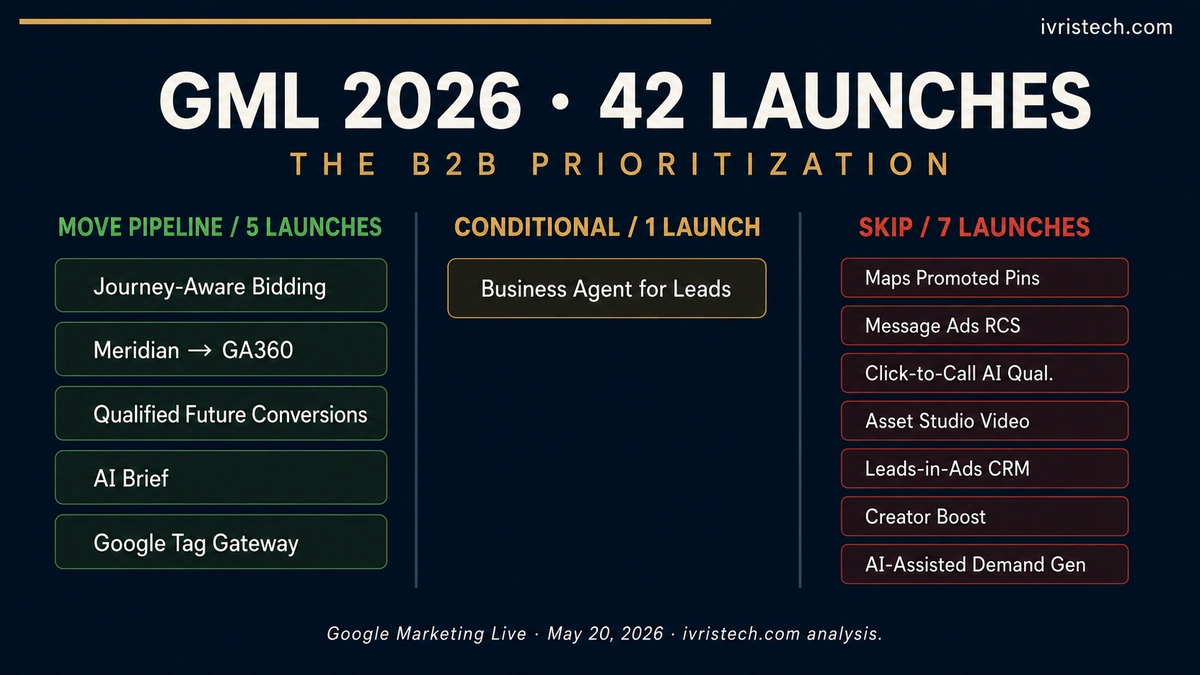
That framing is correct for the consumer-leaning verticals Google demoed (education, automotive, real estate, finance). For B2B teams running long-cycle pipelines through Salesforce or HubSpot, the 42-launch document reads differently. Most coverage so far has treated it as a flat list of new features. The list is not flat. Five launches move B2B pipeline immediately, seven are safely skippable if your team does not already have offline conversion data piped to Google, and the remaining cohort is conditional on the campaign types you already run. This piece is the B2B-only prioritization framework the SERP currently does not have.
Key Takeaways
- GML 2026 (May 20, 2026) shipped 42 lead-gen launches. PPC Land’s consolidated list is the most complete public summary; Ginny Marvin’s business.google.com guide is the official source.
- Move-pipeline 5: Journey-Aware Bidding (JAB), Meridian inside Google Analytics 360, Qualified Future Conversions, AI Brief, Google Tag Gateway. All five close measurement or signal gaps specific to long-cycle B2B.
- Skippable 7 for most B2B teams: Demand Gen → Google Maps Promoted Pins, Message Ads with RCS, Click-to-call AI qualification (unless you take inbound calls), Asset Studio multimodal video, Leads in Google Ads built-in CRM, Creator partnerships boost, AI-assisted campaign creation for Demand Gen.
- Conditional 1: Business Agent for Leads. Worth piloting only if your ICP is broad enough for a Gemini-grounded chat agent to qualify accurately, which usually means you are not enterprise B2B SaaS with twelve-plus firmographic qualification signals.
- Prerequisite for the move-pipeline 5 to actually work: clean offline-conversion uploads from your CRM via Data Manager API, closed-won feedback into Smart Bidding, and a Meridian-ready data structure in GA360. Without those three, JAB optimizes against form fills, not revenue.
The Move-Pipeline 5
The features below are the ones that change B2B paid-search outcomes in the next two quarters if your team has the data infrastructure to feed them.
Journey-Aware Bidding (JAB). JAB lets advertisers share the full lead-to-sale journey with Google Ads bidding, so the system learns from every goal along the path rather than only the final conversion event. For B2B, this is the single most consequential bidding change Google has shipped. The structural problem JAB fixes: B2B buyers cross MQL, SQL, Opportunity, and Closed-Won states across 272 days on average, and Google’s bidding has historically optimized against whichever conversion event fires first (usually the form fill at MQL). JAB inverts that, weighting bid decisions by which initial clicks actually produced downstream pipeline value. The result for accounts with offline conversion data wired correctly: bidding flows budget toward the keyword-and-creative combinations that produce revenue, not the ones that produce the most form fills. Without offline conversion uploads, JAB is just another bidding strategy.
Meridian inside Google Analytics 360. Meridian (Google’s open-source Marketing Mix Model) is now natively integrated into GA360, removing the separate data-science workflow that previously gated MMM adoption to enterprise teams with in-house analysts. For B2B teams running across LinkedIn, Google Ads, Microsoft Ads, and webinar/event channels, Meridian is the cross-channel modeling layer, while causal experiments supply stronger evidence about what changed the outcome. Google’s September update makes that split explicit: Data Strength Uplift measures recovered conversion signal, while Meridian GeoX provides the causal geo-experiment layer. The integration unifies Google Ads, Meta, and TikTok with first-party data from Snowflake, Oracle, and BigQuery in a few clicks. GrowthLoop’s 2026 finding that 77% of A/B-test winners fail when scaled to a global metric is the exact gap Meridian-in-GA360 closes from the measurement side. Google paired it with a second measurement upgrade at the same event: AI Performance Insights, which adds a Share-of-Voice metric for AI answers inside Merchant Center, extending GML’s measurement theme from channel mix to AI visibility.
Qualified Future Conversions. Google now analyzes follow-up searches, video views, and site visits to predict downstream conversion intent up to six months in advance. For B2B, the six-month prediction window matters because it maps roughly to the SQL-to-Closed-Won segment of the buyer journey. Smart Bidding optimizing on Qualified Future Conversions effectively chases buyers whose behavioral patterns predict pipeline contribution, not just buyers ready to submit a form today. The signal is most valuable for B2B teams whose sales cycles run 90 to 270 days, which is most of mid-market and enterprise SaaS, financial services, professional services, and complex manufacturing.
AI Brief. AI Brief lets advertisers steer AI Max campaigns using natural-language messaging guidelines, matching guidelines, and audience guidelines. For regulated B2B verticals (financial services, healthcare, insurance, regulated SaaS), AI Brief is the feature that finally makes AI-generated ad copy legally defensible. The previous tradeoff was: use AI Max for query expansion and accept the risk that auto-generated headlines violate compliance constraints, or stay on manual keyword campaigns and miss the long-tail volume. AI Brief removes the tradeoff. The brand-side compliance team writes the constraints once; every auto-generated ad variant inherits them.
Google Tag Gateway. Server-side conversion routing with confidential computing built in by default. Upgrading requires no changes to existing site code. For B2B teams with SOC 2 or ISO 27001 compliance posture, server-side measurement reduces the data-handling footprint that auditors flag in penetration tests every year. The performance side is incremental, the compliance-side savings can be material.
The Skip-If-You-Are-B2B 7
The features below are the ones B2B teams should not prioritize this quarter. Some are consumer-leaning by design. Others duplicate infrastructure most B2B teams already have.
Demand Gen expanded to Google Maps (Promoted Pins). Promoted Pins target users mid-navigation or during place discovery. B2B does not have a “navigating to your office” moment in the buyer journey. The exception is local B2B services (commercial contractors, regional accounting firms, B2B equipment dealers with showrooms), where the Map placement matters. For SaaS, professional services, and product B2B, this is a feature for the next vertical’s playbook, not yours.
Message Ads with RCS for Business. Click-to-message ads with rich messaging through iOS and Android. B2B buyers do not text vendors during the evaluation phase. They schedule, attend a demo, and submit a procurement form. The format is consumer-pattern. That assessment predates a separate August 27 change: Google is now testing messaging-app conversations from Demand Gen ads on YouTube. The new test is not RCS Message Ads, and Google has not documented its conversation-to-CRM attribution handoff.
Click-to-call with AI qualification. Useful only if your B2B team takes meaningful inbound sales call volume. Most B2B SaaS routes prospects through a form-first motion (demo request → SDR qualification → AE call), in which case the inbound call surface is small. The feature is real but the use case is narrow.
Asset Studio multimodal video (Veo, Nano Banana). Video volume is rarely the bottleneck for B2B paid media. The bottleneck is video quality for the vertical (a thoughtful 30-second case study video out-performs ten Gemini-generated variants in most B2B accounts). Investing setup time here pays back only if your team already has a YouTube-Ads bottleneck on variant production, which most B2B teams do not.
Leads in Google Ads (built-in CRM). A lightweight central place to manage Google-hosted form leads. Most B2B teams already have HubSpot, Salesforce, or Pipedrive doing this job, and the value of a Google-only mini-CRM is negative if it creates a second source of truth your sales team has to reconcile against the primary CRM. SMB B2B with no CRM at all should look at it; everyone else should ignore it.
Creator partnerships boost / creator videos in asset picker. B2C-skewed feature. The Experian case study Google highlighted (3x watch time, 2x interaction, 33% conversion lift on YouTube Shorts) is a consumer-credit-product use case. B2B SaaS creator partnerships exist but they are LinkedIn-creator-driven, not YouTube-Shorts-driven, and the Google ad surface is not yet where that motion lives.
AI-assisted campaign creation for Demand Gen (auto-populate from PMax). A speed feature for advertisers who already have winning PMax campaigns and want to replicate the structure into Demand Gen. For B2B teams not running PMax (which is most B2B SaaS, because PMax’s multi-channel auto-distribution rarely matches the LinkedIn-and-Search-focused B2B paid stack), there is nothing to auto-populate from.
The Conditional Launch: Business Agent for Leads
Business Agent for Leads is the GML headline format, and it deserves its own evaluation. The feature embeds a Gemini-powered chat agent inside Search ads, replacing the static lead form with a conversational interface that qualifies prospects before the form fires. For B2B teams whose ICP qualifies on three or four broad signals (job role, industry, company size, intent), the agent can plausibly handle qualification. For B2B SaaS ICPs that qualify on twelve-plus signals (role, industry, company size, tech stack, deal-trigger, region, compliance posture, integration requirements), the agent’s website-grounded model will struggle to infer all of them during free-text chat. The Gartner finding that B2B buyers use seven information sources per purchase describes the same multi-signal complexity from the buyer side: a Gemini-grounded chat agent represents one of those seven, not the whole funnel.
Our read: pilot Business Agent for Leads only after you have validated that your closed-won leads can be retroactively qualified by chat conversation alone. If a sample of past closed-won contacts could not have been classified correctly from a 30-second chat exchange against your website, the agent will produce false-negatives (qualified buyers turned away) at a rate that wipes out the false-positive savings.
The Prerequisite Most Teams Miss
The move-pipeline 5 only deliver pipeline gains if three pieces of underlying infrastructure are already in place. Without them, the launches produce optimization theater rather than revenue gains.
Offline conversion uploads from your CRM via Data Manager API. Smart Bidding cannot optimize on revenue if it never sees closed-won data. Most B2B accounts have offline conversion imports configured but broken: the tracking pixel was disconnected during a CRM upgrade six months ago, or the closed-won push from Salesforce stopped firing when an admin renamed a stage. Audit before assuming this works.
Closed-won feedback into Smart Bidding. Not just the offline conversion event, but the revenue value attached to it. Bidding without revenue values optimizes against count, not value. Gartner’s 2026 CMO Spend Survey found that only 30% of CMOs have the process maturity to scale AI investments despite 70% naming AI leadership a critical 2026 goal. The Smart Bidding/revenue feedback gap is exactly the kind of infrastructure shortfall the readiness data captures.
A Meridian-ready data structure in GA360. Meridian needs first-party data from Snowflake, Oracle, BigQuery, or comparable warehouse layers to produce MMM results that actually reflect B2B reality. GA360 alone will not generate useful MMM for accounts whose pipeline lives in Salesforce and whose attribution requires offline-conversion stitching across channels. The May 2026 Google Core Update arrived on the same day as GML 2026, and the combination signal matters: organic SEO is being compressed at the same moment paid measurement is being upgraded, which means the B2B teams that win the next two quarters will be the ones who pair organic-content discipline with paid-measurement discipline rather than picking one.
What to Do in the Next 30 Days
The audit framework below is the order in which a B2B paid-media lead should approach GML 2026.
Week 1, audit your offline conversion pipeline. Pull your Google Ads conversion diagnostics report. Confirm every B2B lead conversion action shows green status. If any show red or orange, fix before applying any GML launch. Without this, JAB, Qualified Future Conversions, and Meridian all produce noise.
Week 2, decide your AI Max posture. The move-pipeline 5 (especially Business Agent for Leads and Smart Bidding Exploration) require AI Max for Search or PMax. Dynamic Search Ads are no longer part of the September 2026 auto-migration; Google moved forced DSA migration to February 2027. September’s AI Max migration instead covers campaign-level Broad Match and standalone ACA, so plan DSA testing separately rather than treating the change as an immediate deadline. The same AI Max gating applies to Ads in AI Mode, which is going to be the dominant Google search surface for B2B research queries by Q4 2026.
Week 3, write your AI Brief. If your B2B account runs in a regulated vertical (financial services, healthcare, insurance, regulated SaaS, B2B with compliance constraints), write the messaging guidelines, matching guidelines, and audience guidelines now. Get legal review on the constraints document. Apply across all AI Max campaigns when you migrate.
Week 4, pilot one move-pipeline launch end-to-end. Pick Journey-Aware Bidding on your highest-spend B2B lead-gen campaign. Run with the existing AI Max campaign for 30 days. Compare CPL and revenue per closed-won lead against the pre-JAB baseline. Do not pilot all five launches simultaneously; the measurement signal needs single-variable isolation to be useful.
Frequently Asked Questions
Google Marketing Live 2026 took place May 20, 2026, livestreamed from Google’s Bay View campus in Mountain View to more than 100 countries. Google announced 42 lead-generation-focused launches across conversational ad formats, bidding tools, creative capabilities, brand controls, Demand Gen expansion, and measurement infrastructure. Ginny Marvin (Ads Product Liaison) published the consolidated launch document on business.google.com on May 21.
Five: Journey-Aware Bidding (full lead-to-sale journey shared with bidding), Meridian inside Google Analytics 360 (open-source MMM natively integrated), Qualified Future Conversions (6-month prediction windows aligned to B2B sales cycles), AI Brief (natural-language compliance guardrails for AI Max), and Google Tag Gateway (server-side conversion routing with confidential computing). All five require clean offline-conversion uploads to deliver pipeline gains.
Seven: Demand Gen → Google Maps Promoted Pins (B2B has no navigation moment), Message Ads with RCS (consumer-pattern), Click-to-call AI qualification (only useful if you take inbound sales call volume), Asset Studio multimodal video (video volume rarely the B2B bottleneck), Leads in Google Ads built-in CRM (duplicates HubSpot/Salesforce), Creator partnerships boost (B2C-skewed), and AI-assisted Demand Gen campaign creation from PMax templates (most B2B teams do not run PMax).
Conditional. Business Agent for Leads embeds a Gemini chat agent inside Search ads to qualify prospects before the form fires. The format suits ICPs that qualify on three or four broad signals (job role, industry, company size, intent). B2B SaaS ICPs that qualify on twelve-plus signals (role, industry, company size, tech stack, deal-trigger, region, compliance posture, integration requirements) will see false-negative rates that may wipe out the false-positive savings. Validate by retroactively classifying recent closed-won leads from chat-only data before piloting.
Three pieces: offline conversion uploads from your CRM via Data Manager API (not just the lead event but closed-won revenue), revenue values attached to those conversions so Smart Bidding optimizes on value rather than count, and a Meridian-ready data structure in GA360 that pulls first-party data from Snowflake, Oracle, or BigQuery. Without all three, Journey-Aware Bidding, Qualified Future Conversions, and Meridian-in-GA360 produce optimization theater rather than measurable pipeline gain.