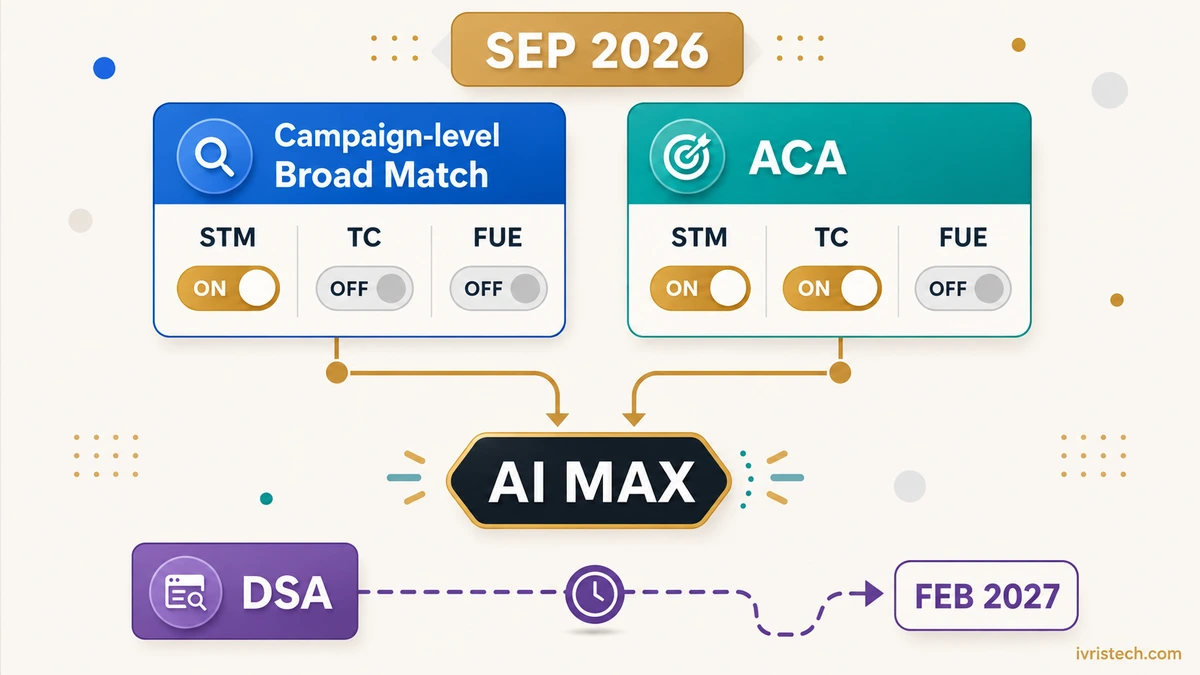
Google Ads began automatically upgrading some Search campaigns to AI Max on September 1, 2026, but the migration is narrower than the phrase “AI Max migration” suggests. According to Google’s August 12 migration notice, the September 1–30 rollout covers campaigns using the legacy campaign-level Broad Match setting or standalone Automatically Created Assets (ACA).
The defaults depend on which legacy setting triggered the move. Campaign-level Broad Match migrates with Search Term Matching on, while Text Customization and Final URL Expansion stay off. Standalone ACA migrates with Search Term Matching and Text Customization on, but Final URL Expansion still stays off. Existing brand inclusions and exclusions are preserved for the campaign-level Broad Match cohort.
For B2B paid-media teams, that makes September primarily a query-matching and control change, not an automatic landing-page expansion event. In our B2B Google Ads operating guide, broad-match expansion already requires active search-term monitoring and negative-keyword guardrails. The migration adds another reason to compare query quality before and after the account changes.
Direct answer — what is actually migrating to Google Ads AI Max in September 2026?
Google is automatically moving eligible Search campaigns that use campaign-level Broad Match or standalone ACA into AI Max during September 1–30, 2026. Campaign-level Broad Match gets Search Term Matching only; ACA gets Search Term Matching plus Text Customization. Final URL Expansion stays off in both migration paths. Dynamic Search Ads are excluded until February 2027.
Key Takeaways
- The September 1–30 migration covers campaign-level Broad Match and standalone ACA, not every Search campaign using broad-match keywords.
- Campaign-level Broad Match moves with Search Term Matching on; Text Customization and Final URL Expansion stay off.
- Standalone ACA moves with Search Term Matching and Text Customization on; Final URL Expansion still stays off.
- Dynamic Search Ads continue serving normally in September; Google schedules their automatic migration for February 1–28, 2027.
What Google Is Migrating in September 2026
Google split the transition into two phases. Phase one is the September migration of campaign-level Broad Match and ACA. Phase two is DSA in February 2027. That distinction matters because ordinary broad-match keywords do not, by themselves, place a campaign in the September cohort. Google’s campaign-level Broad Match setting is a separate legacy control that made every keyword in a Search campaign broad match.
The migrated configuration is deliberately not the same as manually turning on the full AI Max suite today. Google’s normal AI Max setup enables Text Customization and Final URL Expansion by default, but the automatic migration maps legacy settings into narrower equivalents. Final URL Expansion is off for both September cohorts.
That difference also makes Google’s full-suite performance claims a poor benchmark for the migration itself. A campaign receiving only Search Term Matching is not running the same feature bundle as one using Search Term Matching, Text Customization and Final URL Expansion together.
The Hidden Change Is Query Eligibility, Especially for ACA
ACA used to be understood mainly as a creative setting. After migration, an ACA campaign also gets Search Term Matching. Google says that feature can use broad-match and keywordless technology informed by keywords, creatives and URLs to find additional relevant searches. For B2B accounts with narrow ICPs, the first audit question is therefore not “Did Google change my landing page?” It is “Did my search-term mix change?”
The campaign-level Broad Match cohort has a second control issue. Google’s current Help documentation says that when a campaign moves from the legacy setting to AI Max, broad keywords are no longer treated like exact-match keywords for prioritization. Teams that depended on that legacy prioritization can add exact-match copies where preserving it matters; teams that prefer standard AI Max prioritization need no action.
Our read: snapshot search terms, conversion quality and brand controls before treating any September performance movement as an AI Max win or loss. If the campaign changed query eligibility at the same time your CRM conversion imports, bids or landing pages changed, the result becomes much harder to interpret.
Dynamic Search Ads Are Not Migrating This Month
DSA is the easiest part of this story to get wrong because Google originally planned the automatic DSA transition for September. On June 11, Google moved that automigration to February 2027 and restored DSA creation so advertisers would have more time for side-by-side testing and voluntary migration.
Google’s August migration notice is more specific: active legacy DSA campaigns are excluded from September and continue serving normally. During September, Google is instead showing pre-migration banners that encourage a voluntary one-click upgrade. An official reminder is scheduled for January 15, 2027, followed by automatic migration from February 1 through February 28.
That means a September DSA banner is a warning or voluntary-upgrade prompt, not evidence that Google has already forced that DSA campaign into AI Max.
What B2B Paid-Media Teams Should Do Now
- Identify the actual migration cohort. Separate campaigns using the legacy campaign-level Broad Match setting or standalone ACA from campaigns that simply contain individual broad-match keywords.
- Record the migrated defaults. Check Search Term Matching, Text Customization, Final URL Expansion and brand controls rather than assuming the full AI Max suite was enabled.
- Audit ACA search terms. ACA migrations add Search Term Matching, so review query quality, negative keywords and downstream SQL or pipeline quality after the change.
- Review keyword prioritization. If the old campaign-level Broad Match prioritization mattered to your account structure, decide whether exact-match copies are needed under AI Max.
- Keep DSA on its own timeline. Use the extended period for a controlled comparison if you want to migrate early; do not treat February’s forced DSA change as part of September’s rollout.
Frequently Asked Questions
Google is automatically migrating Search campaigns that use the legacy campaign-level Broad Match setting or standalone Automatically Created Assets during September 1–30, 2026. Individual broad-match keywords do not by themselves trigger this migration. The job rolls out progressively through the month rather than switching every eligible campaign on one day.
No. Google’s migration matrix says Final URL Expansion remains off for both September paths. Campaign-level Broad Match gets Search Term Matching on with Text Customization off. Standalone ACA gets Search Term Matching and Text Customization on. Advertisers can later change AI Max settings, but those are not the automatic migration defaults.
No. Google postponed the automatic DSA migration from September 2026 to February 2027. Active legacy DSA campaigns continue serving normally during September. Google is using in-account banners to encourage voluntary upgrades now, with an official reminder planned for January 15 and automigration scheduled for February 1–28, 2027.
Not by itself. The September cohort includes campaigns using Google’s legacy campaign-level Broad Match setting, which applied broad match across the campaign. A Search campaign can contain individual broad-match keywords without using that setting. Teams should check the campaign’s legacy configuration rather than infer migration status from keyword match types alone.