The Federal Trade Commission and 22 states sued Amazon on August 31, alleging that the company secretly changed how prices were set in its advertising auctions while advertisers continued to understand the system as a generalized second-price auction. The case is pending, and Amazon disputes the allegations.
The complaint says the alleged pricing system affected approximately 1.2 million U.S. advertising customers, including more than 500,000 small and medium-sized businesses, and likely extracted more than $20 billion. For Sponsored Products, an internal operating plan cited in the complaint put Amazon’s 2024 “first price rate” at 79.1%.
For paid-media teams, the important question is not simply whether Amazon CPCs or ROAS looked acceptable. When we covered Amazon’s Q2 advertising growth, the decision was whether platform scale justified more budget. This lawsuit adds a more basic control question: can an advertiser explain what actually set the price of a click?
Direct answer — what does the FTC allege changed Amazon advertisers’ CPCs?
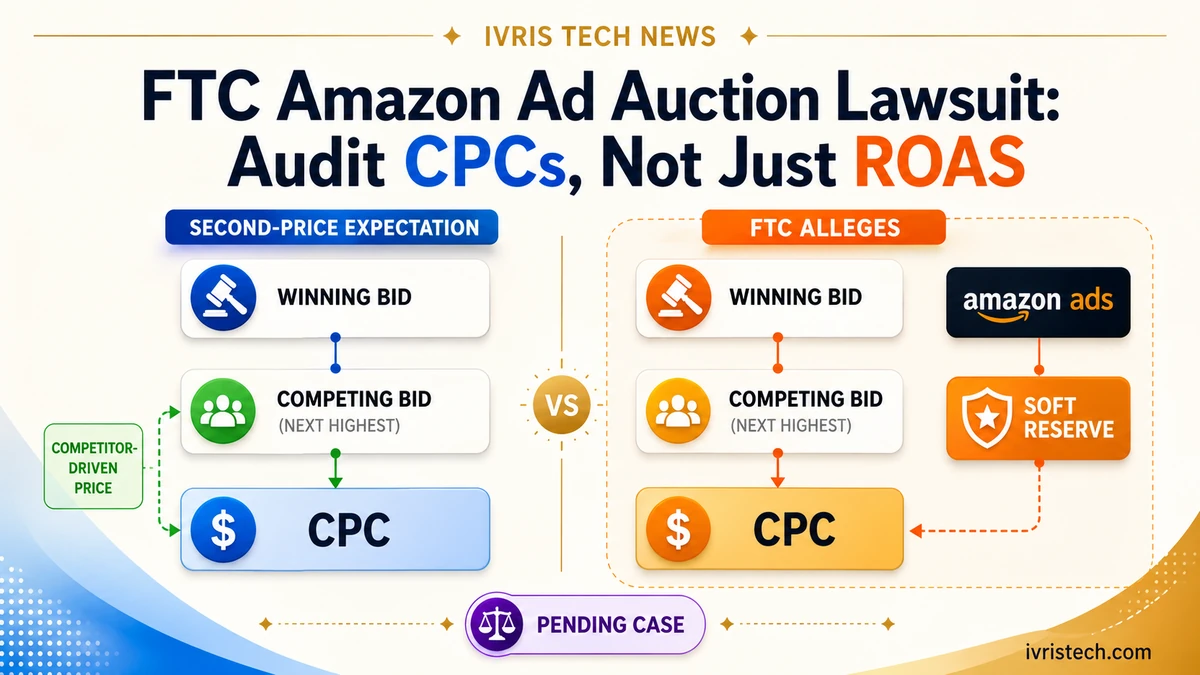
The FTC alleges advertisers expected a generalized second-price auction in which competition largely determined the winning CPC, but Amazon added an undisclosed soft-reserve price that could replace the auction result with a higher Amazon-calculated price. Amazon disputes that advertisers were harmed and says reserve pricing reflects placement value, advertisers never pay above their bids, and its relevance-based system improved performance.
Key Takeaways
- The FTC and 22 states filed the case on August 31, 2026; it remains pending, so the pricing claims are allegations rather than court findings.
- The complaint says approximately 1.2 million U.S. advertisers were affected, including more than 500,000 small and medium-sized businesses.
- An internal Amazon plan cited by the complaint put the Sponsored Products first-price rate at 79.1% in 2024.
- Amazon says inflation-adjusted Sponsored Products CPCs were flat from 2019 through 2024 and argues its relevance-based auction improved advertiser outcomes.
What Advertisers Thought Set Their CPC
Amazon had described its ads as using a form of generalized second-price auction. Advertisers submit a maximum bid, ads are ranked using bid and relevance, and the winner generally expects to pay only enough to beat the next-ranked competitor rather than automatically paying the full maximum bid.
That expectation affects bidding. The FTC’s 181-page complaint alleges Amazon knew advertisers could bid closer to their true ceiling because they believed competitive pressure would usually determine the final CPC. It also alleges some advertisers would bid lower if they knew how often the price approached their own bid.
What the FTC Alleges Amazon Added After the Auction
The FTC alleges that beginning in 2019 Amazon used an undisclosed “soft reserve” in Sponsored Products auctions. The complaint describes a system in which Amazon could calculate a proxy price for an ad placement and use that amount instead of the lower generalized second-price result, pushing the CPC closer to the advertiser’s own bid even when another advertiser did not require the higher price.
The complaint says Sponsored Products advertisers paid their own bid 30% to 40% of the time in 2021, 70% in 2022, and 79.1% in 2024. Those figures are allegations drawn from Amazon records cited by the plaintiffs, not findings accepted by a court.
Amazon’s response rejects the FTC’s harm theory. The company says a soft reserve estimates the market value of an individual placement, no advertiser pays above its maximum bid, and relevance is deliberately weighted alongside bid. Amazon says roughly 92% of selected Sponsored Products ads in 2024 were not the highest bid.
Why ROAS Does Not Resolve the Transparency Question
Amazon says average Sponsored Products CPC was flat after inflation from 2019 through 2024, conversion rates rose 24% from 2021 through 2025, average winning bids fell 50% from 2019 to 2025, and its relevance-based system saved advertisers more than $8 billion from 2021 through 2025.
Those numbers address advertiser outcomes. The FTC’s allegation addresses price formation and disclosure: whether an advertiser would have submitted the same maximum bid if it understood that an Amazon-calculated reserve, rather than the next competitive bidder, could determine the CPC.
Our read: CPC and ROAS can be reported accurately while the price-setting path remains opaque. CPC shows what was charged; ROAS shows what came back. Neither metric, by itself, proves which auction input caused that exact price to clear. That makes advertiser trust here a measurement-governance issue as much as a legal one.
What Paid-Media Teams Should Audit Now
- Separate performance from pricing evidence. Good CPC, conversion or ROAS results do not prove that auction mechanics were fully disclosed or independently auditable.
- Preserve bid and CPC history. Retain bids, dynamic-bidding settings, placements, CPCs, spend and major configuration changes. Account data cannot reconstruct a hidden reserve, but it preserves the record if new disclosure rules emerge.
- Track CPC against the effective bid. Monitor how often CPC approaches the bid and segment the pattern around major shopping periods. Treat shifts as a prompt for investigation, not proof of a specific mechanism.
- Document auction-rule changes. Keep dated copies of platform guidance and record when reserve pricing, bid adjustment or ranking documentation changes.
- Add price formation to vendor governance. Ask what variables can set the final price, which are platform-controlled, what appears in reporting, and what cannot be independently verified.
The FTC’s case page lists the matter as pending, with no court finding that Amazon unlawfully overcharged advertisers. The practical takeaway is narrower: performance dashboards are necessary, but they are not a substitute for knowing how the platform formed the price those dashboards measure.
Frequently Asked Questions
The FTC and 22 states allege Amazon represented its advertising system as a generalized second-price auction while using undisclosed soft-reserve pricing that could lift the winning CPC above the competitive auction result. Amazon disputes the claim that advertisers were deceived or harmed. The case remains pending.
The complaint says approximately 1.2 million U.S. advertising customers were affected. The FTC separately says the group includes more than 500,000 small and medium-sized businesses. Those figures describe the plaintiffs’ allegations and do not represent a final court determination of who was harmed.
No. The dispute is not that Amazon charged above the submitted maximum. The FTC argues advertisers may have chosen different maximum bids if they understood how reserve pricing could set the final CPC. Amazon says advertisers bid based on observed performance and that no advertiser pays more than its bid.
Not reliably from ordinary outcome data alone. Advertisers can preserve bids, CPCs, placements and performance history, but those records do not necessarily reveal every platform-controlled input that formed a specific auction price. That is why the disclosure question cannot be resolved simply by looking at CPC or ROAS trends.