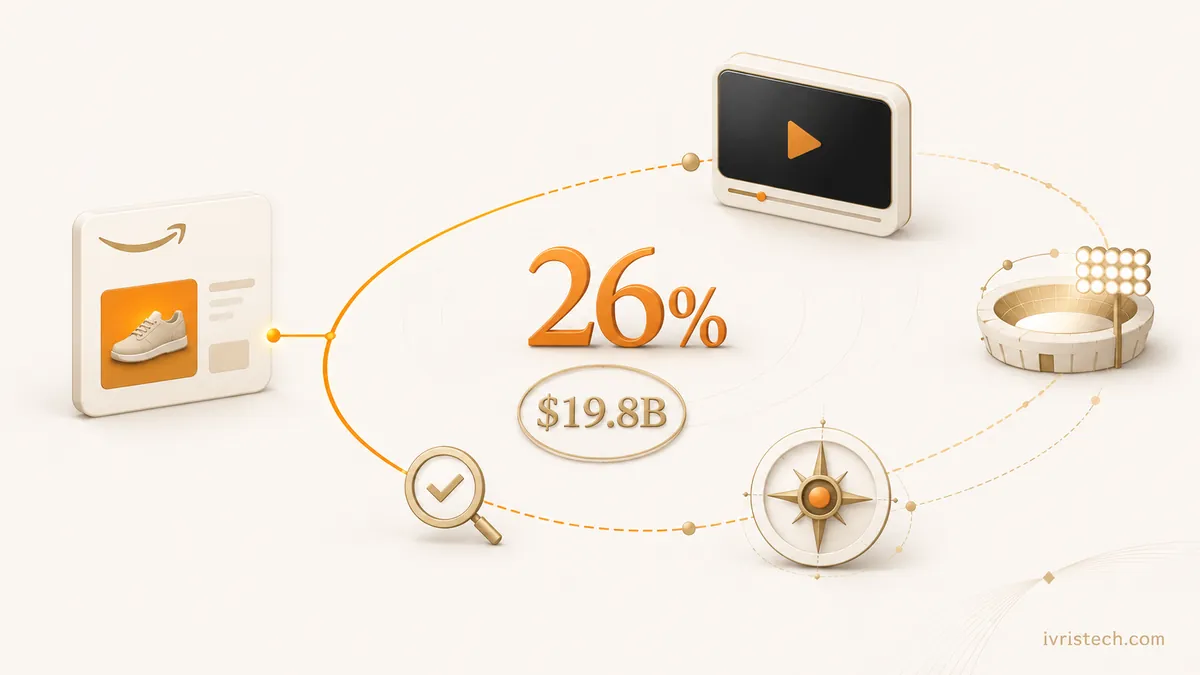
Amazon’s advertising services revenue reached $19.809 billion in the second quarter of 2026, up 26% from $15.694 billion a year earlier, according to Amazon’s July 30 earnings release. The result lifted growth excluding foreign-exchange effects above the 22% rate Amazon reported in each of the previous four quarters.
Adding Q1’s $17.243 billion puts Amazon advertising revenue 2026 at $37.052 billion for the first six months. The four most recent disclosed quarters total $76.072 billion.
The growth is not a pure retail-media number. Amazon defines the line as sponsored ads, display, and video advertising sold to sellers, vendors, publishers, authors, and others. For B2B paid-media teams, the 26% result is a demand signal, much like LinkedIn’s latest platform-revenue growth, but it is not evidence that an individual advertiser should move budget.
Direct answer — how much Amazon advertising revenue has been reported in 2026?
Amazon advertising revenue 2026 reached $37.052 billion in the first half, including $19.809 billion in Q2, up 26% year over year. The Q2 line covers sponsored ads, display, and video advertising, so it is broader than marketplace retail media alone. Amazon cited Sponsored Products, streaming, conversational shopping, and AI tools, but did not disclose ad profit or advertiser-level ROI.
Key Takeaways
- Amazon Advertising Services generated $19.809 billion in Q2 2026, up $4.115 billion and 26% from Q2 2025.
- H1 2026 advertising revenue totaled $37.052 billion; the trailing four-quarter total reached $76.072 billion.
- The reporting line includes sponsored ads, display, and video advertising, not retail-media placements alone.
- Amazon said Sponsored Products remained its largest offering while live sports, conversational shopping, and Ads Agent expanded inventory and automation.
- Platform growth should trigger a channel audit, not an automatic budget increase; advertiser-side incrementality remains the test.
What Amazon Actually Reported in Q2 2026
Amazon’s supplemental financial data shows Advertising Services rising from $15.694 billion in Q2 2025 to $19.809 billion in Q2 2026. The $4.115 billion year-over-year increase was accompanied by 26% growth both as reported and excluding foreign-exchange effects. Q1 2026 revenue was $17.243 billion, up 22%.
Advertising represented about 9.9% of Amazon’s $200.606 billion in quarterly net sales. That makes it a large revenue line, but not a standalone reporting segment. The release provides no advertising operating income, margin, seller-versus-brand split, or breakdown by sponsored search, display, streaming, and sports.
That boundary matters for marketers. A platform can grow because more advertisers are bidding, more inventory is available, or pricing is rising while an individual account becomes less efficient. Teams should compare the headline with the pipeline and efficiency metrics that justify their own spend, not treat Amazon’s revenue growth as an advertiser benchmark. That budget test now also needs a price-formation check: the FTC’s Amazon ad auction lawsuit alleges that an undisclosed reserve could raise CPCs above the competitive second-price result.
Why the $19.8B Line Is Broader Than Retail Media
Retail media is central to Amazon’s advantage because sponsored placements sit close to product discovery and purchase. Yet the official definition also includes display and video. The distinction mirrors the different jobs explained in PPC versus display advertising: one captures active demand, while the other can build reach, retarget audiences, or support longer buying cycles.
Sponsored Products remains Amazon’s largest advertising offering and a key growth driver, according to the company. But Prime Video ads, live-sports inventory, and other video placements also sit inside the same revenue line. Without a product-level split, the earnings release cannot show how much of the 26% increase came from marketplace retail media versus streaming or other formats.
Our recent reporting on the measurement gap in in-store retail media applies here as well. Amazon can connect advertising exposure with shopping behavior more directly than many publishers, but attribution is not the same as incrementality. A sale after an ad does not prove the ad caused the sale.
How Sponsored Products, Sports and AI Are Expanding Inventory
In a separate Q2 explanation of Amazon Ads growth, Amazon said shoppers who clicked a Sponsored Prompt converted to a sale 48% more often and spent 21% more on average than shoppers who did not. Those are company-reported comparisons between clickers and non-clickers, not a disclosed randomized test, so they should not be read as causal lift.
Amazon also said inventory sold out across Thursday Night Football, the NBA, WNBA, and NASCAR, and that it brought more than 30 new advertisers to the NBA in its first year. That expands Amazon’s reach beyond shopping pages into premium video inventory.
Ads Agent adds an automation layer. Amazon reported that advertisers using its targeting saw 8% lower cost per impression and 6% lower cost per acquisition, and said the tool expanded to 11 new countries in 2026. The figures support a controlled pilot, but advertisers still need to verify lead quality, downstream revenue, and whether the result holds outside Amazon’s reported cohort.
What B2B Paid-Media Teams Should Do Now
- Separate the media jobs. Track marketplace sponsored ads, display or DSP activity, and streaming video as different budget lines with different objectives, audiences, and measurement windows.
- Connect platform conversions to revenue. Apply the same discipline used in B2B Google Ads measurement: import qualified and closed-won outcomes, segment by campaign, and compare paid acquisition cost with margin or pipeline value.
- Test incrementality before scaling. Use holdouts, geographic tests, matched cohorts, or another stated counterfactual. Amazon-attributed sales are useful operational evidence, but they are not enough to establish incremental demand.
- Treat AI performance claims as a pilot hypothesis. Pre-register cost, quality, and revenue thresholds for Sponsored Prompts or Ads Agent, then scale only when the advertiser-side data reproduces the platform claim.
Our read: Amazon’s 26% growth shows the retail-media model expanding into a broader advertising platform. The hidden catch is that one reporting line now blends marketplace demand, video, sports, and AI-assisted placements while revealing little about advertiser profitability. Budget should follow measured incremental value, not Amazon’s growth rate.
Frequently Asked Questions
Amazon reported $19.809 billion in Advertising Services revenue for the quarter ended June 30, 2026. That was 26% above the $15.694 billion reported in Q2 2025, an increase of $4.115 billion. The figure includes sponsored ads, display, and video advertising.
Amazon reported $17.243 billion in Q1 and $19.809 billion in Q2, bringing first-half 2026 Advertising Services revenue to $37.052 billion. A full-year 2026 total is not available because Amazon had reported only the first two quarters when this article was published.
No. Retail-media placements such as Sponsored Products are important, but Amazon’s Advertising Services definition also covers display and video advertising sold to sellers, vendors, publishers, authors, and others. Prime Video and live-sports ads therefore sit within a line that is broader than marketplace retail media.
Amazon identified Sponsored Products as its largest offering and a key growth driver. It also highlighted Prime Video and sold-out live-sports inventory, Sponsored Prompts in conversational shopping, and Ads Agent automation. Amazon did not disclose how much revenue each product contributed to the 26% increase.