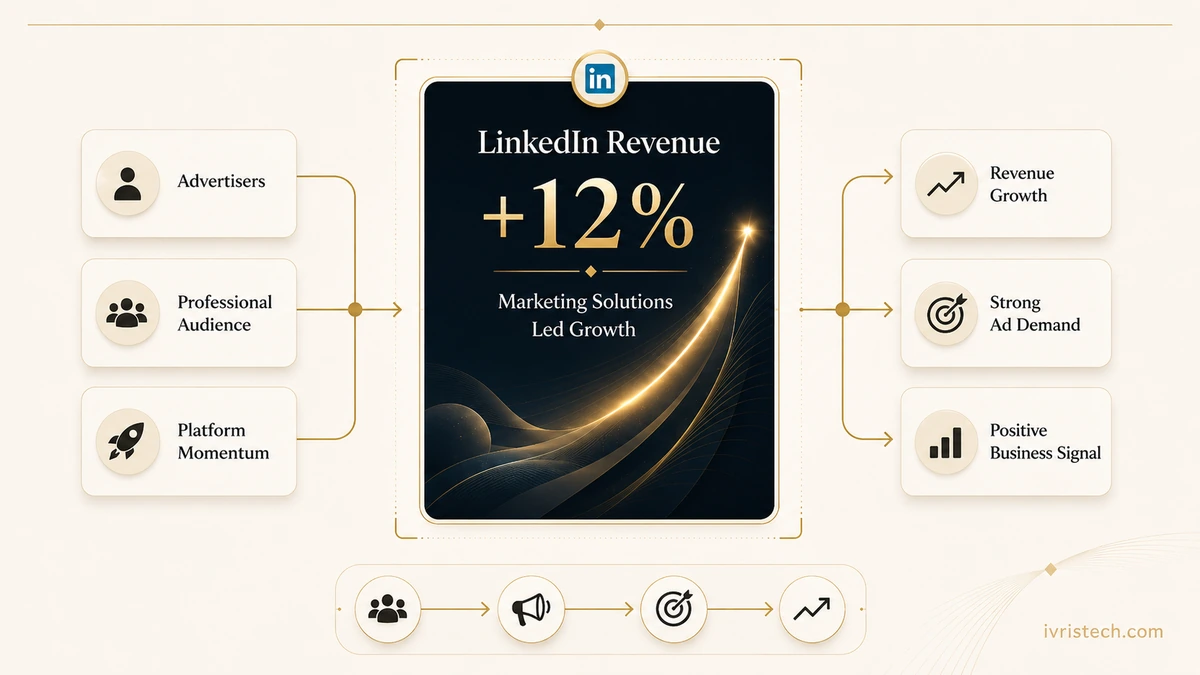
Microsoft’s latest LinkedIn revenue growth 2026 disclosure shows the professional network expanding at a double-digit rate. In its fiscal 2026 fourth-quarter results released July 29, Microsoft said LinkedIn revenue rose 12% year over year, or 10% in constant currency, for the three months ended June 30.
The more important detail came in Microsoft’s earnings call: LinkedIn’s increase was primarily driven by Marketing Solutions. That attribution points to advertising demand as the lead contributor, but Microsoft did not disclose a separate Marketing Solutions growth rate or revenue figure.
For B2B marketers, the result adds financial weight to LinkedIn’s push for more accountable advertising. When we covered LinkedIn’s “Cut the Bullspend” positioning, the platform was arguing that professional context should earn budget by producing business outcomes. That claim still depends on a coherent B2B marketing campaign strategy and account-level measurement. The latest quarter shows advertiser spending remained a source of growth, even though the result says nothing about whether any individual campaign generated incremental pipeline.
Direct answer – how fast did LinkedIn revenue grow in 2026?
LinkedIn revenue increased 12% year over year in Microsoft’s fiscal 2026 fourth quarter, or 10% in constant currency. Microsoft said the increase was primarily driven by Marketing Solutions. The 12% figure applies to total LinkedIn revenue, not Marketing Solutions alone, and Microsoft did not provide a separate advertising revenue amount.
Key Takeaways
- LinkedIn revenue rose 12% year over year in Microsoft’s FY26 Q4 and 10% in constant currency.
- The quarter ended June 30, 2026, and Microsoft reported the result on July 29.
- Microsoft said Marketing Solutions was the primary driver of LinkedIn’s revenue increase.
- The reported LinkedIn metric also includes Talent Solutions, Premium Subscriptions, and Sales Solutions.
- Microsoft did not disclose a separate Marketing Solutions growth rate or dollar amount.
What Microsoft Actually Reported
LinkedIn sits inside Microsoft’s Productivity and Business Processes segment, which generated $37.8 billion in quarterly revenue and grew 14% year over year. Within that segment, LinkedIn’s 12% reported growth outpaced the 10% constant-currency result by two percentage points, showing that foreign exchange helped the reported rate.
Microsoft’s investor metrics page defines LinkedIn revenue as income from Talent Solutions, Marketing Solutions, Premium Subscriptions, and Sales Solutions. That definition matters because the headline number is a platform-wide result. It is not a disclosed advertising-only growth rate. Starting in FY27, that combined definition is replaced: Microsoft’s Agents and Infra reporting change moves Talent Solutions and Sales Solutions into Industry solutions, while Marketing Solutions and Premium Subscriptions move into Search and advertising.
The clean reading is therefore narrow: total LinkedIn revenue grew 12%, and Marketing Solutions contributed more to that increase than LinkedIn’s other businesses. Any estimate of Marketing Solutions revenue, share, or standalone growth would go beyond what Microsoft reported.
Why Marketing Solutions Is the Important Part
Marketing Solutions covers the commercial side of LinkedIn that matters most to demand generation teams: paid media sold against the platform’s professional audience. When Microsoft names that business as the primary growth driver, it signals that advertiser demand was stronger than the contribution from LinkedIn’s recruiting, subscription, and sales products during the quarter.
That does not make LinkedIn an automatic budget winner. Channel allocation still depends on audience fit, cost per opportunity, sales-cycle contribution, and whether the campaign supports a coherent strategy. A rising platform revenue line can coexist with weak performance inside a poorly targeted account.
The result is more useful as a confidence signal for the channel than as a performance benchmark. Teams reviewing format mix can use current LinkedIn ad examples by format to test where Sponsored Content, Document Ads, Lead Gen Forms, and Thought Leader Ads fit, but the 12% figure should not be used to set CPC, CTR, or conversion targets.
The Hidden Catch in the 12% Figure
The first catch is currency. LinkedIn grew 12% as reported and 10% in constant currency, so roughly two percentage points of the reported increase came from exchange-rate movement rather than underlying business growth. The constant-currency figure is the cleaner measure for comparing operating momentum across periods.
The second catch is attribution. “Primarily driven by Marketing Solutions” identifies the leading contributor, not its exact size. It does not mean Marketing Solutions revenue itself grew 12%, and it does not establish what percentage of LinkedIn revenue came from advertising.
The third catch is measurement. Platform revenue reflects what advertisers paid LinkedIn; it does not prove those advertisers produced incremental revenue. The same distinction appears in our coverage of LinkedIn’s content-conversion research: influenced outcomes can look strong while still requiring exposed-versus-unexposed testing to establish lift.
What B2B Teams Should Do Now
- Do not reallocate budget from the headline alone. Use the result as evidence of platform momentum, then validate your own cost per opportunity, influenced pipeline, and closed-won revenue.
- Separate brand and demand objectives. Marketing Solutions growth can be led by multiple formats and buying goals. Evaluate awareness, engagement, lead capture, and pipeline campaigns on their own measurement windows.
- Audit execution before increasing spend. Review targeting, creative rotation, conversion tracking, and partner capability. The current landscape of LinkedIn Ads tools and agencies can help identify where internal gaps are operational rather than strategic.
- Watch the next disclosure. A second quarter of Marketing Solutions-led growth would strengthen the demand signal. A slowdown would show whether this was durable momentum or a quarter-specific mix effect.
Our read: the result is positive for LinkedIn’s advertising business, but it is not a permission slip for undisciplined spend. The useful takeaway is that professional-audience media remains commercially important to LinkedIn. B2B teams still have to prove that importance inside their own pipeline. Australia’s proposed policy now adds a regulatory question to that commercial one: the 2026 News Bargaining Incentive design removes the professional-networking exclusion, although the government has not established that LinkedIn exceeds the Australian digital-advertising threshold.
Frequently Asked Questions
LinkedIn revenue increased 12% year over year for the quarter ended June 30, 2026. On a constant-currency basis, growth was 10%. Microsoft reported the result on July 29 as part of its fiscal 2026 fourth-quarter earnings release. The figure covers all LinkedIn business lines, not advertising alone.
No. The 12% figure applies to total LinkedIn revenue. Microsoft said the increase was primarily driven by Marketing Solutions, but it did not disclose a separate Marketing Solutions growth rate or revenue amount for the quarter. The earnings call only identified it as the leading contributor.
Constant-currency growth removes the effect of exchange-rate changes by translating current and prior-period results at comparable rates. LinkedIn’s 10% constant-currency increase indicates underlying growth was two percentage points lower than the 12% reported figure. This comparison helps isolate operating performance from currency movements.
The result signals continued advertiser demand for LinkedIn’s professional audience, but it is not a campaign benchmark. B2B teams should compare the platform’s momentum with their own account-level exposure, cost per opportunity, influenced pipeline, and closed-won revenue before changing budgets.