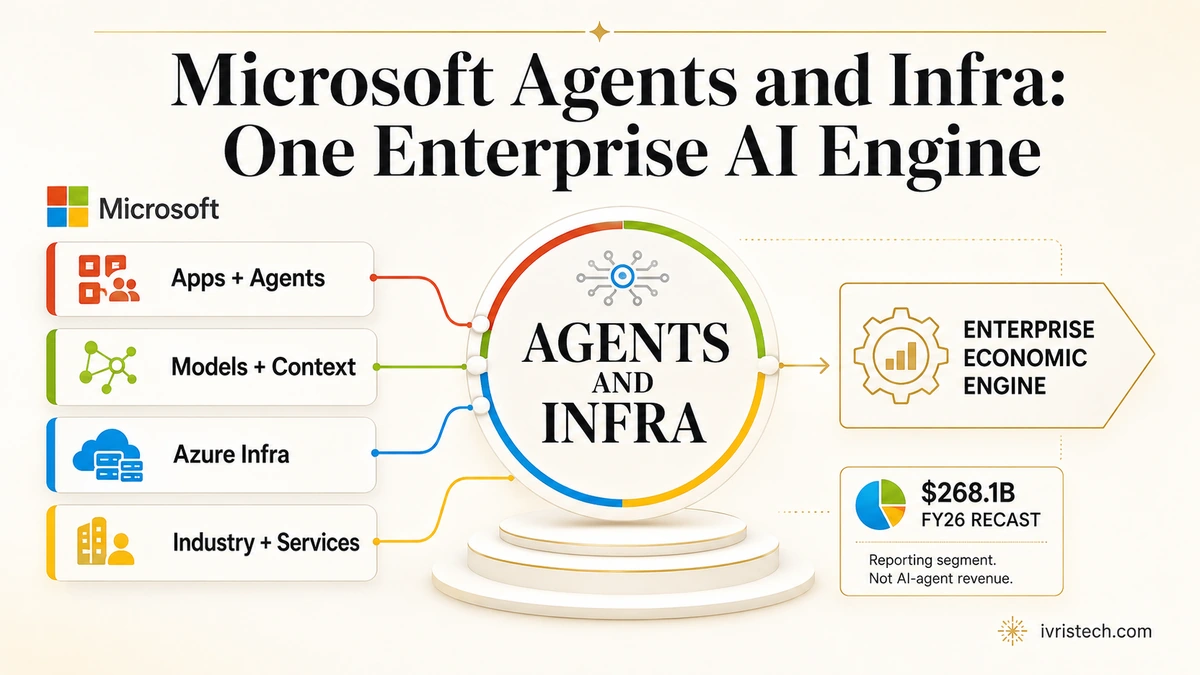
Microsoft is redrawing its financial map around AI. In a Form 8-K filed September 2, the company said fiscal 2027 reporting will replace its three segments with two: Agents and Infra and Devices and Consumer.
The scale is the first clue. In Microsoft’s recast fiscal 2026 presentation, Agents and Infra accounts for $268.1 billion of $331.8 billion in revenue, or about 81%. It combines Azure, Microsoft 365, GitHub-related products, productivity and server licensing, industry solutions, and enterprise support.
For B2B teams, the segment name matters less than the grouping. Microsoft is now managing agents, productivity software, developer tools, cloud infrastructure, business-process applications, licensing, and services as one economic engine. That shows how Microsoft wants to organize enterprise AI monetization. It does not show that agents generated $268.1 billion, that per-seat pricing is disappearing, or that customers have proved agent ROI.
Direct answer – what does Microsoft Agents and Infra mean?
Microsoft Agents and Infra is Microsoft’s new fiscal 2027 reporting segment for Azure, Microsoft 365, GitHub-related offerings, productivity and server licensing, industry solutions, and support. It shows Microsoft treating enterprise software, agents, models, and infrastructure as an integrated commercial stack. Microsoft does not, however, disclose standalone AI-agent revenue or establish one universal agent-pricing model.
Key Takeaways
- Microsoft will report two segments in FY27: Agents and Infra, and Devices and Consumer.
- Recast FY26 Agents and Infra revenue was $268.1 billion, about 81% of Microsoft’s $331.8 billion total.
- Azure becomes a narrower consumption-based platform and infrastructure metric after several businesses are reassigned.
- LinkedIn’s enterprise products and advertising products move into different reporting families.
- The filing reveals Microsoft’s management architecture, not standalone agent revenue or agent ROI.
What Microsoft Actually Moved Into Agents and Infra
Most enterprise-facing economics now sit inside Agents and Infra, while Windows, Xbox, search, and advertising sit inside Devices and Consumer. Azure is also being cleaned up: GitHub cloud and other developer cloud services plus Security Copilot move into Microsoft 365 commercial cloud, while Healthcare and Life Sciences cloud moves to Industry solutions. Microsoft says Azure therefore becomes more purely its consumption-based platform and infrastructure business.
Microsoft 365 commercial cloud becomes broader, adding the GitHub cloud/developer services and Security Copilot. Industry solutions combines Dynamics 365, LinkedIn Talent Solutions and Sales Solutions, and Healthcare and Life Sciences cloud. The labels are following workloads and commercial economics more closely than the old product boundaries.
LinkedIn makes the change tangible. In our FY26 Q4 LinkedIn reporting, Microsoft still treated Talent Solutions, Marketing Solutions, Premium Subscriptions, and Sales Solutions as one LinkedIn revenue metric. In FY27, that standalone growth metric disappears: Talent and Sales move to Industry solutions, while Marketing Solutions and Premium Subscriptions move to Search and advertising.
Why the New Segment Is a B2B Monetization Signal
Microsoft’s presentation explicitly links Microsoft 365 and GitHub apps and agents, models grounded in enterprise context, and Azure infrastructure as reinforcing layers of one stack. It says this architecture shapes customer engagement while “driving their outcomes, building products, and monetization.”
That matters because one enterprise job can generate revenue at several layers: user software, agent entitlements, Azure consumption, security and data services, implementation, or partner software. The reporting change does not merge those charges into one price. It shows Microsoft increasingly sees them as connected parts of one customer and resource-allocation system.
Microsoft’s current Marketplace documentation for AI apps and agents also allows SaaS-based agent offers to use entitlement pricing, including per-user or flat-rate plans, usage pricing, or combinations. That is ecosystem guidance, not Microsoft’s first-party pricing policy, but it undercuts any reading that the filing announces one universal consumption model.
Our read: Agents and Infra is a stronger signal about where Microsoft expects enterprise AI value to accrue than about how every AI product will be priced. The economic engine spans software and consumption; the filing does not say one replaces the other.
The Hidden Catch: This Is Not an AI Revenue Disclosure
The $268.1 billion figure is recast FY26 revenue for the whole segment, including mature Microsoft 365 businesses, Azure, licensing, industry applications, LinkedIn enterprise products, and support. Microsoft does not break out “agent revenue” inside it.
The same caution applies to pricing. The filing explicitly characterizes Azure as consumption-based, but it does not say Microsoft is abandoning seats or subscriptions elsewhere. That matters as buyers work through the broader AI subscription pricing reset: a financial-reporting reclassification is not a contract amendment.
Nor is it proof of customer economics. A segment can reveal management priorities without establishing productivity, payback, or ROI for an agent deployment. Those questions still have to be measured at the workflow level. Investors also gain cleaner Azure and product revenue lines, but the new structure still puts many mature businesses inside one reportable segment. Better revenue visibility is not a standalone AI P&L.
What B2B Teams Should Do Now
- Separate reporting signals from commercial terms. Use Agents and Infra to understand Microsoft’s strategy, then verify seat, usage, Azure, Marketplace, and services charges in your contracts.
- Track the layers independently. If an agent increases Azure consumption while changing licenses or services hours, measure each movement before declaring the deployment cheaper or more expensive.
- Preserve metric lineage. FY27 changes Azure, Microsoft 365 commercial cloud, Industry solutions, Search and advertising, and LinkedIn definitions. Compare growth rates only against restated definitions.
- Measure agents at the job level. AI-agent implementation in RevOps still needs workload-specific measures such as cycle time, data quality, human review, conversion impact, and total cost.
Microsoft’s restructuring makes its direction clearer: agents are being managed inside the same economic system as software and infrastructure. The discipline is to stop there. The filing supports an integrated-stack thesis; it does not yet support an agent-revenue thesis.
Frequently Asked Questions
Agents and Infra is one of Microsoft’s two reportable segments starting in fiscal 2027. It includes Azure, Microsoft 365 cloud, productivity and server licensing, Industry solutions, and Frontier and support services. Microsoft says the structure better reflects how it operates, allocates resources, builds products, and monetizes its enterprise stack.
Devices and Consumer includes Search and advertising, Xbox, and Windows OEM and devices. Search and advertising now also includes LinkedIn Marketing Solutions and LinkedIn Premium Subscriptions. Microsoft is grouping LinkedIn’s ad-oriented economics with its broader advertising business rather than keeping all LinkedIn revenue in one disclosure.
No. Microsoft’s filing describes Azure as a consumption-based platform and infrastructure business, but it does not say per-user licensing is ending. Microsoft Marketplace documentation also supports entitlement, usage-based, and hybrid monetization for SaaS-based agent offers. The reporting structure should not be treated as a universal pricing announcement.
Not under the FY27 investor-metric structure presented September 2. LinkedIn Talent Solutions and Sales Solutions move into Industry solutions, while Marketing Solutions and Premium Subscriptions move into Search and advertising. That split replaces the prior standalone LinkedIn revenue-growth metric with reporting aligned to those different business economics.