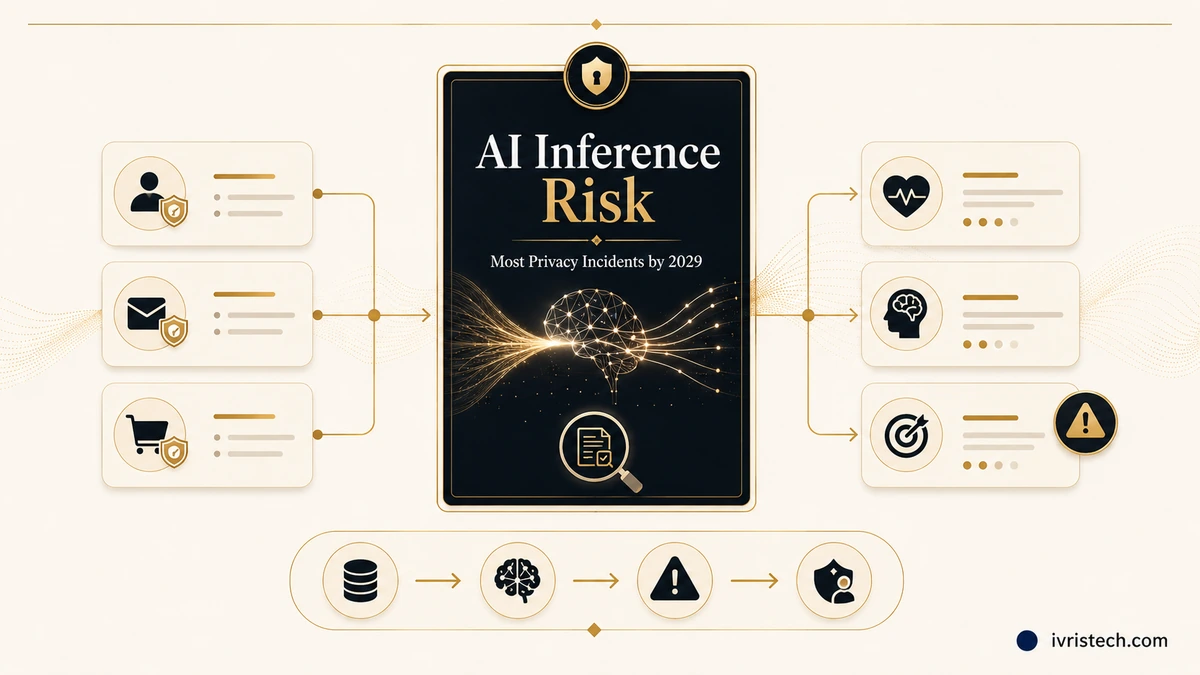
Gartner predicted on July 30, 2026, that most privacy incidents will stem from AI-generated inferences about people by 2029, rather than direct exposure of personally identifiable information. The forecast turns AI inference privacy risk into a governance problem for every system that profiles, scores, prioritizes, or personalizes.
Gartner expects data-integrity protection spending to match confidentiality investment by 2028. Bart Willemsen, a Gartner VP analyst, called it a shift from “data exposure to insight exposure.” The concern is an AI system combining ordinary signals into a sensitive conclusion, then storing or acting on it.
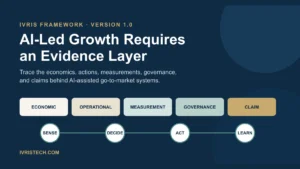
For B2B marketing and RevOps teams, that risk already sits inside CRMs, CDPs, intent platforms, lead-scoring models, and customer agents. Our Evidence Layer for AI-led growth shows the operating requirement: generated profiles need traceable inputs, owners, permitted uses, review paths, and correction records.
Direct answer: what is AI inference privacy risk?
AI inference privacy risk is the risk that an AI system reveals, creates, or acts on sensitive conclusions about a person without a conventional data breach. Gartner predicts that such inferences will drive most privacy incidents by 2029. B2B teams therefore need controls over what models may infer, which data feeds them, where outputs are stored, who may use them, and how affected people can challenge or correct them.
Key Takeaways
- Gartner predicts that AI-generated inferences will cause most privacy incidents by 2029.
- Data-integrity protection spending could match confidentiality spending by 2028.
- Gartner recommends privacy-enhancing technologies, data minimization, monitoring, audits, and human oversight.
- The announcement gives no percentage, incident baseline, or methodology behind “most.”
- B2B teams should govern model-created attributes as carefully as collected personal data.
What Gartner Actually Predicted About AI Inference Privacy Risk
Gartner’s claim extends beyond model inversion or membership-inference attacks. It includes conclusions about health, behavior, and other sensitive attributes derived from data that may look harmless, anonymized, or aggregated when viewed separately.
The NIST Generative AI Profile describes the same failure mode: a model can combine disparate sources to infer sensitive information that was neither in its training data nor disclosed by the user. Inaccurate inferences can still cause harm when they influence decisions.
That distinction matters in B2B data-enrichment workflows. A profile may mix verified firmographic fields, observed behavior, vendor attributes, and model predictions. An inventory that records only source data can miss the conclusion that creates the larger risk.
Gartner calls for AI governance inside privacy programs, differential privacy and synthetic data where appropriate, data minimization, monitoring for indirect exploitation, documented inference boundaries, regular audits, and human validation before sensitive inferences trigger action.
Why B2B Marketing Systems Create Inferred Profiles
Marketing systems turn signals into predictions. Governed predictive models in SAS 360 Marketing AI, for example, can support churn, conversion, segmentation, and next-best-action use cases. The valuable output is the system’s conclusion about what a person or account is likely to do.
Customer decisioning raises the same issue at execution. Our reporting on human oversight in Pega Customer Engagement Studio focused on approvals, audit records, and rollback. Gartner adds another test: whether the profile contains an inference the system should never have generated or reused.
Not every inference is sensitive or harmful. Risk rises when a model creates a personal conclusion, combines datasets unexpectedly, treats a probability as fact, affects access or opportunity, or leaves no practical correction route.
For UK operations, the Information Commissioner’s Office guidance on AI inferences says data-protection law can apply when a model uses personal data to predict or decide something about an identifiable person, including someone outside the training dataset. Teams should obtain jurisdiction-specific advice.
The Hidden Catch in Gartner’s 2029 Forecast
The headline is directional, not a measured incident rate. Gartner’s announcement does not define the percentage represented by “most,” publish a current baseline, explain the forecast sample, or disclose the method used to reach 2029. It should not become an invented 51% statistic.
Organizations also need a definition of an inference-related incident. A breach taxonomy may capture stolen records but miss an unauthorized profile, an inaccurate sensitive label, a hidden eligibility decision, or an output reused beyond its approved purpose.
Our read: the forecast changes the unit of control. Protecting databases, transfers, and access rights remains necessary, but those controls do not show what a model concluded, why it concluded it, where the result traveled, or which action used it.
What B2B Teams Should Audit Now
This extends the ownership discipline in our RevOps data-governance practices. Model outputs need named owners, definitions, quality checks, retention rules, and escalation paths.
- Inventory inferred attributes and decisions. Record the system, model, inputs, output, affected person or group, confidence, business use, and downstream destinations.
- Set prohibited inference boundaries. Document conclusions the system must not generate, especially where ordinary signals could reveal health, financial vulnerability, or other sensitive traits.
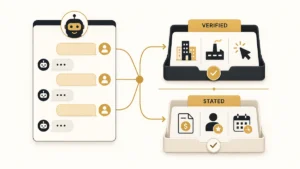
- Separate observations from conclusions. Label fields as supplied, observed, enriched, or inferred. Retain model version, timestamp, lineage, confidence, and expiry date.
- Gate consequential use. Require human review before inferred profiles affect suppression, prioritization, eligibility, pricing, account treatment, or sensitive messages. Log approvals and overrides.
- Test correction and deletion. Confirm teams can locate an inference, explain its use, correct or remove it, stop further action, and identify consuming workflows.
- Red-team data joins. Test whether separate low-risk datasets can reconstruct a sensitive attribute, and monitor repeated attempts to extract profiles.
Gartner’s prediction does not make every prediction a privacy incident. It makes “we protected the raw data” incomplete. The practical response is an inference register, permitted-use rules, decision logs, human-review thresholds, and a correction path that works after a model acts.
Frequently Asked Questions
AI inference privacy risk arises when a model derives or acts on personal or sensitive conclusions that were not directly supplied. The risk can exist without a database breach because the harm comes from the generated profile, its accuracy, its downstream use, or the lack of a correction route.
A data breach usually involves unauthorized access, loss, or disclosure of stored information. An inference incident can occur when protected data remains secure but an AI system combines available signals to create an unauthorized, inaccurate, or harmful conclusion about a person and uses it in a decision.
Gartner predicts that most privacy incidents will stem from AI-generated inferences about individuals by 2029, rather than direct PII exposure. Its public announcement does not publish the percentage behind “most,” a current incident baseline, or the forecast methodology, so the claim should remain clearly attributed.
Start with an inventory of inferred fields, scores, segments, and automated decisions. For each one, document inputs, model version, owner, permitted use, retention period, downstream systems, human-review threshold, and correction process. Prioritize profiles that can affect eligibility, prioritization, pricing, suppression, or sensitive communications.