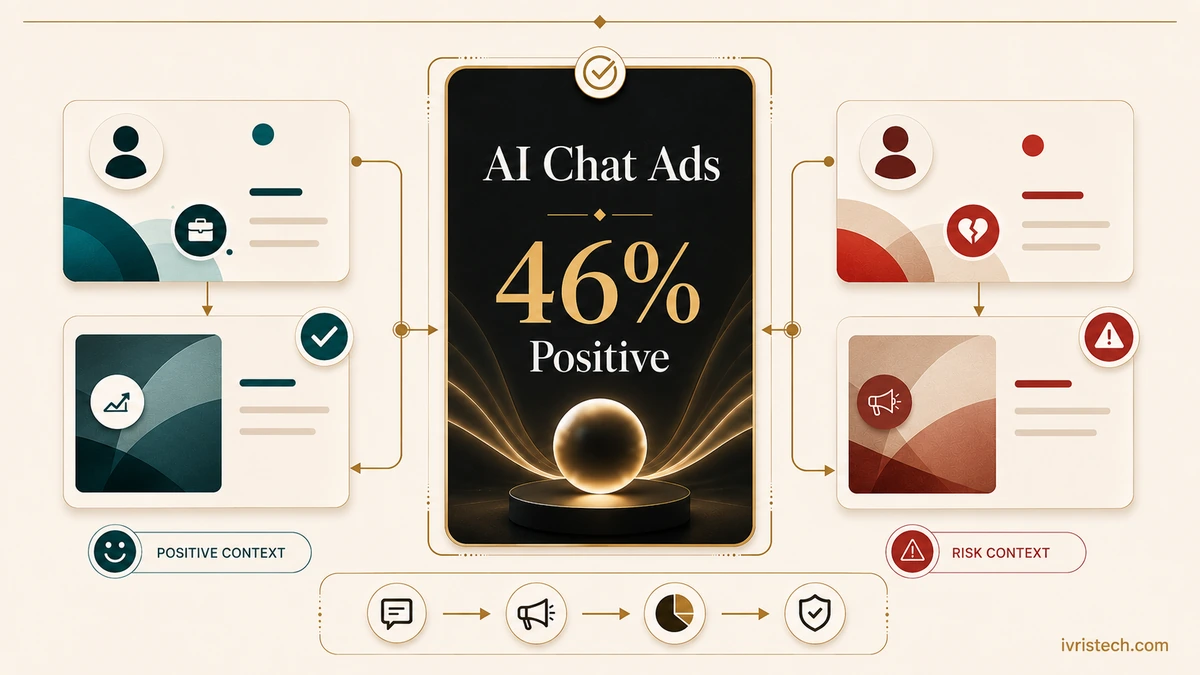
DoubleVerify’s July 29, 2026 global study found that 46% of consumers view ads in AI chat platforms positively. That is the sense in which this headline uses “accept”: the figure measures stated sentiment, not purchase intent or blanket approval of every placement.
The research, commissioned by DoubleVerify and fielded by Sapio Research in February 2026, surveyed 22,000 consumers and 2,020 marketing and advertising decision-makers. The North America report shows the caveat: only 34% of consumers in the region felt positive about AI-platform ads, and several common chat scenarios pushed negative sentiment above positive sentiment.
For B2B advertisers, the hidden catch is that high intent does not automatically create a suitable placement. Our earlier coverage of how contextual ChatGPT ads work explains why a conversation can offer a richer signal than a keyword. DoubleVerify’s data shows that the same signal can make an ad useful in one exchange and intrusive in the next.
Direct answer — What does DoubleVerify’s AI chat ads consumer sentiment research show?
DoubleVerify found that 46% of consumers globally feel positive about ads in AI chat platforms, but acceptance is conditional. In North America, highly relevant ads were the only tested scenario where positive brand sentiment exceeded negative sentiment. Irrelevant ads and placements beside negative, sad, or highly personal chats produced more negative than positive reactions.
Key Takeaways
- Globally, 46% of consumers felt positive about ads in AI chat platforms, compared with 33% neutral and 21% negative.
- North American sentiment was more cautious: 34% positive, 37% neutral, and 29% negative.
- Highly relevant ads produced 31% positive versus 19% negative brand sentiment, the only tested context where positive outweighed negative.
- Irrelevant ads produced 33% negative sentiment; negative or sad chats produced 34%; highly personal chats produced 32%.
- Among North American marketers, 39% wanted transparent placement reporting and 39% wanted reliable measurement and attribution.
What DoubleVerify Found About AI Chat Ad Sentiment
The global result is not a simple approval vote. DoubleVerify recorded 46% positive, 33% neutral, and 21% negative sentiment toward ads shown within AI platforms. North America was more cautious, with 34% positive, 37% neutral, and 29% negative.
Teams used to running B2B Google Ads campaigns can separate the query from the page where an ad appears. In an AI chat, the user’s question, the assistant’s response, and the ad form one experience. Context is part of the impression.
Context Is the Brand-Risk Switch
DoubleVerify tested four North American chat scenarios:
- Highly relevant to the chat: 31% positive brand impact and 19% negative.
- Irrelevant to the chat: 20% positive and 33% negative.
- Alongside a negative or sad chat: 20% positive and 34% negative.
- Alongside a highly personal chat: 22% positive and 32% negative.
Our read: relevance is the permission layer for AI chat advertising, not merely a performance lever. A matched placement can feel like useful next-step information. A mismatched or emotionally insensitive placement can make the brand seem careless or opportunistic.
Creative quality is a separate control. Canva’s AI slop and marketing-trust findings show what happens when the asset itself feels generic. DoubleVerify adds a second risk: polished creative can still damage perception when the conversation around it is unsuitable.
What the 46% Result Does Not Mean
The survey was fielded in February 2026, so it captures stated attitudes in an early market rather than mature campaign behavior. It measures stated perception, not observed click-through rate, conversion rate, or revenue. The 46% figure supports a controlled test, not a forecast that nearly half of users will engage or buy.
It also does not justify targeting the most personal signal available. Relevance can come from the active topic without inferring sensitive traits, emotional state, health status, or financial distress. The question is not “How much can the platform infer?” It is “What context can the brand defend?”
A B2B pilot should be judged against qualified pipeline and brand outcomes. The discipline used to choose B2B marketing metrics that connect activity to revenue applies here: define the conversion event, monitor negative feedback, and set a stop condition before spend begins.
What B2B Advertisers Should Require Before Testing
- Write contextual exclusions first. Start with negative or sad conversations, highly personal exchanges, and topics unrelated to the offer. Add category-specific restrictions where the brand cannot tolerate ambiguity.
- Demand placement-level transparency. Ask how the platform classifies the conversation, what context reached the matching system, where the ad appeared, and whether the advertiser can review, pause, or exclude placements.
- Separate relevance from sensitivity. Match the ad to the current task or business problem, but do not treat emotional intensity or personal disclosure as a stronger bid signal.
- Pre-register measurement and kill criteria. Track qualified leads, pipeline, brand-lift movement, complaints, and placement exceptions. Compare results with an established paid-search baseline, and require independent verification before scaling.
The opportunity is real but conditional. The 46% global figure can justify an experiment. It does not justify scale until the platform can prove where the ad appeared, why it matched, and how the advertiser can prevent the next placement from crossing the line.
Frequently Asked Questions
It means 46% of surveyed consumers globally said they felt positive about ads shown in AI platforms such as chats. The study measured sentiment, not purchase intent, click behavior, or unconditional permission. Another 33% were neutral and 21% were negative, so acceptance remains meaningful but qualified.
In DoubleVerify’s North American scenarios, ads beside negative or sad chats produced 34% negative brand sentiment. Irrelevant ads produced 33% negative sentiment, and ads beside highly personal chats produced 32%. Each of those results exceeded the positive response for the same scenario.
They performed better in the survey. Highly relevant ads were the only tested scenario where positive brand sentiment, at 31%, exceeded negative sentiment, at 19%. That does not remove every risk, but it supports using topic relevance with suitability controls rather than treating all chat inventory as interchangeable.
Request placement reporting, reliable attribution, contextual targeting controls, verified brand-suitability settings, the ability to pause or exclude placements, and independent verification. Define sensitive-context exclusions and campaign stop conditions before launch so the team is not writing its safety policy after a damaging impression appears.