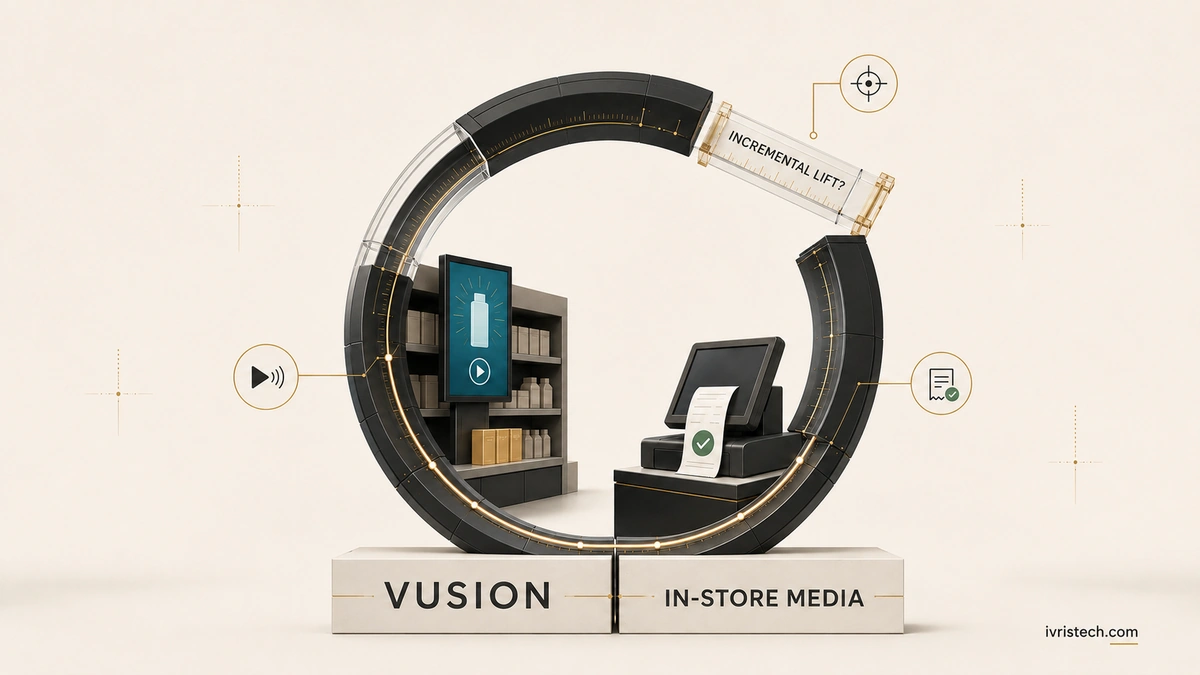
Vusion signed an agreement on July 27, 2026, to acquire Barcelona-based In-Store Media (ISM). The proposed Vusion In-Store Media acquisition would pair Vusion’s connected-store infrastructure with an operator that designs, deploys, and monetizes media inside physical stores. Vusion’s announcement says the transaction remains subject to regulatory approvals and customary closing conditions and is expected to be financed with debt.
ISM brings relationships with 90 retail banners and more than 1,600 brands across nine countries. It generated approximately €120 million in 2025 revenue and offers more than 50 print and digital media solutions. That scale gives Vusion more than screen inventory. It adds campaign operations, advertiser demand, and retailer relationships.
Our read: the strategic logic is credible, but measurement is the real test. Vusion could verify when and where media ran, while ISM could bring the campaigns and commercial reach. A closed loop still requires evidence that exposure changed shopper behavior, not merely that a promoted product sold after an ad played.
Direct answer — What could the Vusion In-Store Media acquisition mean for retail media?
The proposed deal could connect store-level campaign activation with ISM’s retail and brand network, making in-store media easier to deploy, verify, and relate to sales. It does not yet prove closed-loop measurement. Brands still need common metric definitions, privacy-safe data joins, comparable reporting across retailers, and incrementality tests that separate attributed purchases from sales the store would have made anyway.
Key Takeaways
- Vusion signed the agreement on July 27, 2026; the transaction has not closed and still requires regulatory approvals and customary conditions.
- ISM works with 90 retail banners and more than 1,600 brands across nine countries and generated approximately €120 million in 2025 revenue.
- The combination could join Vusion’s store technology with ISM’s campaign design, execution, and monetization capabilities.
- Activation logs can prove that media ran; they do not, by themselves, prove that the media caused incremental sales.
- The buyer test is whether Vusion can make measurement auditable and comparable across retailers, formats, and markets.
What Vusion Has Agreed to Acquire
ISM is not simply a digital-signage vendor. Founded in 1998, the company operates retail-media programs across Europe, Latin America, and Asia, covering supermarkets, hypermarkets, shopping centers, department stores, and specialty retail. Its portfolio spans more than 50 print and digital formats, which means Vusion would be acquiring both media operations and a route to advertiser budgets.
Vusion CEO Thierry Gadou has framed physical stores as the next retail-media frontier. The announcement does not provide a product-integration timetable or measurement methodology, so those benefits remain proposed rather than delivered.
Why the Activation Layer Is the Strategic Prize
Vusion says its existing in-store media platform can schedule content across individual touchpoints, store groups, or whole chains; update or pause campaigns in real time; monitor display status; and report execution with shelf images, traffic, engagement, and sales data. Those are the controls needed to turn a collection of screens into managed media inventory.
ISM adds the people and commercial processes around that control plane: retailer relationships, brand demand, campaign design, placement, and field execution. The opportunity is to move from a brief to a live placement and then to execution evidence without rebuilding the campaign across disconnected systems. That is the physical-retail version of the activation gap between insight and action, and it reinforces why campaign architecture has to connect every touchpoint to a measurable outcome.
The same control layer could suppress media for out-of-stock products, although the acquisition announcement does not promise that integration.
Measurement Is the Harder Test
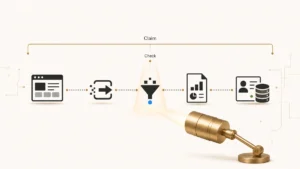
In-store retail media has three different proof layers. Delivery asks whether the correct creative played in the correct zone at the correct time. Attribution asks whether an exposed shopper or store later produced a purchase. Incrementality asks whether the campaign caused sales that would not have happened without it. A platform can perform well on the first two and still overstate the third.
IAB and IAB Europe’s in-store standards provide shared definitions for formats, store zones, and campaign measurement. Their later commerce-media incrementality guidance raises the bar further: causal claims need a credible counterfactual and controls for bias. Neither requirement is solved simply by placing activation and sales data in one dashboard.
In our earlier reporting, GrowthLoop’s measurement findings showed how local campaign wins can fail at scale when teams cannot connect actions to business outcomes. The same caution applies here. Even the strongest attribution software depends on the signals, identity joins, and rules it receives; ownership of more data does not automatically make the conclusion causal.
What Retail-Media Buyers Should Ask Next
The practical scorecard should separate operational proof from business proof, just as a useful marketing measurement framework separates activity, conversion, and revenue outcomes. Retailers and brands should ask five questions before treating the proposed combination as a closed-loop platform:
- What is the common metric dictionary? Ad plays, qualified exposure, dwell, engagement, attributed sales, and incremental sales need distinct definitions across every retail banner.
- How are data sets joined? Buyers need to know how display logs, store traffic, POS transactions, loyalty data, and ecommerce activity connect, including consent, retention, and access controls.
- Where is the counterfactual? Reporting should show when lift comes from randomized holdouts, matched controls, geographic tests, or another stated method, rather than a post-exposure sales match.
- Can brands compare networks? The value of a larger footprint falls if each retailer uses different windows, baselines, and sales definitions.
- Can the result be audited? Methodology disclosures, exportable evidence, and independent validation would make the platform more credible than another retailer-owned dashboard.
The proposed deal could make in-store activation faster and more visible. Its larger opportunity is to make physical-store media easier to buy with confidence. Vusion will need to prove both sides of that promise separately.
Frequently Asked Questions
No. Vusion announced a signed agreement on July 27, 2026, but described the transaction as proposed. Completion remains subject to regulatory approvals and other customary closing conditions. Vusion also said it expects to finance the acquisition with debt. Until those conditions are met, ISM remains a separate business.
ISM brings campaign design and execution, retailer and brand relationships, and an international operating footprint. Vusion says ISM works with 90 retail banners and more than 1,600 brands across nine countries, generated approximately €120 million in 2025 revenue, and offers more than 50 print and digital media solutions.
Vusion could combine its connected displays, store-level controls, and execution reporting with ISM’s campaign operations and commercial network. That could make it easier to schedule, update, verify, and optimize campaigns across many stores. The acquisition announcement does not yet provide a detailed integration roadmap or delivery timetable.
Credible proof would separate delivery, attribution, and incrementality; disclose how exposure and purchase data are joined; use holdouts or another defensible counterfactual; apply consistent definitions across retailers; and allow independent review. A dashboard that links an ad play to a later sale is useful evidence, but it is not causal proof by itself.