Revelio Labs launched its AI Labor Market Tracker on July 28, 2026, using workforce and job-posting data to create a monthly view of AI’s effect on work. The first release finds hiring demand weakening in occupations with the most AI-exposed work while firms classified as AI adopters expand headcount.
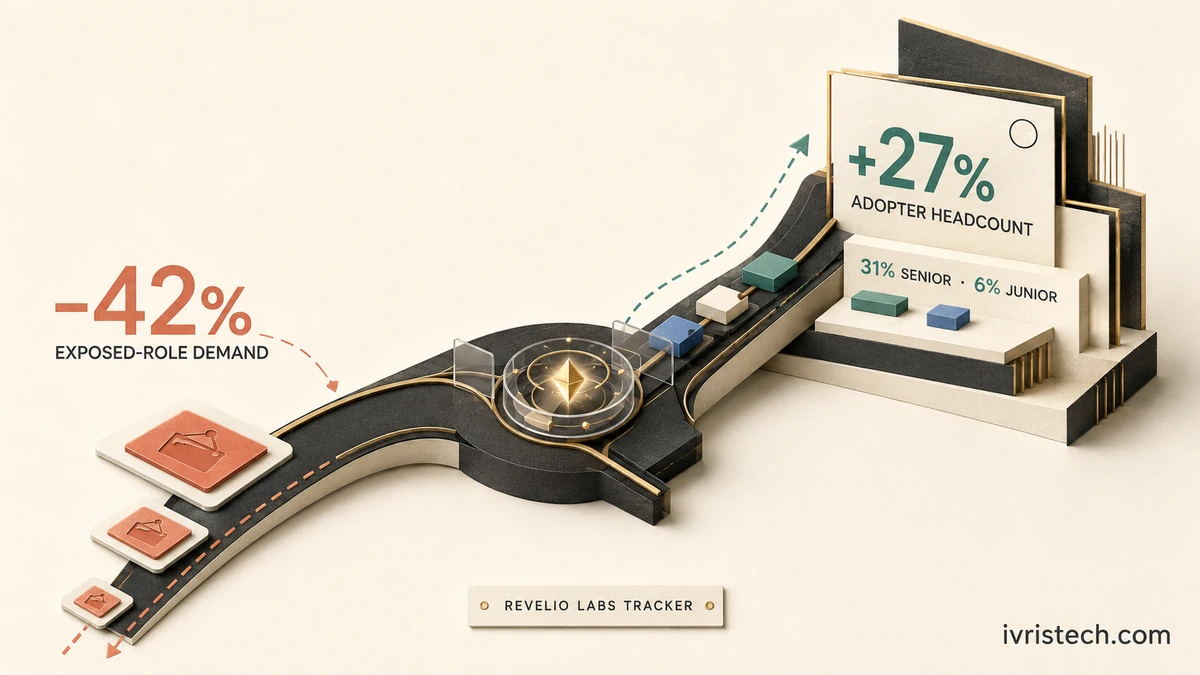
The live July dashboard reports a 42% decline in job-posting demand for the most AI-exposed occupations versus the least exposed since October 2022. It also reports 27% greater headcount growth at adopting firms than at non-adopters over the same period. That growth is uneven: senior headcount rose 31%, compared with 6% for junior roles.
Our read: this is not evidence that AI simply destroys jobs or creates them. The unit of change is often the task mix inside a company. That extends our earlier reporting on quiet AI-driven role compression, where stopped backfills and fewer junior seats mattered more than visible layoffs. Revelio now puts a broader labor-market frame around that shift.
Direct answer — What did the Revelio Labs AI Labor Market Tracker find?
Revelio Labs found that demand for the most AI-exposed occupations fell 42% relative to the least exposed since October 2022, while firms identified as AI adopters grew headcount 27% more than non-adopters. The gains were concentrated in senior roles. The comparison is descriptive, not proof that AI adoption caused the growth.
Key Takeaways
- Revelio Labs released its monthly AI Labor Market Tracker on July 28, 2026.
- Demand for the most AI-exposed occupations fell 42% relative to the least exposed since October 2022.
- AI-adopting firms recorded 27% greater headcount growth, with senior roles up 31% and junior roles up 6%.
- Adopters are identified through AI-integrator job postings and were already growing faster before adoption.
- Workers aged 22 to 25 in the most exposed occupations saw employment fall 13% relative to least-exposed peers.
What the AI Labor Market Tracker Measures
The tracker follows five parts of the US labor market: worker supply, employer demand, employment and wages, work activities, and hiring matches. Revelio says it is designed to describe changes already visible in the data, not forecast whether AI will eventually raise or reduce total employment.
Its central distinction is exposure versus adoption. Exposure estimates how much of an occupation’s work AI could plausibly perform, not whether a specific employer has deployed it. Adoption is measured through postings for roles that integrate AI into operations. Employers can anticipate automation before deployment, while firms building AI capability can grow around new workflows.
The 42% result is relative, not a claim that all hiring fell 42%. Revelio compares the highest and lowest occupational-exposure quintiles against October 2022. Its press release uses 36% from November 2022. Those different reference-period descriptions should not be treated as interchangeable.
Why Exposed Hiring Can Fall While Adopters Grow
A company can reduce demand for drafting, summarization, routine analysis, or data-entry work without reducing total headcount. It can also hire more product, engineering, sales, implementation, or management staff as AI-supported output expands. Revelio’s work-content index rose 8.4 percentage points year over year in June 2026, mostly through changes inside occupations.
That reconciles the 42% demand decline with the 27% adopter-growth result. The first measures exposed work across occupations; the second compares firm headcount trajectories. Together they point to reallocation, which is why a workflow-first business process improvement cycle should precede headcount changes.
The same distinction appears in OpenAI’s B2B Signals adoption-gap data, where deeper workflow use mattered more than prompt volume. Access alone does not create an advantage. Firms need operating processes, accountable owners, and roles designed around delegated work before AI use can compound into output or growth.
The Hidden Catch in the 27% Headcount Figure
The launch release describes companies as having successfully adopted AI, but the published method does not independently verify successful deployment. Revelio classifies a firm as an adopter when it posts for an AI-integrator role. That signal can capture intent, capability-building, or implementation work rather than a completed, productive rollout.
Revelio also states that adopter firms were growing faster before adoption. The 27% gap is therefore an association, not a causal estimate of jobs created by AI. Faster-growing companies may have stronger demand, more capital, or better hiring capacity. Turning the figure into a claim that AI caused 27% growth would overstate the evidence.
The data source has boundaries too. Revelio’s methodology appendix says professional profiles overrepresent white-collar workers and large cities, then applies sampling weights calibrated to government labor statistics. That improves coverage without making every occupation, firm size, or industry equally observable.
What B2B Leaders Should Change Now
The practical response is not a blanket hiring freeze or blanket AI expansion. Leaders should separate task demand, role demand, and company growth, then measure each directly.
- Audit activities before roles. Identify disappearing steps, required review, and new bottlenecks before changing the org chart.
- Protect the junior-to-senior pipeline. A 31% versus 6% growth split can improve near-term output while weakening the future supply of experienced operators.
- Measure deployment, not intent. Track cycle time, quality, rework, customer outcomes, and economic impact. An AI-integrator posting is investment evidence, not proof of a working workflow.
- Set guardrails around delegated work. Effective agentic AI marketing workflows need explicit handoffs, review conditions, and named accountability.
The tracker is a better monthly test than a binary jobs-up-or-jobs-down framing. The useful questions are which work is shrinking, which firms are growing, who receives that growth, and whether companies are building the people needed to run the redesigned system.
Frequently Asked Questions
It is a monthly US labor-market report built from Revelio Labs workforce profiles, job postings, salary data, employee sentiment, and layoff notices. It tracks worker supply, employer demand, employment and wages, work activities, and hiring matches to describe measurable changes associated with AI.
No. The 42% figure is a relative event-study result comparing job-posting demand in the most AI-exposed occupations with the least exposed, using October 2022 as the baseline. It should not be read as a 42% decline in all hiring or all employment.
No. Revelio found 27% greater headcount growth at firms classified as adopters, but those firms were growing faster before adoption. The method identifies adoption through AI-integrator job postings, so the result is an association and does not isolate AI as the cause of growth.
Adopting firms grew senior headcount 31% versus 6% for junior roles. For B2B teams, that suggests AI-supported expansion may favor experienced operators while narrowing entry paths. Leaders should preserve training work that builds judgment and track whether short-term efficiency creates a future talent gap.