Direct answer – why did Salesforce acquire Fin?
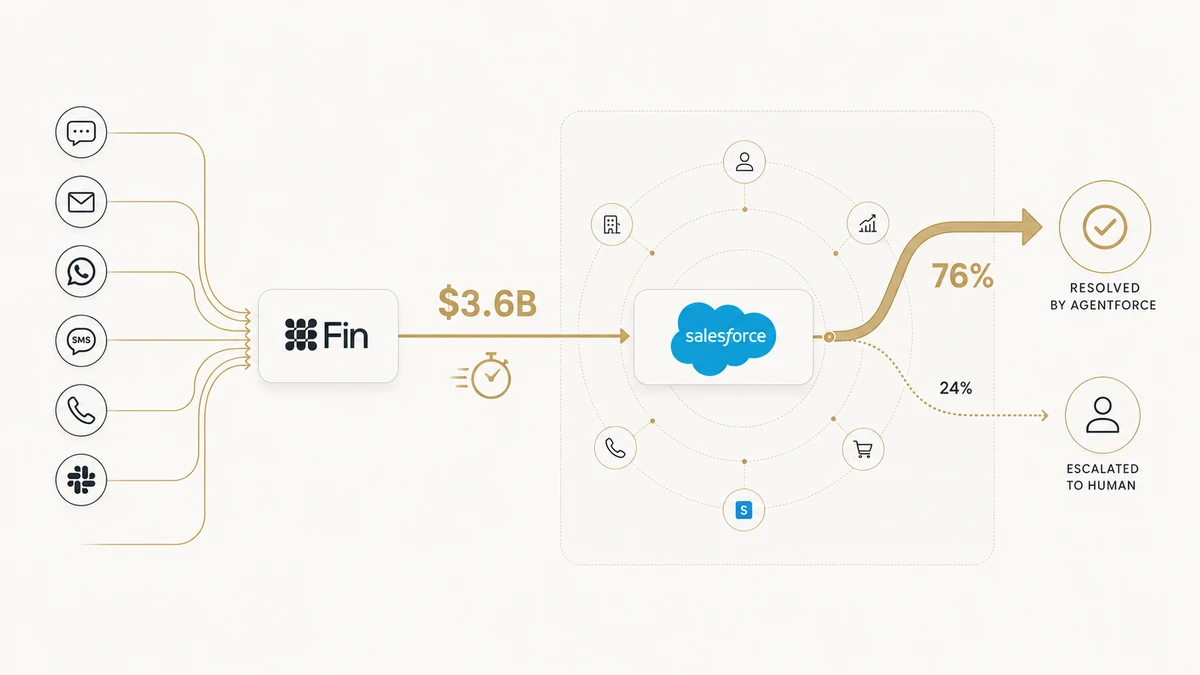
Salesforce signed a June 15, 2026 agreement to acquire Fin, formerly Intercom, for about $3.6 billion because Fin gives Agentforce a faster customer-service agent path. Salesforce already has a broad agent platform. Fin adds a packaged AI support agent, a proprietary Apex model, a claimed 76% average support-volume resolution rate, and a 30,000-company customer base.
Salesforce signed a definitive agreement to acquire Fin, formerly Intercom, for approximately $3.6 billion, adding a customer-service AI agent company to the Agentforce portfolio.
Fin’s AI Agent resolves customer queries across live chat, email, WhatsApp, SMS, phone, and Slack. Salesforce says Fin’s Apex model is built for customer support, the deal is expected to close in Q4 of Salesforce’s fiscal year 2027, and Fin brings an established base of more than 30,000 companies.
For B2B teams, the deal is less about Salesforce buying another AI logo and more about time-to-value. Salesforce has a broad agent platform. Fin gives it a faster, service-specific agent package for teams that need support resolution before they are ready for a full custom Agentforce build.
Key Takeaways
- Salesforce announced the Fin acquisition on June 15, 2026 for approximately $3.6 billion.
- Fin’s AI Agent supports live chat, email, WhatsApp, SMS, phone, and Slack.
- Salesforce says Fin resolves an average of 76% of support volume end-to-end and brings more than 30,000 companies.
- The transaction is expected to close in Q4 of Salesforce’s fiscal year 2027, subject to customary conditions and regulatory clearance.
- The B2B test is whether Fin shortens Agentforce deployment time without creating a second support-agent stack to govern.
What Salesforce Actually Bought
Fin is a customer-service agent platform. Fin’s own product page positions the AI Agent around automated support resolution, handoffs, and omnichannel customer conversations rather than a general-purpose agent builder.
That distinction matters. Agentforce is broad and highly configurable. Fin is narrower and closer to a packaged support product. Salesforce’s release says the two will give customers more ways to deploy AI agents, especially for SMB and commercial organizations that want faster setup, existing-system integration, and measurable outcomes.
CMSWire called the acquisition the largest agentic customer-experience deal to date. That framing is useful because it places the deal in the customer-service layer, not only the CRM-platform layer.
The Time-to-Value Problem Is the Real Story
When we covered Salesforce’s Agentforce ARR and adoption gap, the tension was clear: Agentforce ARR crossed $1.2 billion, but paid adoption was still concentrated in a small share of the customer base. Fin addresses the same gap from a product-shape angle.
Enterprise teams with Salesforce architects, clean data, and partner support can build custom agents. Smaller teams often need a narrower path: connect the channels, ingest the knowledge base, define escalation rules, and start with support cases that have measurable resolution outcomes.
That is where Fin fits. A packaged AI support agent can be easier to buy, pilot, and evaluate than a platform promise. It also gives Salesforce a clearer answer to AI-native support vendors that already sell on resolved conversations rather than CRM breadth. Freshworks’ Q2 result provides a current commercial example: Freddy AI Copilot was attached to more than 71% of new enterprise deals, showing that a named service-AI add-on can become part of the initial enterprise package.
What B2B Support and RevOps Teams Should Test
Our read: do not evaluate the deal by asking whether Fin is “better” than Agentforce. Ask whether the combined product creates one governed service-agent path or two overlapping systems.
- Resolution definition: Confirm what counts as a resolved case. Deflection, answer quality, customer satisfaction, and escalation accuracy should be reported separately.
- Data boundary: Map which knowledge-base, CRM, billing, contract, and order data the agent can read before allowing it to act.
- Escalation rule: Define when a case must move to a human, and preserve the conversation context so the human does not restart the support interaction.
- Cost-per-resolution: Compare agent cost against human handling cost, customer satisfaction, and churn risk, not only ticket volume.
The acquisition also changes how teams should read Agentforce Operations and Headless 360. Salesforce is building a platform where agents can act across front-office, service, and back-office work. Fin adds a fast service entry point. The governance burden still lands on the buyer.
The clean pilot is one support category, one language, one channel, one escalation owner, and one 30-day before-and-after window. If Fin reduces support load while preserving answer quality, Salesforce gains a concrete Agentforce on-ramp. If not, the deal becomes another acquisition that increases platform surface area faster than buyers can govern it.
Frequently Asked Questions
Fin is an AI customer-service agent company, formerly known as Intercom. Its AI Agent handles customer queries across channels such as chat, email, WhatsApp, SMS, phone, and Slack, using its Apex model built for customer support.
Salesforce said it will acquire Fin for approximately $3.6 billion, subject to customary purchase price adjustments. The deal is expected to close in the fourth quarter of Salesforce’s fiscal year 2027 if closing conditions and regulatory approvals are satisfied.
Fin gives Salesforce a packaged customer-service agent that can complement the broader Agentforce platform. That matters because some teams need a fast support-agent deployment before they are ready for a custom enterprise agent architecture.
Test one support category first. Measure true resolution rate, customer satisfaction, escalation accuracy, cost per resolved case, and CRM data quality. The goal is not more automation by itself; it is lower support friction without weaker customer outcomes.