Updated Q2 2026. All vendor pricing verified this quarter.
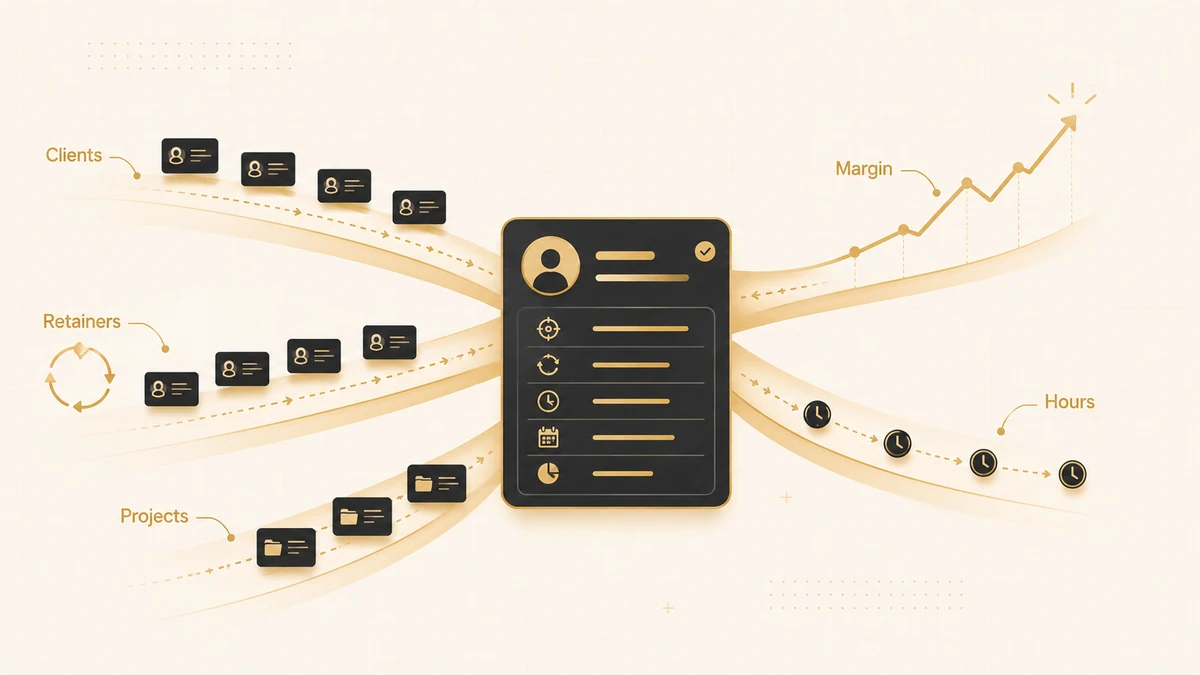
The best CRM for agencies is not the platform with the longest feature list. It is the one that fits how a service business actually makes money: many clients running at once, work sold as retainers and projects instead of one-time deals, and margin that lives or dies on how many billable hours you recover. A generic sales CRM tracks a lead to a closed deal and then goes quiet, which is the exact moment agency work begins.
Most CRM round-ups answer a broader question. Our general CRM software examples shortlist maps twelve platforms by company stage, and the HubSpot versus Salesforce comparison settles the two-horse enterprise race. This guide is narrower on purpose. It ranks ten CRMs for agencies and service businesses by the jobs that decide an agency’s profit: client management, multi-client pipelines, retainer and project billing, and client profitability.
We reviewed ten tools across three groups, each with verified Q2 2026 pricing, one honest limitation, and a use-case verdict. Two freelancer-first tools, Bonsai and HoneyBook, were evaluated and left out of the picks because they fit solo operators better than agency teams, and we mark where that line falls. Read the table for the shortlist, then the reviews for the trade-offs that decide the choice.
Key Takeaways
- Agency CRMs answer a different question: not “how do we sell,” but “how do we manage many client relationships and stay profitable on each one.” Pick for client workflow, not raw sales features.
- Best all-in-one for agency operations: Productive.io ($9/user/mo as of Q2 2026) is the only pick that carries CRM, projects, time, billing, and profitability in one tool.
- Cheapest entry points: Productive ($9), monday CRM ($12), Zoho CRM ($14), and Pipedrive ($14) all start under $15/user/mo (as of Q2 2026); Zoho, HubSpot, Capsule, and Attio carry usable free tiers.
- No single tool does everything: none of these ten replace dedicated project management or accounting software, and none are true white-label resell platforms. Expect to connect two or three systems.
- Match the tool to the bottleneck: client profitability points to Productive, new-business calling to Close, marketing-led growth to HubSpot, and simple multi-client order to Capsule.
Why Agencies and Service Businesses Need a Different CRM
A product company sells the same thing to many buyers, so its CRM is built around a lead becoming an opportunity becoming a closed deal. An agency sells time and outcomes to a handful of clients it then serves for months or years. The record at the center is not a lead, it is a client account with a contract, a scope, a budget, and a renewal date. That difference changes what the CRM has to track, and it is why a tool tuned for transactional sales leaves agencies patching gaps with spreadsheets.
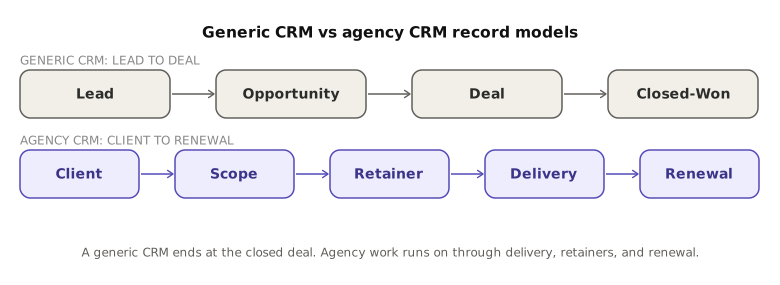
Four jobs separate an agency CRM from a generic one. The first is managing many clients in parallel rather than one pipeline of strangers. The second is a pipeline shaped for retainers and scoped projects, where the same client reappears as new work rather than disappearing after the sale. The third is billing that reflects recurring retainers and project milestones, not a single transaction. The fourth, and the one most CRMs ignore, is profitability: knowing which clients earn their margin and which quietly lose money on over-servicing.
That last job is where the numbers bite. Healthy agencies run billable utilization in the 70 to 80% range, and a few points of slippage on a major account erases a quarter’s profit before anyone notices. A CRM that cannot connect a client’s pipeline value to the hours actually burned on delivery leaves that leak invisible. It is the same discipline behind clean revenue operations, applied to a business that bills for its people’s time.
Retention raises the stakes again. In AgencyAnalytics’s 2025 survey of more than 220 agency leaders, 81% named strong client relationships their top driver of retention, while 34% said winning new clients was their single biggest operational pain. A CRM for marketing agencies has to do double duty there: keep the relationship history that protects renewals, and track the new-business pipeline that replaces churn. When it does both, it earns a place next to the performance metrics you report to clients every month.
How We Picked These CRMs
We screened against five criteria, and every pick clears all five.
1. Real fit for client-services work. The tool has to support managing multiple client accounts, not just one sales pipeline. A CRM with no concept of recurring client relationships was scored as a sales tool, not an agency tool.
2. Honest, current pricing. We publish a real per-seat number for every tool and tag the quarter we verified it. Where a vendor’s pricing page blocks automated checks, we cross-check against consistent 2026 sources and say so rather than dressing an estimate up as official.
3. A clear primary job. Each tool does one thing better than the field, so a buyer can match it to a bottleneck. This is where the line between a CRM and a wider operations stack matters, and it tracks the same split as sales ops versus revenue ops: a CRM owns the client relationship, not the entire delivery machine.
4. Built for teams, not solo freelancers. The buyer is an agency or service firm with several people touching each client. Tools designed for a one-person shop were noted and excluded from the ranked picks, with the reasoning stated.
5. Verified live in Q2 2026. We confirmed every vendor is operating, self-serve-reachable or sales-reachable, and we flag where a price has shifted out from under older third-party guides.
The 10 Best CRMs for Agencies and Service Businesses in 2026
Here are the ten picks, grouped by how they fit an agency and numbered 1 to 10. Each gets an honest write-up, a best-for line, a standout, a Q2 2026 starting price, and a link.
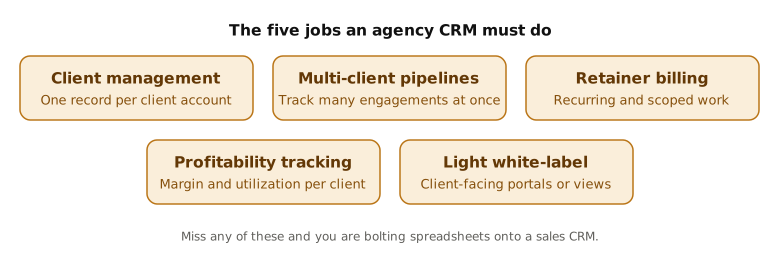
Agency and Client-Services CRMs (1-3)
These are the tools built for, or widely adopted by, agencies that manage ongoing client relationships rather than one-off sales.
1. Productive.io: Best All-in-One for Agency Operations
Productive is the closest thing on this list to a CRM built for how agencies run. It carries a sales pipeline, project management, time tracking, budgets, and billing in one tool, so a deal that closes flows straight into a project with a budget and a margin you can watch in real time. That single thread from pipeline to profitability is the headline, and no general CRM here matches it without bolting on two more products. Client accounts are free, so inviting a client to view a project does not cost a seat. The honest limits: there is a three-user minimum, those client accounts are view-only rather than a true white-label portal, and a team that only wants a lightweight contact tracker will find Productive heavier than it needs.
Best for: Agencies that want CRM, projects, time, and profitability in one system.
Standout: A single thread from pipeline to project budget to client margin, with free client accounts.
Starting price (as of Q2 2026): Essential $9/user/mo billed annually; Professional $24/user/mo; Ultimate roughly $33-40/user/mo (as of Q2 2026). Three-user minimum, free trial.
2. Folk: Best for Relationship-Led Agencies Managing Many Pipelines
Folk is the modern, lightweight CRM for agencies that live on relationships across clients, partners, and prospects at the same time. Its pipelines bend to how an agency actually labels work, so retainers, projects, and referral partners each get their own view rather than being forced into one sales funnel. Contact enrichment and email campaigns are built in, and the interface is fast enough that a small team will actually keep it updated, which is the quiet failure point of heavier CRMs. The trade-off is scope: Folk is a pipeline and relationship tool, not a delivery platform, so there is no native project management, time tracking, or billing. Pair it with a project tool and it shines; expect it to run your whole agency and it will not.
Best for: Relationship-led agencies juggling multiple client and partner pipelines.
Standout: Flexible pipelines plus built-in enrichment in an interface small teams keep current.
Starting price (as of Q2 2026): Standard $24/user/mo billed annually; Premium $48/user/mo; Custom $80/user/mo (as of Q2 2026). Free trial, no free tier.
3. Close: Best for Outbound and New-Business Calling
Close is a sales CRM rather than an agency-specific one, but agencies that win work by phone and email lean on it for good reason. Calling, SMS, and email sequencing are native, so a new-business team can prospect and follow up without stitching three tools together, and the reporting on outreach activity is genuinely strong. For an agency whose constraint is filling the pipeline rather than managing delivery, that focus is the appeal, and it pairs well with the prospecting and lead-gen tools that feed it. The limits are the flip side of that focus: no project management, no billing, and no retainer or profitability tracking. Close fills the top of the funnel; it leaves the rest of the agency workflow to other systems.
Best for: Agencies whose main constraint is new-business outreach and calling.
Standout: Native calling, SMS, and email sequencing with strong outreach reporting.
Starting price (as of Q2 2026): Solo $9/user/mo billed annually; Essentials $35/user/mo; Growth $99/user/mo; Scale $139/user/mo (as of Q2 2026). Free trial, no free tier.
General CRMs That Fit Agencies Well (4-8)
These are general-purpose CRMs that agencies adopt successfully, usually because they are already in the wider tool ecosystem or because the price and simplicity fit.
4. HubSpot: Best for Scaling Agencies That Run Marketing in the CRM
HubSpot is the pick for an agency that wants its CRM, marketing, and reporting in one place and intends to grow into it. Custom pipelines, sequences, and a deep app ecosystem make it easy to model client work, score inbound leads against clear criteria, and run the agency’s own demand generation from the same platform. The catch every buyer should price in is the tier jump: the free tools and the roughly $15-per-seat Starter plan are friendly, but the automation and reporting that justify HubSpot usually require Professional at around $100/seat/mo billed annually (as of Q2 2026), plus a first-year onboarding fee. One operational caveat from the field: HubSpot is only as good as its data hygiene, and agencies routinely trip over hidden fields that quietly drop UTM data on client reporting. Set it up carefully and it scales a long way.
Best for: Scaling agencies that want CRM plus marketing automation in one platform.
Standout: Marketing, sales, and reporting native in one CRM with a huge integration ecosystem.
Starting price (as of Q2 2026): Free tier; Starter ~$15/seat/mo; Professional ~$100/seat/mo billed annually (where automation lives); Enterprise ~$150/seat/mo (as of Q2 2026).
5. Pipedrive: Best for Small Agencies That Want a Simple New-Business Pipeline
Pipedrive is the lightweight, visual-pipeline answer for a small agency that wants its new-business deals organized without HubSpot’s price step or learning curve. The drag-and-drop pipeline is the easiest on this list to adopt, automation handles the routine follow-ups, and the entry tier runs about $14/seat/mo (as of Q2 2026). For keeping a clean new-business funnel moving, it does the job and gets out of the way. Where it falls short for agencies is everything after the sale: there are no sub-accounts for managing many clients in parallel, and no native delivery, retainer, or billing features. Pipedrive is a deal tracker, an excellent one, but it expects the rest of the agency stack to live elsewhere.
Best for: Small agencies that want a simple, cheap new-business pipeline.
Standout: The most approachable visual pipeline, with automation at an SMB price.
Starting price (as of Q2 2026): Lite ~$14/seat/mo billed annually; Growth ~$39/seat/mo; Premium ~$49/seat/mo (as of Q2 2026). Free trial.
6. Zoho CRM: Best for Agencies on a Budget That Want One Connected Stack
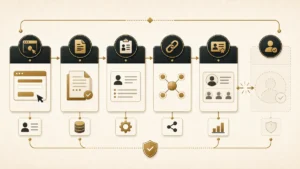
Zoho CRM is the value pick, and it is strongest when an agency adopts the wider Zoho suite rather than the CRM alone. On its own, Standard runs about $14/user/mo (as of Q2 2026) with a free tier for up to three users, which is hard to beat. Connected to Zoho Projects and Zoho Books, it becomes a genuine pitch-to-project-to-invoice loop, the kind of end-to-end agency workflow that otherwise costs three separate subscriptions. The honest trade-offs are setup and polish: wiring those integrations takes effort, and the interface feels denser than Folk or Pipedrive. For a cost-conscious agency willing to invest the configuration time, Zoho delivers the most workflow per dollar of anything here. The “suite rather than the CRM alone” point generalises past Zoho, since the CRM covers about two of the seven layers a lead actually travels through, which is why that question keeps returning whichever vendor you land on.
Best for: Budget-conscious agencies that will run the wider Zoho ecosystem.
Standout: CRM plus Projects plus Books gives a pitch-to-invoice loop at a low price.
Starting price (as of Q2 2026): Free for 3 users; Standard ~$14/user/mo; Professional ~$23/user/mo; Enterprise ~$40/user/mo billed annually (as of Q2 2026).
7. Capsule CRM: Best for Small Agencies That Want Simple Multi-Client Order
Capsule is the quietly practical option for a small or creative agency that wants its clients, contacts, and deals organized without a heavy rollout. Tags, custom fields, and a clean contact model make it genuinely easy to keep many client relationships straight, and a light project-tracking feature handles simple delivery stages. It earns its spot on simplicity and price: a free tier covers two users, and the Starter plan runs about $21/user/mo (as of Q2 2026). The ceiling is real, though. There is no time tracking, no billing, and no profitability reporting, so a creative agency that grows into retainer-margin questions will eventually outgrow it. For staying organized in the early years, it is one of the best-value CRMs for creative agencies on the market.
Best for: Small and creative agencies that want simple, affordable client organization.
Standout: Clean contact management and light project tracking with a genuinely usable free tier.
Starting price (as of Q2 2026): Free for 2 users; Starter ~$21/user/mo; Growth ~$38/user/mo; Advanced ~$60/user/mo billed annually (as of Q2 2026).
8. Copper: Best for Google Workspace Agencies Wanting CRM Plus Light PM
Copper is built to live inside Google Workspace, and for an agency that runs on Gmail, Calendar, and Drive that native fit is the whole pitch: the CRM works where the team already does, with no extra tab to forget. A 2025 update added built-in project management, so deals can convert into projects and delivery can be tracked without a separate tool, which closes a gap that used to push agencies elsewhere. Two caveats matter. The entry Basic plan at about $23/seat/mo (as of Q2 2026) does not include the full sales pipeline features, which sit on Professional, and there is still no time tracking or billing. For a Google-first agency wanting CRM and light delivery in one place, Copper is the natural fit.
Best for: Google Workspace agencies wanting CRM and light project tracking together.
Standout: Deep native Google Workspace integration plus built-in project management.
Starting price (as of Q2 2026): Basic ~$23/seat/mo billed annually; Professional ~$59/seat/mo; Business ~$99/seat/mo (as of Q2 2026). Free trial.
Lightweight and Modern Picks (9-10)
These two are newer or more flexible CRMs for teams that want to shape the tool around their own workflow rather than accept a fixed sales model.
9. Attio: Best for Data-Driven Agencies That Want a Customizable CRM
Attio is the modern, data-native CRM for an agency that finds rigid sales tools too constraining. Its custom-object model lets you build the exact data structure your agency works in, mapping clients, projects, partners, and whatever else matters as first-class records rather than shoehorning them into contacts and deals. No-code automation and a genuinely good free tier for up to three seats make it easy to start. The constraints are worth knowing: paid plans bill annually only, with Plus at $29/seat/mo and Pro at $69/seat/mo (as of Q2 2026, cross-checked against consistent 2026 sources because Attio’s pricing page blocks automated reads), and there is no native project management or billing. For a team that wants to design its own CRM rather than adopt one, Attio is the most flexible pick here.
Best for: Data-driven agencies that want to model their own workflow in the CRM.
Standout: A custom-object data model with no-code automation and a 3-seat free tier.
Starting price (as of Q2 2026): Free for 3 seats; Plus $29/seat/mo; Pro $69/seat/mo, billed annually (as of Q2 2026).
10. monday CRM: Best for Agencies That Want a Visual, Board-Based Pipeline
monday CRM brings the colorful, board-based approach of monday.com to sales, and for an agency that thinks visually it is an easy way to see every client deal at a glance. Boards, views, and automations are highly customizable, so a team can shape pipelines and client trackers to match how it works, and the entry plan starts low at about $12/seat/mo (as of Q2 2026). The two things to understand before buying: monday CRM is a separate subscription from the monday.com work-management product many agencies already use, so running both means paying for both, and the CRM itself has no native time tracking or billing. As a flexible, visual pipeline tool it is strong; as a complete agency-operations system it is not.
Best for: Agencies that want a flexible, visual, board-based sales pipeline.
Standout: Highly customizable boards and automations in a familiar visual interface.
Starting price (as of Q2 2026): Basic ~$12/seat/mo billed annually; Standard ~$17/seat/mo; Pro ~$28/seat/mo (as of Q2 2026). Free trial.
Agency CRMs Compared (Q2 2026)
The table lines up all ten tools on best-fit buyer, the agency-specific capability that matters most, starting price, integrations, and a one-line verdict. Prices are the entry paid reference as of Q2 2026.
| CRM | Best for | Agency-specific capability | Starting price (as of Q2 2026) | Integrations | Verdict |
|---|---|---|---|---|---|
| Productive.io | Agency operations end to end | Time, billing, retainers, profitability | $9/user/mo | QuickBooks, Xero, HubSpot, Jira, Slack | Best all-in-one for agency ops |
| Folk | Relationship-led agencies | Flexible multi-client pipelines + enrichment | $24/user/mo | Gmail, LinkedIn, 5,000+ via integrations | Light pipeline CRM, no delivery |
| Close | Outbound and new business | Native calling, SMS, email sequencing | $9/user/mo | Zapier, Zoom, native dialer | Sales CRM for filling the pipeline |
| HubSpot | Scaling agencies + marketing | Custom pipelines, marketing in one CRM | Free; $15/seat/mo | 1,700+ app marketplace | Powerful, but priced up at Pro |
| Pipedrive | Small agency new business | Simple visual pipeline + automation | $14/seat/mo | 500+ marketplace, Gmail, Outlook | Cheap, clean pipeline; weak post-sale |
| Zoho CRM | Budget all-Zoho stack | CRM + Projects + Books for billing | Free; $14/user/mo | Zoho suite, 800+ apps | Most workflow per dollar |
| Capsule CRM | Small, creative agencies | Tags, custom fields, light projects | Free; $21/user/mo | Xero, QuickBooks, Mailchimp, 60+ | Simple and affordable; no billing |
| Copper | Google Workspace agencies | Deal-to-project, native Workspace | $23/seat/mo | Google Workspace, Slack, Zapier | CRM + light PM for Google shops |
| Attio | Data-driven, modern teams | Custom objects, flexible data model | Free; $29/seat/mo (annual) | Native API, Zapier, hundreds of apps | Most customizable; annual-only paid |
| monday CRM | Visual, board-based teams | Customizable boards and automations | $12/seat/mo | 200+ integrations | Flexible boards; separate product |
Agency CRM Pricing Benchmarks for 2026
Agency CRM pricing falls into three per-seat bands, and where a tool sits says more about the buyer than the quality. The figures below are all as of Q2 2026 and reflect the entry paid tier; several tools also carry a free plan worth starting on.
| Band | Price range (as of Q2 2026) | Example CRMs (as of Q2 2026) | Who it fits |
|---|---|---|---|
| Entry | $9-$21/user/mo (as of Q2 2026) | Productive ($9), monday ($12), Zoho/Pipedrive ($14), HubSpot Starter ($15), Capsule ($21) | Solo operators and small agencies buying without a sales call |
| Professional | $23-$48/user/mo (as of Q2 2026) | Copper ($23), Folk ($24), Attio Plus ($29), Close Essentials ($35), Folk Premium ($48) | Growing agencies that need automation and reporting |
| Scale | $59-$150+/user/mo (as of Q2 2026) | Copper Business ($59-99), Attio Pro ($69), Close Growth ($99), HubSpot Pro to Enterprise ($100-150) | Larger agencies standardizing across teams |
Two things distort the headline numbers. Free tiers from HubSpot, Zoho, Capsule, and Attio let a small team start at zero and only pay as it grows, which often beats a cheap paid plan on day one. And the all-in-one tools change the math entirely: Productive at $9/user/mo replaces a CRM, a project tool, and a time-and-billing app, so its real comparison is against three subscriptions, not one.
PRO TIP
Price the CRM at the tier where the feature you actually need turns on, not the entry tier. HubSpot’s automation lives on Professional, Copper’s full pipeline lives on Professional, and Close’s calling volume scales by plan. Build the budget from the working tier up, count the seats you truly need, and use the free tiers to trial the workflow before you commit a card.
Which Agency CRM Fits Your Team
The picks sort cleanly by agency type and stage. Here are the quick verdicts to short-circuit the comparison.
Solo or Freelance Service Providers: Close Solo or a Free Tier
If it is just you, Close’s Solo plan at $9/user/mo gives real outreach power, and the free tiers from HubSpot, Zoho, or Capsule cost nothing to start. Pure freelancers who want invoicing and contracts in the same tool are the one case where the excluded names, Bonsai and HoneyBook, genuinely fit better, because they are built for a one-person business rather than a team.
Small Agencies (2-10 People): Capsule or Pipedrive
For a small team that wants order without overhead, Capsule keeps many clients organized at $21/user/mo, and Pipedrive runs a clean new-business pipeline at $14. Both adopt in a day and neither needs an admin to maintain. This is also the bracket where the best free CRM for agencies matters most, and Zoho’s three-user free tier stretches furthest.
Scaling Agencies: HubSpot or Productive.io
Once you are scaling, the question splits. Choose HubSpot if growth is marketing-led and you want demand generation and a repeatable go-to-market motion inside the CRM. Choose Productive if the pressure is operational, with too many projects and unclear margins, because it ties pipeline to delivery and profit in one place. A digital marketing agency tilting toward inbound usually lands on HubSpot.
Best for Service and Client Billing: Productive.io
If the real problem is knowing which clients are profitable, Productive is the clear answer and the only pick here that tracks billable time, budgets, and margin against the client record. No other CRM on the list closes the loop from a signed retainer to the hours burned delivering it.
IMPORTANT
None of these ten are true white-label CRMs you can rebrand and resell to clients as your own software. That is a separate category led by platforms like GoHighLevel and SuiteDash, and if reselling a white-label client portal is your core model, shortlist there instead. Among the ten here, the closest to client-facing is Productive’s view-only client accounts and Zoho’s client portals, neither of which is a full white-label product. Confirm seat minimums and annual-only billing too: Productive has a three-user minimum, and Attio’s paid plans bill annually only. HighLevel’s Summer of AI 2026 offer makes five assistant tools free through August 31, giving agencies a short window to test whether AI changes delivery margin before choosing a white-label platform.
What an Agency CRM Won’t Replace
Even the most complete tool here sits inside a stack rather than running the whole agency. Drawing the lines keeps the buying decision honest and stops you expecting one subscription to do three jobs.
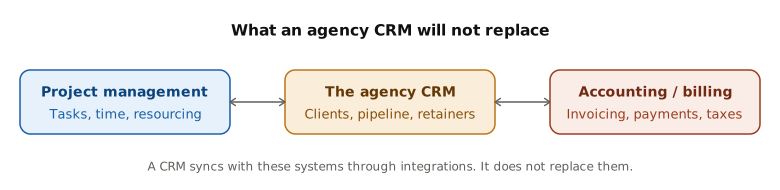
Dedicated project management. Except for Productive, which carries it natively, these CRMs do not run real delivery: detailed task management, resource scheduling, and capacity planning belong to tools built for that job. Most agencies connect their CRM to a separate project platform rather than forcing the CRM to do both.
Accounting and billing software. A CRM may track contract value and even raise an invoice, but it is not your books. Tax, reconciliation, payroll, and financial reporting live in accounting software like QuickBooks or Xero, which is why integration with those tools appears in the comparison table above.
White-label resale. If your model is rebranding software and reselling it to clients, that is a platform category of its own, not a feature you bolt onto a standard CRM. None of the ten here are built for it, and stretching one to fit usually ends badly.
What We Did Not Cover
A few adjacent guides answer questions this one deliberately set aside, because each is a different buyer at a different altitude.
General CRM selection. If you are not an agency and just want the broad market mapped, our round-up of general-purpose CRM platforms maps the broad market by company stage, and the HubSpot versus Salesforce comparison goes deep on the two enterprise giants this list keeps in proportion.
Vertical and ops-specific tools. Trade businesses should start with our construction-specific CRM guide instead, since job-site workflows differ sharply from agency retainers. And teams whose real need is revenue tooling beyond the CRM, forecasting, attribution, and pipeline governance, belong in the RevOps software stack rather than here.
Frequently Asked Questions
It depends on the bottleneck. For managing client profitability and delivery, Productive.io is the strongest pick. For marketing-led growth, HubSpot fits. For a simple, affordable way to keep many clients organized, Capsule or Folk work well. There is no single best CRM for marketing agencies, only the best fit for your workflow.
A general CRM works for tracking new-business deals. The gap shows up after the sale: retainer billing, multi-client delivery, and profitability tracking. If those matter, an agency-built tool like Productive closes the loop. If you only need a pipeline, a general CRM like Pipedrive or HubSpot is fine.
Zoho CRM’s free tier covers up to three users with real features, which usually stretches furthest for a small agency. HubSpot’s free tools scale as you grow, Capsule’s free plan covers two users, and Attio is free for three seats. All four let you start at zero and pay only when you outgrow it.
Yes, especially for scaling agencies that run marketing inside the CRM, with custom pipelines and a deep app ecosystem. The catch is price: the automation that justifies HubSpot sits on the Professional tier near $100/seat/mo (as of Q2 2026), plus onboarding. It is strong if you grow into it, expensive if you do not.
Your First Move
Name the one job your agency loses the most money to, because that single answer collapses the list fast. If it is unclear client profitability, start a Productive trial. If it is a thin new-business pipeline, look at Close or Pipedrive. If you want marketing and CRM in one place as you scale, trial HubSpot. If you just need many clients organized cheaply, Capsule or Zoho’s free tier will do.
Whatever you shortlist, run a real client through it during the trial rather than a demo record, and confirm the seat minimums and billing terms before you commit. Pick for the bottleneck you have now, not the feature list you might grow into, and the CRM earns its seat cost back in the margin it keeps you from leaking.