
Ask ten B2B teams what their lead management system is and nine will name a product. HubSpot. Salesforce. Pipedrive. That answer is how most stacks end up with an expensive CRM and no working system, because the CRM is one component of a lead management system and it is not the interesting one.
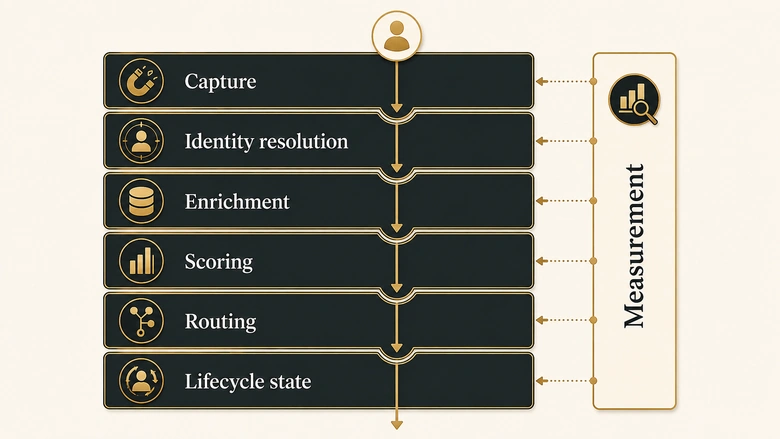
A lead management system is a set of layers that hand a record to each other in a defined order. Capture passes to identity resolution. Identity resolution passes to enrichment. Enrichment passes to scoring, scoring to routing, routing to lifecycle state, and all six report to measurement. When a lead goes missing, it went missing at a handoff between two of those layers, and the reason nobody can find it is that no one wrote down what each layer was supposed to receive and what it was supposed to produce.
This page specifies the layers. For each one you get the job it does, the data contract it owes the next layer, the failure that shows up when it is missing, and the test that proves yours works.
Direct answer — What is a lead management system?
A lead management system is the connected set of processes and tools that moves a prospect from first contact to an owned, qualified sales record. It has seven layers: capture, identity resolution, enrichment, scoring, routing, lifecycle state, and measurement. A CRM supplies storage and lifecycle state, but it does not supply identity resolution, enrichment, or routing logic on its own. Those are separate capabilities you either configure, buy, or go without.
Key Takeaways
- A lead management system is seven layers, not one product. Your CRM covers roughly two of them out of the box.
- Every layer owes the next one a data contract. Write the contract down and lost leads become traceable instead of mysterious.
- Identity resolution belongs between capture and the CRM write. Plauti found 80% of records arriving through API integrations were duplicates, against 19% of manual imports.
- Score without a reason code and sales cannot tell why a lead qualified, so they stop trusting the score. Reason codes are a requirement, not a nice-to-have.
- Measurement is a layer, not a report. Without a scheduled test lead, a broken system looks identical to a slow quarter.
- Evaluate vendors against the requirements matrix below, not against feature lists. Feature lists are written by the vendor.
What is a lead management system?
A lead management system is the connected set of processes and technology that captures inbound and outbound leads, resolves them against existing records, enriches and scores them, assigns them to a named owner, tracks their lifecycle stage, and measures the whole path. It is a system in the engineering sense: distinct components with defined inputs and outputs.
That definition matters because the market uses the phrase two different ways. Vendors use “lead management system” to mean their product. Practitioners use it to mean the whole path a lead travels, most of which runs across several products plus a pile of configuration. This page uses the practitioner meaning, because that is the one that determines whether leads actually reach a rep.
The distinction has teeth. You can buy every product on the market and still have no lead management system, if nothing defines what happens between them. You can also run a competent one on a mid-tier CRM plus three well-configured rules, if someone has specified the handoffs. Tooling is downstream of specification.
Lead management system vs CRM vs marketing automation
A CRM stores records and lifecycle state, a marketing automation platform runs campaigns and drip sequences, and a lead management system is the layer specification that decides what those two exchange. They overlap heavily in marketing copy and barely at all in what they are accountable for.
| Capability | Lead management system | CRM | Marketing automation platform |
|---|---|---|---|
| Primary job | Move a lead from capture to owned, qualified record | Store records and the state of relationships | Run campaigns, drip sequences, and email sending |
| Identity resolution | Owns it | Partial: duplicate rules on write | Rarely: usually resolves on email only |
| Routing and assignment | Owns it | Basic rules, often single-object | Hands off, does not assign |
| Scoring | Owns the criteria and reason codes | Stores the score | Often calculates the score |
| Lifecycle state | Defines entry and exit criteria | Owns the field and the audit trail | Mirrors it, usually with drift |
| Measurement | Owns per-stage leakage and test leads | Reports on records it holds | Reports on campaign attribution |
| What it cannot do alone | Nothing: it is the specification, not a product | Decide who should own a lead and why | Guarantee the lead reached a human |
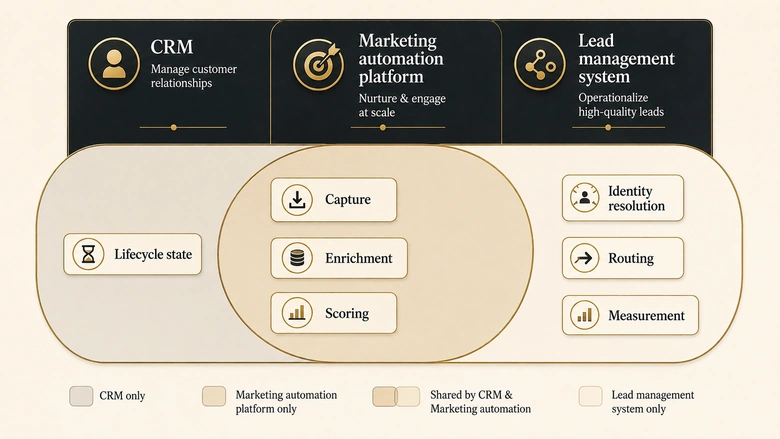
The practical read: if you are asking “should I buy a lead management system or a CRM,” the question is malformed. You will buy a CRM. The lead management system is what you specify on top of it, and the specification determines how much additional software you need to buy.
The seven layers of a lead management system
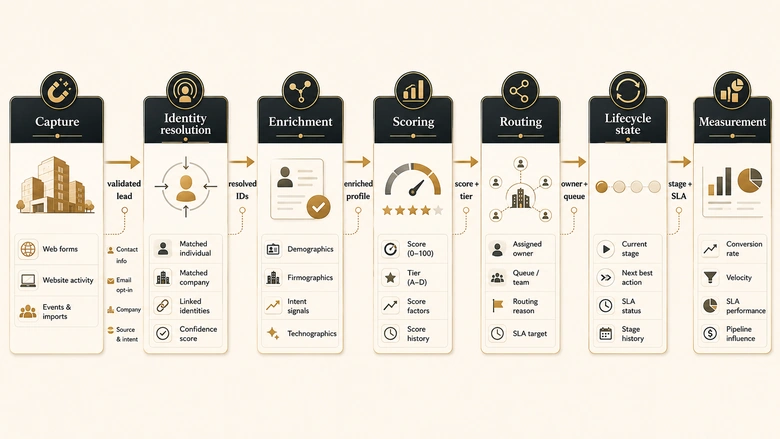
Each layer takes a defined input, does one job, and produces a defined output for the next layer. Read them in order, because the failures cascade downward and diagnosing layer five when layer two is broken wastes weeks.
Layer 1: Capture
Capture gets the lead into the system with the fields every later layer depends on. That means web forms, chat, calls, events, list imports, and partner or API feeds, each stamped with source, timestamp, and consent state at the moment of entry. A capture point that does not stamp its source cannot be measured later, and a lead whose consent state is unknown cannot be worked in most jurisdictions.
The field set is the part teams get wrong. Capture only needs the fields that a downstream rule actually reads, plus the identifiers that identity resolution needs to do its job. Everything else is friction on the form. If you are unsure which fields those are, the nine checks that separate a workable record from an unworkable one are a better starting list than whatever the form builder ships with.
Layer 2: Identity resolution
Identity resolution answers two questions before anything else runs: is this person already in the database, and does this person belong to an account we already know? Person-level matching is deduplication. Account-level matching is lead-to-account matching. They are different problems with different failure modes and they both belong here, upstream of the CRM write.
The evidence for putting them upstream is unusually clean. Plauti analysed more than 12 billion Salesforce records and found that 80% of records arriving through API integrations were duplicates, against 19% of manual imports. Integrations are where the volume is, which means the layer that catches duplicates has to sit in the integration path rather than in a monthly cleanup job. The mechanics of survivorship and merge governance are covered in the field-by-field rules for deciding which record wins a merge, and the exact, domain, and fuzzy methods for the account side are in the three matching methods and their confidence thresholds.
Layer 3: Enrichment
Enrichment adds the firmographic, technographic, and intent fields that scoring and routing depend on but the form never asked for: employee count, industry, revenue band, region, installed technologies. It runs after identity resolution so it enriches one resolved record rather than three duplicates.
The requirement people skip is the null rate. Every enrichment provider misses records, and a scoring rule reading a null field does not error, it just scores everyone in that segment identically. Track coverage per field, per source, and treat any field a rule depends on as a monitored dependency.
Layer 4: Scoring and qualification
Scoring converts attributes and behaviour into a decision plus the reason for that decision. The score alone is not the output. A rep who receives a lead marked 87 with no explanation has to redo the qualification work themselves, which is why score-only handoffs quietly lose sales trust within a quarter.
Reason codes fix that, and they are cheap: store which criteria fired and what each contributed. The signal selection itself is its own discipline, and the twelve signals worth scoring and the point values behind them is the practical starting set. Where the qualification threshold sits, and who is allowed to move it, is a governance question rather than a modelling one.
Layer 5: Routing and assignment
Routing puts the qualified record in a specific named human’s hands and starts an SLA clock. This is the layer with the most silent failure modes, because assignment logic runs server-side where nobody watches it.
One example worth internalising: Salesforce documents that when a Lead is created through the REST API, the Sforce-Auto-Assign header defaults to TRUE and active assignment rules apply, while the SOAP path applies nothing unless the header is explicitly present. Two integrations writing the same object can therefore produce entirely different ownership, and neither logs an error.
Eligibility, capacity, and fallback all live in this layer too, and they have to run in a defined order or a strategic account’s inquiry lands with whoever happens to be next in the rotation. The full path from capture through to accepted ownership sets out that sequence. On Salesforce the trap is sequencing of a different kind: the documented order of execution decides whether your field updates have already run by the time the assignment rule reads them.
Rotation is the piece most teams implement first and revisit last. Simple round robin distributes evenly and ignores everything else, which holds up until capacity or working hours vary across the team, and the weighted and capacity-aware variants are where that gets handled.
Layer 6: Lifecycle state
Lifecycle state records where the lead is and who owns the next action. The requirement most models miss is an acceptance gate: a stage that only the receiving team can set, which distinguishes “we assigned it” from “they took it.” Without that gate, an unworked lead sitting in a rep’s queue and a lead being actively worked look identical in every report you have.
Platform defaults are a reasonable starting point but not a specification. HubSpot’s documentation, updated June 2026, separates the lifecycle stage from the lead status property that holds sub-stages within Sales Qualified Lead, which is a useful split to copy even on other platforms. The handoff definition itself, and where the boundary sits, is covered in the handoff rules that decide when marketing lets go.
Layer 7: Measurement and QA
Measurement proves the other six layers still work. It needs per-stage volume, conversion, and time-in-stage, and it needs one thing most stacks lack: a synthetic test lead on a schedule that alerts when it fails to complete the path.
This is the layer that separates a system from a hopeful arrangement of tools. Dashboards read from the same database the failure corrupted, so a routing rule that silently stopped firing shows up as a soft quarter rather than an incident. A scheduled test lead is the only control that fails loudly. The staged version of this, with the specific tests per stage, is the thirteen-stage audit and the tests that belong at each one.
IMPORTANT
A test lead that only checks “did a record get created” tests one layer. The test has to assert the record reached a named owner with a started clock, or it will pass while routing is broken.
The lead management system requirements matrix
The matrix below states, for each layer, the requirement it must satisfy, the data contract it owes the next layer, what breaks when it is absent, and the test that proves it works. Use it to evaluate vendors, scope an implementation, or audit what you already run.
| Layer | Mandatory requirement | Data contract (in → out) | Failure mode if missing | Acceptance test |
|---|---|---|---|---|
| 1. Capture | Every capture point stamps source, timestamp, and consent state | Form, chat, call, import, API → record with identifiers and provenance | Attribution and routing both read nulls; the lead cannot be traced to an origin | Submit a test lead through every live capture point; confirm all three stamps populate |
| 2. Identity resolution | Person-level dedup and account matching run before the CRM write | Raw record → resolved person ID, account ID, duplicate verdict | Split activity history; two reps work one account; scoring counts one buyer twice | Submit one email twice and one known-customer domain; expect one person, one correct account link |
| 3. Enrichment | Every field a downstream rule reads has a monitored coverage rate | Resolved record → record plus firmographic, technographic, region fields | Rules read nulls and score whole segments identically without erroring | Report null rate per rule-critical field; alert above your agreed threshold |
| 4. Scoring | Every qualification decision carries the reason it fired | Enriched record → score, qualified flag, reason codes | Reps redo qualification manually, then stop trusting the score entirely | Pull ten recent qualified leads; every one shows which criteria contributed |
| 5. Routing | Named owner assigned and SLA clock started at assignment, not at first touch | Qualified record → owner, queue, clock start, fallback path | Default-owner black hole; API and SOAP writes assign differently and silently | Fire one test lead per segment; confirm named owner and a running clock for each |
| 6. Lifecycle state | An acceptance stage exists that only the receiving team can set | Owned record → stage with entry criteria, exit criteria, owner | Assigned and accepted look identical; rejected leads vanish instead of recycling | Confirm the acceptance field is write-restricted and that a return path exists |
| 7. Measurement | A scheduled synthetic lead alerts when it fails to complete the path | System state → per-stage volume, conversion, time-in-stage, test result | Breakage reads as a slow quarter; nobody is paged because nothing errored | Disable one routing rule in a sandbox; confirm the monitor fires |
Suggested citation: IVRIS Tech, “Lead Management System Requirements Matrix,” ivristech.com/lead-management-system/ (2026).
Where lead management systems break
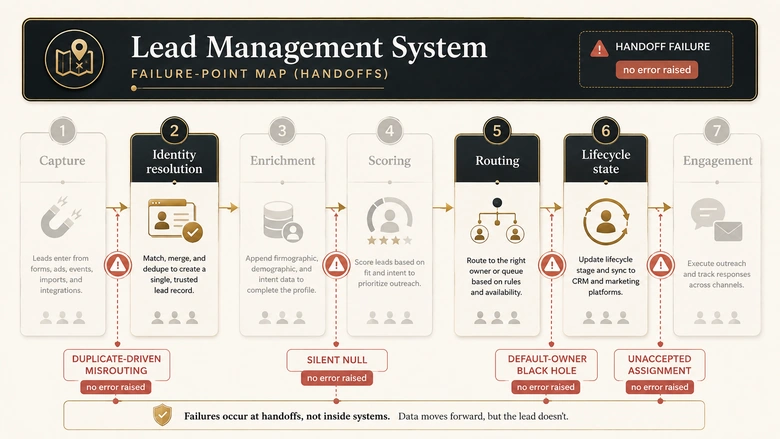
Lead management systems fail at handoffs between layers, not inside them. Each layer generally does its own job correctly; what goes wrong is that it produces something the next layer was not expecting, and nothing in between checks.
Four failures account for most of it. The default-owner black hole: routing has a fallback owner nobody monitors, so every unmatched lead accumulates in one queue that gets read quarterly. Duplicate-driven misrouting: identity resolution runs after the write, so two records for one buyer route to two reps who both call. The silent null: an enrichment field stops populating, a scoring rule that reads it stops firing, and volume drops with no error anywhere. The unaccepted assignment: no acceptance gate, so leads sit assigned and unworked while dashboards count them as handled.
All four share a shape. Nothing throws an error, so nothing gets investigated until someone notices a number moving in the wrong direction weeks later. That is why layer seven is a layer and not a report, and it is also why response-time research is worth reading with the scope attached: Harvard Business Review’s audit of 2,241 US companies found 37% responded to a test lead within an hour and 23% never responded at all. The 23% is the interesting number for architecture purposes. Those companies were not choosing to ignore leads. Something in the path was broken and nobody knew. What the evidence supports, and what it does not, is set out in the honest reading of the five-minute rule and where it came from.
How to evaluate a lead management system
To evaluate a lead management system, test the seven layers against your own stack before you look at a single vendor demo. The output is a list of layers you are missing, which is the only thing that makes a vendor conversation useful.
Workflow · half a day
How to evaluate a lead management system: a six-step audit
Run each layer’s acceptance test against your live stack, then score the gaps. The result is a requirements list you can hand to a vendor instead of a feature wishlist.
Inventory every live capture point
List every form, chat widget, call tracking number, event import, and API feed writing leads today. Include the ones marketing forgot about; those are usually the unstamped ones.
Submit a test lead through each one
Use a tagged email you control. Record whether source, timestamp, and consent state populate, and where the record lands.
Test identity resolution with a deliberate collision
Submit the same email twice and one address on a known customer domain. Confirm you get one person record and a correct account link, not two orphans.
Report null rates on rule-critical fields
List every field a scoring or routing rule reads, then measure how often it is empty. Any field above your threshold is an outage waiting to happen.
Trace assignment and the SLA clock
For each test lead, confirm a named owner and a clock that started at assignment. Check the API and the UI paths separately; they often diverge.
Score the gaps against the requirements matrix
Mark each of the seven layers present, partial, or absent. Take the absent and partial rows to vendors as requirements, and ignore any feature that does not map to one.
Build, buy, or extend your CRM
Use your existing CRM when the gaps are in lifecycle state and basic assignment, because those are the two layers CRMs genuinely cover. Native assignment rules, duplicate rules, and lifecycle fields are adequate for a single-region team with one product and predictable segments.
Buy a dedicated routing and matching tool when identity resolution or routing is the gap and the volume is real. The trigger is not company size, it is branching: multiple regions, named-account ownership, capacity limits, or a partner channel each multiply the rule count past what native tools express cleanly. If you are scoping that purchase, the twelve platforms and what each one actually covers is a useful map of where native capability stops.
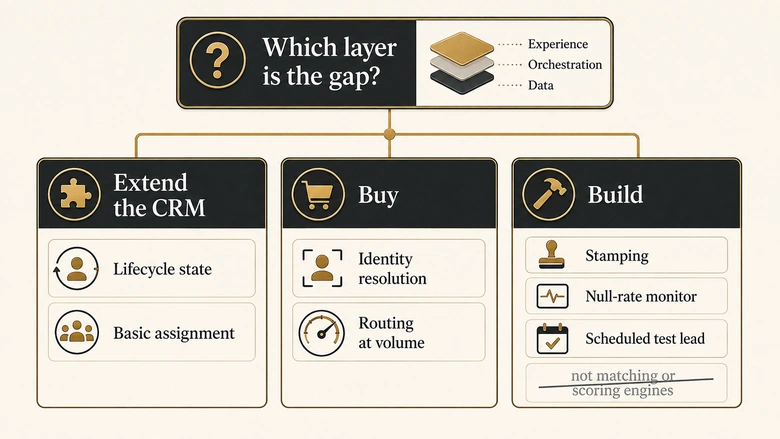
Build only the glue. Custom code is defensible for a stamping layer on capture, a null-rate monitor, or the scheduled test lead, because those are small, stable, and nobody sells them well. Avoid building matching or scoring engines. Both look tractable and both turn into permanent maintenance the moment your data changes shape.
PRO TIP
Run the six-step audit before the first vendor call, not after. Vendors scope against the requirements you bring; with no requirements, they scope against their feature list, and you buy layers you already had.
One caveat worth stating plainly: this specification assumes a considered B2B sale with an assignment step. If you run high-velocity self-serve with no rep assignment, layers five and six compress into product analytics and most of this is overhead. The seven-layer model earns its keep when a human owns the next action.
Frequently Asked Questions
A CRM stores records and relationship state. Lead management is the process that decides what happens to a lead before and after it reaches the CRM: how it is resolved against existing records, enriched, scored, assigned, and measured. The CRM is one component inside lead management, not a substitute for it.
No. Lead management software is a product category. A lead management system is the specification of how your layers hand records to each other, which usually spans several products plus configuration. You can own a lot of software and still have no system, and the reverse is also true.
Seven: capture, identity resolution, enrichment, scoring and qualification, routing and assignment, lifecycle state, and measurement. Each takes a defined input and produces a defined output for the next. Most stacks cover capture, lifecycle state, and partial scoring, and are thin on identity resolution and measurement.
They need the specification, not necessarily extra software. A small team can run all seven layers on one CRM plus a stamping rule and a monthly test lead. What small teams cannot skip is the acceptance gate and the test lead, because with fewer people watching, a silent failure runs longer before anyone notices.
Track per-stage volume, conversion, and time-in-stage, then add a scheduled synthetic lead that asserts a named owner and a started clock. Conversion metrics alone read from the same data a failure corrupted. The test lead is the only measure that fails loudly when a layer stops working.