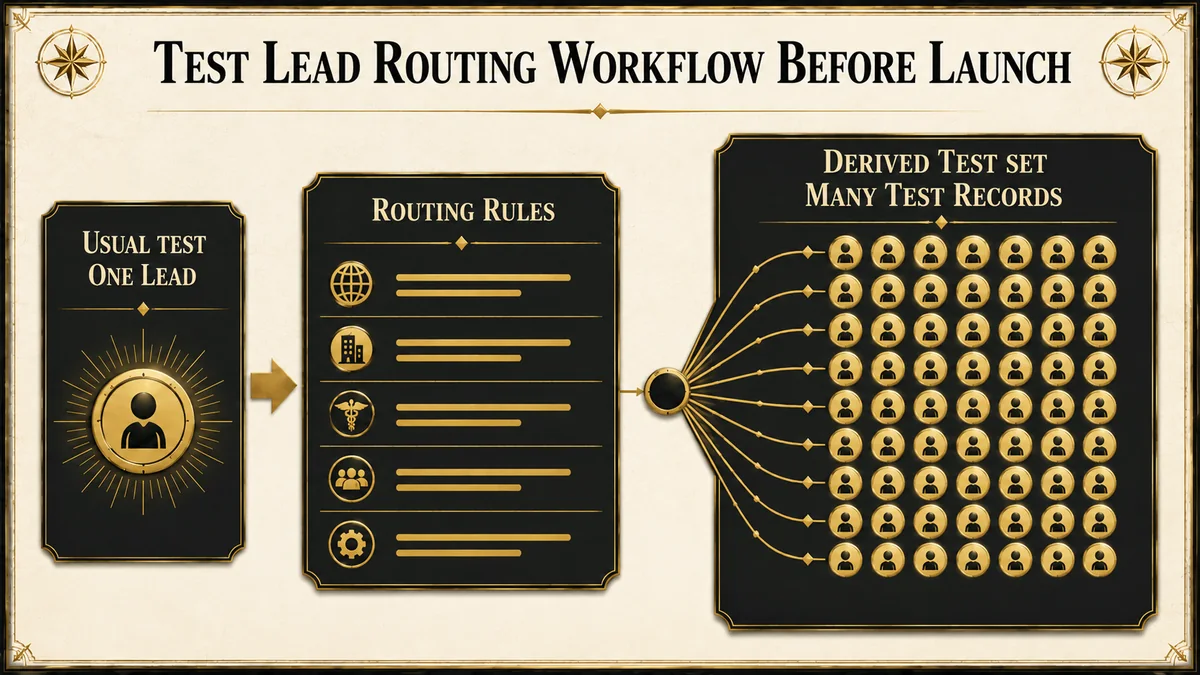
Most routing changes ship on the strength of one test lead. Someone fills in the form with their own name, watches it land on the rep they expected, and calls the rule proven. Then the first Monday arrives, and the records that do not look like that one test start going quiet.
A routing workflow is not a rule. It is a set of rules, the overlaps between them, the fallback paths underneath them, and every channel that can create a record. Testing one path proves one path. The distance between that and what you actually shipped is where leads disappear.
The pre-launch version of this problem has a useful property: nothing has broken yet, so the whole failure surface is still cheap to inspect.
Direct answer — what is lead routing testing?
Lead routing testing is the pre-launch validation of a new or changed routing workflow. You derive one test case for every rule, every overlap between rules and every fallback path, run that set through each ingestion channel in a sandbox, then compare each result against a frozen table of expected owners before any real lead reaches the rules. It differs from a lead routing audit, which diagnoses a system already running in production.
Key Takeaways
- The number of test leads you need is derivable, not a matter of judgement: one case per rule, plus one per overlap pair, plus one per fallback path, multiplied by your ingestion channels.
- Twelve rules across three channels needs roughly 57 test cases. Most teams run five and call the workflow proven.
- A sandbox proves assignment logic and precedence. It cannot prove notification, enrichment timing, capacity state or dedup behaviour, and knowing which is which is the difference between a real gate and a false pass.
- In Salesforce, a blocking duplicate rule stops the record saving before assignment ever evaluates, so a lead that vanishes in testing is often a dedup result rather than a routing result.
- Coverage is a number you can publish. Cases run divided by minimum test set, stated as a percentage, is what turns “we tested it” into a claim someone can check.
What is lead routing testing?
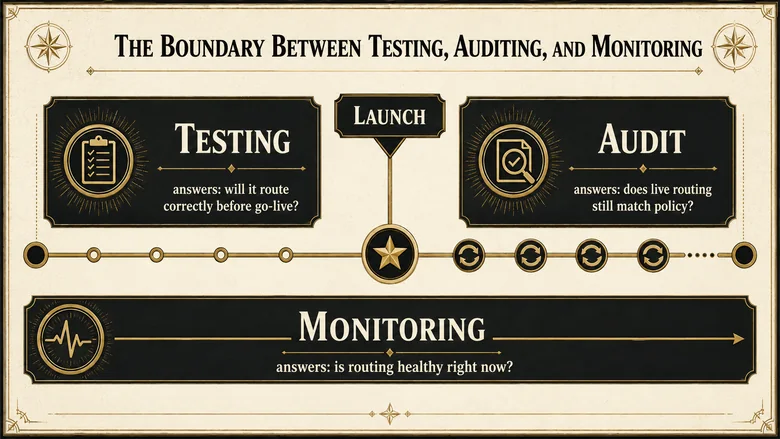
Lead routing testing is the practice of proving a routing workflow behaves as specified before it handles a real lead. It runs against a deliberate set of records built from your own rules, and it produces a pass or fail against a written expectation rather than an impression.
Three activities get called testing and they answer different questions. Keeping them apart matters, because teams routinely run the cheapest one and believe they have the assurance of the most expensive one.
| Activity | What it proves | When you run it | What it cannot tell you |
|---|---|---|---|
| Pre-launch testing | A new or changed workflow handles every rule, overlap and fallback correctly | Before the change reaches production | How the workflow behaves under real volume, real data quality and real rep behaviour |
| Routing audit | A live workflow is actually delivering owned, accepted and worked leads | Months after launch, and on a cadence | Whether a change you have not shipped yet is safe |
| Monitoring | Something has started failing right now | Continuously | Why it failed, or whether the rule was ever correct |
The distinction is not academic. A pre-launch test is the cheap, preventive version of the diagnostic work in a lead routing audit, which exists to find the leads a rule quietly misrouted over the preceding quarter. If you can catch the same defect the week before launch, you never pay for the quarter. The rules themselves, and the models they express, sit in the routing pillar.
Why “we tested it” usually means five leads and a hope
The best-ranking guides on this topic give pre-launch testing a single sentence. Chili Piper’s routing guide, updated in November 2025, advises that before you activate any router you should send dummy data through it yourself and follow the trail. That is correct and it is not enough, because it does not answer the only question that decides whether a test means anything: how much dummy data, covering what?
The failure is one of coverage, not effort. A team that submits five leads has genuinely tested. They have tested five paths through a system that has forty. The result reads as a pass because every case they thought to build was a case they had already reasoned about, and reasoning about a case is what makes you build it correctly.
A test set you invented from memory tests your memory. A test set derived from the rule table tests the rules.
This is why the pre-launch gate has to start from an artefact rather than an intention. The rule table already exists; you wrote it when you built the workflow. Everything the test needs can be derived from it, which also means the size of the job stops being a matter of opinion.
How many test leads does your routing actually need?
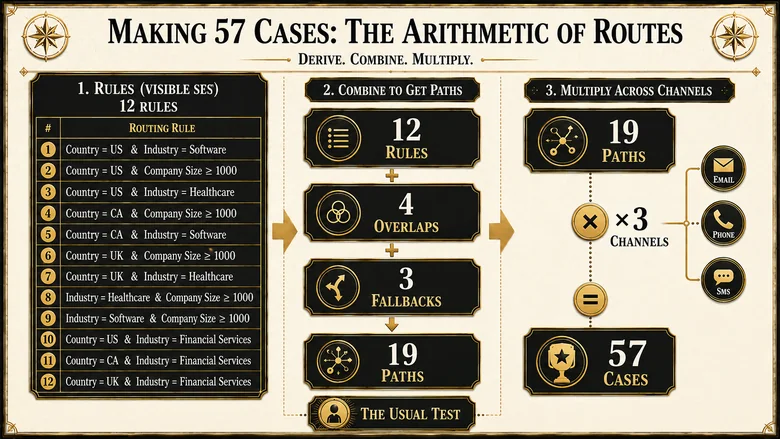
To size a routing test set, count the things that can independently decide an outcome: each rule, each pair of rules that can match the same record, and each path the record takes when nothing matches or the chosen owner is unavailable. Then multiply by the channels that can create a record. If the second count is the one you cannot answer, the gap is upstream of testing, because the overlap pairs are a property of how the rule set was ordered, not of the test.
Minimum test set = (rules + overlap pairs + fallback paths) × ingestion channelsTake a workflow with twelve routing rules. Four pairs of those rules can match the same record, because a company-size band and a territory band genuinely overlap for some accounts. Three fallback paths exist: no match, owner inactive, owner at capacity. Leads arrive through the web form, a partner API and a list import.
That is nineteen distinct decision paths across three channels, so fifty-seven cases. The number is uncomfortable, and it should be, because it is the honest size of what you built. It is also the number that makes the next conversation possible: fifty-seven cases is a defensible half-day, and it lets you argue for the half-day.
Coverage then becomes a figure rather than a feeling.
Coverage % = cases run ÷ minimum test set × 100The channel multiplier is the part teams cut first and regret most. A rule that passes when a record is created in the interface can still fail from an integration, because whether assignment fires at all depends on how the record arrived. The Salesforce assignment-rule mechanics make this concrete: an API insert only triggers assignment when the request asks for it.
You can reduce the multiplier honestly. If two channels write through the same integration path with the same payload, test one and record the equivalence as a decision. What you cannot do is drop the channel and leave the coverage figure unchanged.
Build the test records from the rule table, not from your imagination
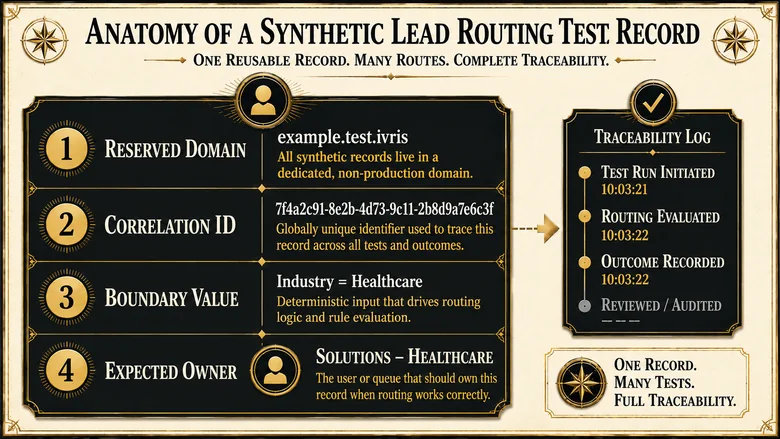
Each test case needs a record built to satisfy exactly one condition, and a written statement of the owner it should reach. Build both before you run anything, because a result you interpret after the fact is not a result.
Three properties make a test record usable more than once. Use a reserved domain such as example.com so no synthetic record can ever be mistaken for a prospect or reach a real inbox. Give each record a unique correlation ID in a spare field so you can follow it across the form export, the integration log and the CRM. And set the deciding field to the boundary value rather than a comfortable one, because a territory split at fifty employees is proved by 49, 50 and 51, not by 200.
PRO TIP
Write the expected owner for every case before you submit anything. A frozen expectation is what makes “wrong owner” a fact rather than an argument, and it stops the quiet drift where a fallback owner gets accepted as a pass.
Records that depend on matching need more care than records that depend on a field value. A case that tests lead-to-account matching only means something if the account it should match actually exists in the environment you are testing in, and a case that tests deduplication needs the duplicate to be present already. Both assumptions break in a sandbox, which is the subject of the next section.
What a sandbox cannot prove
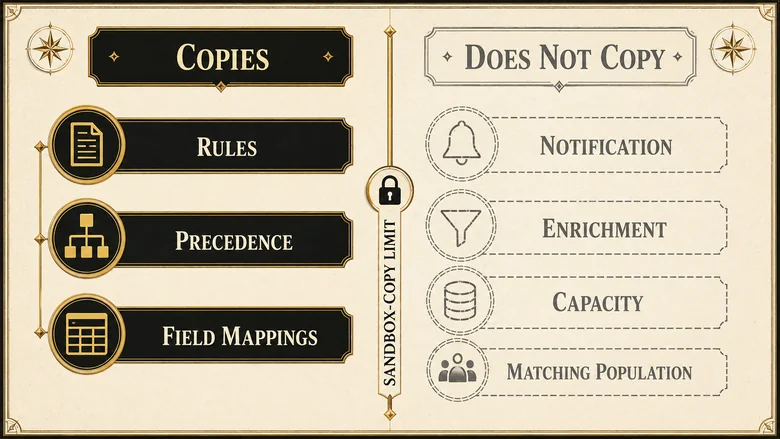
A sandbox faithfully reproduces logic and does not reproduce state. Assignment rules, precedence and field mappings copy across as metadata, so the decisions they drive are testable. Everything that depends on live connections, seat assignment, workload or populated data is not, and the gap is documented rather than mysterious. That boundary matters in AI-assisted CRM moves too: Dynamics 365 Activate’s Salesforce migration preview can accelerate discovery and execution, but routing still needs expected-owner tests against the target environment.
| What you want to prove | Sandbox proves it? | Why |
|---|---|---|
| The right rule wins for a given record | Yes | Rules and precedence are metadata and copy across |
| Overlapping rules resolve in the intended order | Yes | Order is configuration, not state |
| The assigned rep is notified | No | New and refreshed sandboxes default to System email only |
| An email alert from a flow or workflow fires | No | User addresses have .invalid appended on refresh |
| A duplicate is caught and blocked | Partly | Developer sandboxes copy metadata without data, so there is nothing to match |
| Account matching finds the right parent | Partly | A Partial Copy carries a sample, not your full account table |
| Enrichment fills the routing field in time | No | Vendor endpoints are not wired to the sandbox |
| Capacity and availability pick the right rep | No | Seat assignment and current workload differ from production |
Two of those rows are worth stating plainly because they produce confident false results. Salesforce sets new and refreshed sandboxes to System email only by default, which permits automatically generated messages such as password resets and blocks the rest. Separately, user email addresses are appended with .invalid on refresh or clone, and Salesforce is explicit that the suffix must be removed before a user can receive alerts from a workflow, process, flow or trigger. A notification step that silently does nothing in a sandbox tells you nothing about production.
Capacity is the other reliable trap. Whether a rep is eligible at all depends on live seat and workload state, and in HubSpot only main team members holding an assigned Sales or Service Hub Professional or Enterprise seat are eligible for rotation, with over-capacity users dropping out of the pool entirely. A sandbox or test portal with different seat assignments will distribute leads differently from production while appearing to work. The mechanics of the models this affects sit in round robin assignment.
None of this makes sandbox testing pointless. It makes the scope explicit: a sandbox is where you prove the decision, and a controlled production run is where you prove the delivery. Write down which rows you deferred, because an untested row that nobody recorded becomes an assumption within a week.
The two failures that look like routing and are not
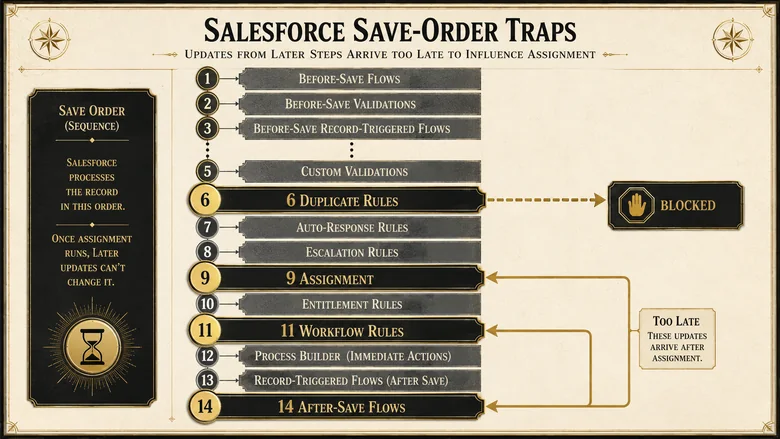
Before you interpret a single result, know the two behaviours that make a correct rule look broken. Both produce a lead that never reaches the expected owner, and both are documented platform behaviour rather than defects.
The first is order of execution. Salesforce evaluates duplicate rules at step 6 of its save order and assignment rules at step 9, and the documentation is unambiguous that when a duplicate rule uses the block action the record is not saved and no further steps are taken. The lead does not get misrouted; it never exists to route. That is a deduplication outcome wearing a routing costume.
IMPORTANT
The same ordering explains the most common routing bug of all. Assignment runs at step 9, while workflow rules run at step 11 and after-save record-triggered flows at step 14. Any routing field populated by those later steps is still empty when assignment evaluates, so the rule reads a blank and falls through to the default owner.
The second is timing. HubSpot delays the rotate-leads action by ten minutes for newly created contacts when company-to-contact owner sync is enabled, because the association has to resolve before rotation can be meaningful. A tester who checks the owner field immediately records a failure that is not one, then “fixes” a workflow that was correct.
Run the pre-launch test
With the set derived and the environment understood, the run itself is mechanical. Work through it in order, because each step depends on the artefact the previous one produced.
Workflow · 4 hours
How to test a lead routing workflow before launch
A derived, recorded test run that produces a coverage figure and a go or no-go decision for a routing change that has never handled a real lead.
Freeze the rule table and the expected owners
Export the active rules with their order and versions, and write the owner each rule should produce. Save it as a dated file so the expectation cannot move during the run.
Derive the minimum test set
Count rules, overlap pairs and fallback paths, then multiply by the channels that can create a record. Record any channel you deliberately treat as equivalent to another.
Build the test records
Create one record per case on a reserved domain, each carrying a unique correlation ID and the boundary value for the field that decides the outcome.
Confirm what the environment can prove
Check email deliverability, user address suffixes, seat assignment and whether matching data is present. Mark every stage the environment cannot exercise as deferred rather than passed.
Run every case through every channel
Submit the set through each ingestion path separately, waiting out any documented rotation delay before reading the owner field.
Score coverage and decide
Compare each result to the frozen expectation, calculate cases run against the minimum set, and classify every mismatch before making the go or no-go call.
The go/no-go decision: what blocks a launch
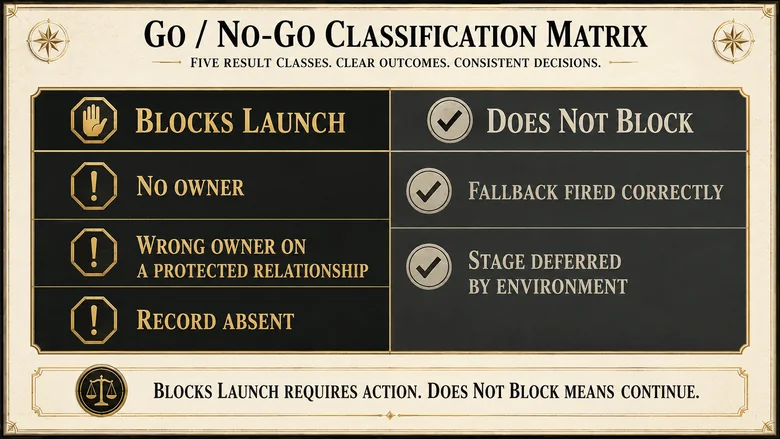
A test run only earns its cost if some result can stop the launch. Decide the blocking classes before you see the results, because a defect found at four o’clock on a Friday is remarkably easy to reclassify as minor.
Three outcomes should block. A lead that reaches no owner at all blocks, because silent loss is the failure that never generates a complaint. A lead that reaches the wrong owner on a protected relationship blocks, since a named account landing in a round robin is a commercial problem rather than a routing one. And any case where the record does not appear at all blocks until you have established whether it was rejected, blocked by a duplicate rule or simply lost.
Two outcomes should not block on their own. A fallback that fires correctly is a pass for the fallback and a flag for the rule that should have matched first. A stage the environment could not exercise is deferred, not failed, provided it is written down and scheduled for the controlled production run.
Set the coverage floor with the same discipline. A workflow tested at forty percent coverage may still be worth shipping to a limited segment; it is not worth shipping to everything. Whoever owns the number should be the person who carries the consequence, which in most teams means the RevOps owner rather than the admin who built the rules. If the tooling itself is the constraint rather than the process, the trade-offs across routing platforms are a separate decision.
The first hour after go-live
Launch with a smoke test already written, because the cases you want in the first hour are a subset you have already built. Take one positive case per critical rule, plus every fallback path, and run them in production against real reps immediately after the change is live.
This is the run that closes the rows a sandbox deferred. Notification actually sends, enrichment actually responds, capacity reflects real workload, and matching runs against the full account table. Delay costs real money here in a way it does not in a sandbox, which is the practical argument for keeping the first-hour set small and rehearsed rather than improvised. The evidence on what that delay is worth sits in the speed-to-lead research.
Keep the rollback trigger explicit and time-boxed: if the smoke test produces a blocking class, revert to the previous rule version rather than patching forward while leads are arriving. From that point the workflow stops being a change and becomes a system, and the assurance question passes to the audit cadence.
Download the pre-launch routing test plan
The test plan turns this into an artefact you can hand to someone else. You enter your rule table; it derives the minimum test set, lays out the channel matrix, records the frozen expected owners, tracks the run, and returns a coverage percentage and a go or no-go summary.
It is deliberately not an audit workbook. An audit scores a running system against evidence it has already produced; this scores a change that has produced nothing yet, from rules alone, which is why the case count is derived rather than fixed. Teams already running the same gate on campaign tracking will recognise the shape from pre-launch UTM QA.
Cite it as: IVRIS Tech, Pre-Launch Routing Test Plan (2026).
Frequently Asked Questions
Freeze your rule table and write the owner each rule should produce. Build one test record per rule, per overlap pair and per fallback path, each on a reserved domain with a unique correlation ID. Run that set through every ingestion channel, then compare each result against the frozen expectation.
Add your rule count, the number of rule pairs that can match the same record, and the number of fallback paths, then multiply by your ingestion channels. A twelve-rule workflow with four overlaps, three fallbacks and three channels needs fifty-seven cases, not the five most teams run.
Yes, but only with restraint. Use synthetic records on a reserved domain, run outside business hours, and route to a test user rather than live reps. You gain real notification, enrichment and capacity behaviour, and you accept that every record you create is real data someone must clean up afterwards.
Testing runs before launch against a change that has never handled a lead, and asks whether it is safe to ship. An audit runs months later against a live workflow, and asks which leads it already lost. Testing prevents the defect; the audit measures what a missing test cost you.
A frozen rule table with expected owners, the derived case list covering rules, overlaps and fallbacks, a channel matrix, a run log recording actual owner against expected, a coverage percentage, and a go or no-go section naming which result classes block the launch.
Methodology and sources
Platform behaviour in this article was verified against vendor documentation in July 2026. Salesforce save-order positions for duplicate rules, assignment rules, workflow rules and record-triggered flows come from the Apex developer guide’s order of execution. Sandbox email deliverability defaults and the .invalid address suffix come from Salesforce Help. HubSpot’s ten-minute rotation delay for new contacts and its seat and capacity eligibility rules for rotation come from HubSpot’s knowledge base.
The coverage formula is IVRIS’s own construction rather than a published standard, and it is stated as a minimum rather than a sufficiency claim: covering every rule, overlap and fallback path is the floor below which a test result is not interpretable, not a guarantee of correctness. No universal benchmark for routing defect rates is published here, because no defensible public source for one exists. Platform behaviour changes; re-verify the linked documentation before relying on any specific step number or default.