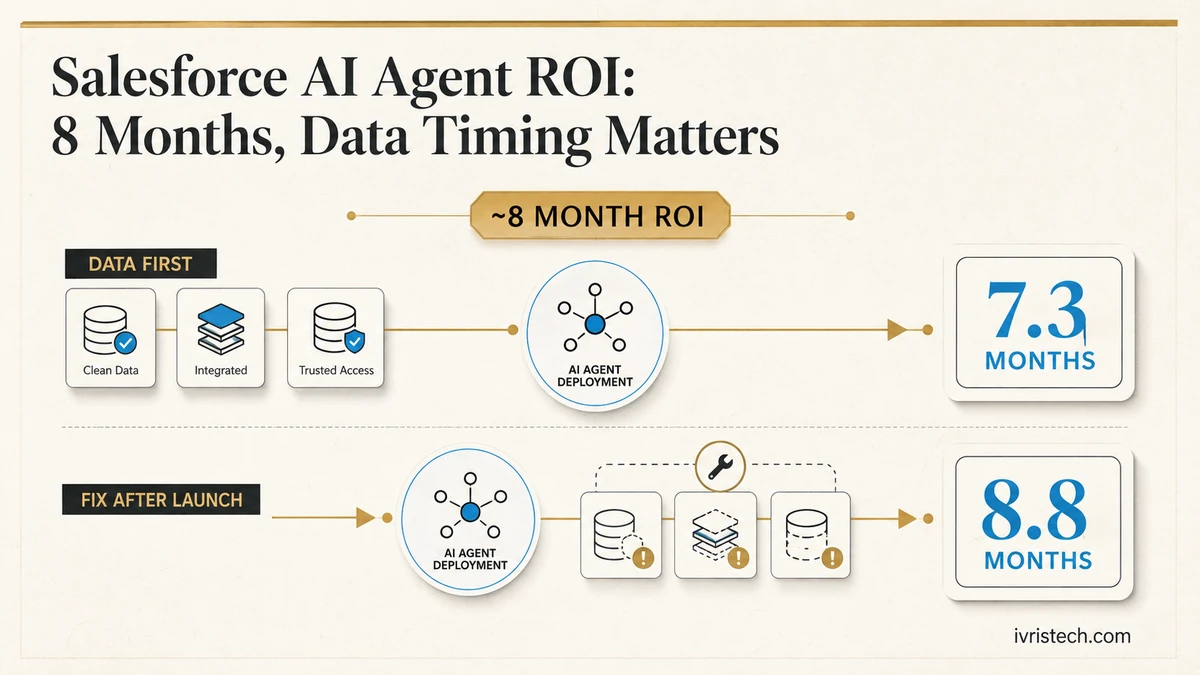
Salesforce’s new State of Agentic AI in the Enterprise research puts a number on a question most AI-agent pilots eventually face: when should the investment start producing a meaningful return? Among organizations that had fully deployed AI agents, respondents reported reaching meaningful ROI in about eight months.
The more useful number sits underneath that headline. Organizations that unified the relevant data before deploying reported meaningful ROI in 7.3 months, compared with 8.8 months for organizations that launched first and addressed data-infrastructure gaps afterward. Yet only 31% of deployers had fully unified their data before launch.
For B2B marketing and RevOps teams, that changes the readiness question. The job is not to clean every system before an agent goes live. It is to make the data required by the first workflow accurate, accessible, current, and governed before the agent is allowed to act on it. The eight-month figure is a planning benchmark, not a guaranteed Agentforce payback period.
Direct answer — how long does Salesforce say AI agents take to reach meaningful ROI?
Salesforce’s August 2026 survey says organizations with fully deployed AI agents report meaningful ROI in about eight months. Teams that unified the relevant data before deployment reported 7.3 months, versus 8.8 months for teams that fixed data-infrastructure gaps afterward. The finding is self-reported, applies to AI-agent deployments broadly, and is not an Agentforce payback guarantee.
Key Takeaways
- Salesforce surveyed 2,025 AI-agent decision-makers across 20 countries; 30% were fully deployed, 47% piloting, and 23% evaluating.
- Among deployers, the reported time to meaningful ROI was about eight months.
- Preparing the relevant data before launch was associated with a 7.3-month ROI timeline versus 8.8 months when data gaps were addressed after launch.
- Only 31% of deployers had fully unified their data before launch, so enterprise-wide data perfection was not a prerequisite.
What Salesforce Actually Measured
Salesforce fielded the double-blind survey from May 14 to May 28, 2026. All 2,025 respondents influenced AI-agent purchasing decisions, but Salesforce says most findings reflect the 30% that had fully deployed agents. The survey spans 20 countries on five continents.
The eight-month figure is an average reported by that deployed group, not a universal implementation schedule. The range also moved by sector: Professional and Business Services reported meaningful ROI in 6.5 months, while High Tech reported 10.1 months. Salesforce also says every outcome measure in the study, including time to ROI, was self-reported.
That distinction matters because the SERP is already mixing calculators, Agentforce business cases, and partner commentary under the same “ROI” label. When we looked at Agentforce ARR and adoption in May, the signal was commercial momentum, not customer-level proof of return. This new survey adds an outcome benchmark, but it still does not turn vendor revenue into buyer ROI.
The Useful Number Is the 1.5-Month Data Gap
Salesforce found that only 31% of deployers had fully unified data before launching agents. The other 69% were still integrating sources, working around gaps, or operating with fragmented data. That is an important correction to the idea that an organization has to finish a company-wide data transformation before testing an agent.
The stronger sequencing signal is narrower. Teams that unified the relevant data before deployment reported meaningful ROI in 7.3 months, compared with 8.8 months when they launched first and repaired data-infrastructure gaps afterward. Salesforce also found clean, accessible data and a tightly bounded use case were the two most-cited success factors for highly autonomous agents, at 36% each.
For RevOps, a practical way to translate that finding is to define a use-case data contract before go-live: which records the agent reads, which fields or knowledge sources it can trust, how fresh they must be, who owns exceptions, and what the agent must not infer. Teams that need a baseline can first measure CRM data quality without borrowing arbitrary target percentages.
The 8-Month Benchmark Has Two Important Limits
First, Salesforce does not publish a standardized accounting definition of “meaningful ROI” on the study page. One respondent may be counting operating-cost savings, another may be counting revenue lift, and another may be using a broader internal business-case threshold. The number is useful as a survey benchmark, but it is not a common payback formula.
Second, the 7.3-versus-8.8-month comparison is observational. It shows an association between preparing relevant data first and faster reported ROI; it does not prove the data work caused the entire difference. The publisher is also Salesforce, a vendor with a direct commercial interest in AI-agent adoption.
There is a second tradeoff in the same study. Organizations with lighter governance reported positive ROI in 7.2 months versus 9.3 months with heavier governance. But below-average-governance teams were more likely to discover an agent operating outside its parameters only after a consequential error, 32% versus 18%. Our read: shortening the ROI clock by removing controls would be the wrong lesson from this research.
What B2B RevOps Teams Should Change Before Go-Live
Start with one workflow whose before-and-after result can be measured. Record the current cost, cycle time, error rate, conversion rate, or service outcome before the agent touches the process. Without that baseline, month eight arrives and finance still cannot tell whether the agent created a return.
Then prepare only the data needed for that workflow. Map the systems and fields the agent uses at the moment it makes a decision, assign an owner for stale or conflicting records, and set an escalation path before autonomy expands. Broader cleanup can continue in parallel.
Finally, treat eight months as a review checkpoint rather than a promise. Compare your own accepted outcomes, operating cost, adoption, exceptions, and error rate against the pre-launch baseline. If the first workflow works, expand deliberately. Our AI-agent rollout model for RevOps covers the copilot-to-autopilot progression once the data and process gates are defined.
Frequently Asked Questions
No. The study surveyed decision-makers using AI agents broadly, and Salesforce says the outcome measures are self-reported. The roughly eight-month figure describes reported time to meaningful ROI among fully deployed organizations. It is not an Agentforce-specific guarantee, a contractual payback period, or a standardized financial-return calculation.
No. Only 31% of deployers had fully unified their data before launch. Salesforce’s stronger finding is about the relevant data for the agent’s job: organizations that prepared it before deployment reported meaningful ROI in 7.3 months, compared with 8.8 months when data gaps were addressed afterward.
Measure the workflow before automation: current cost, cycle time, error or exception rate, adoption, and the business outcome the agent is meant to improve. Also document the data sources and escalation rules. That gives the team a baseline for deciding whether reported gains at month eight represent real economic value.