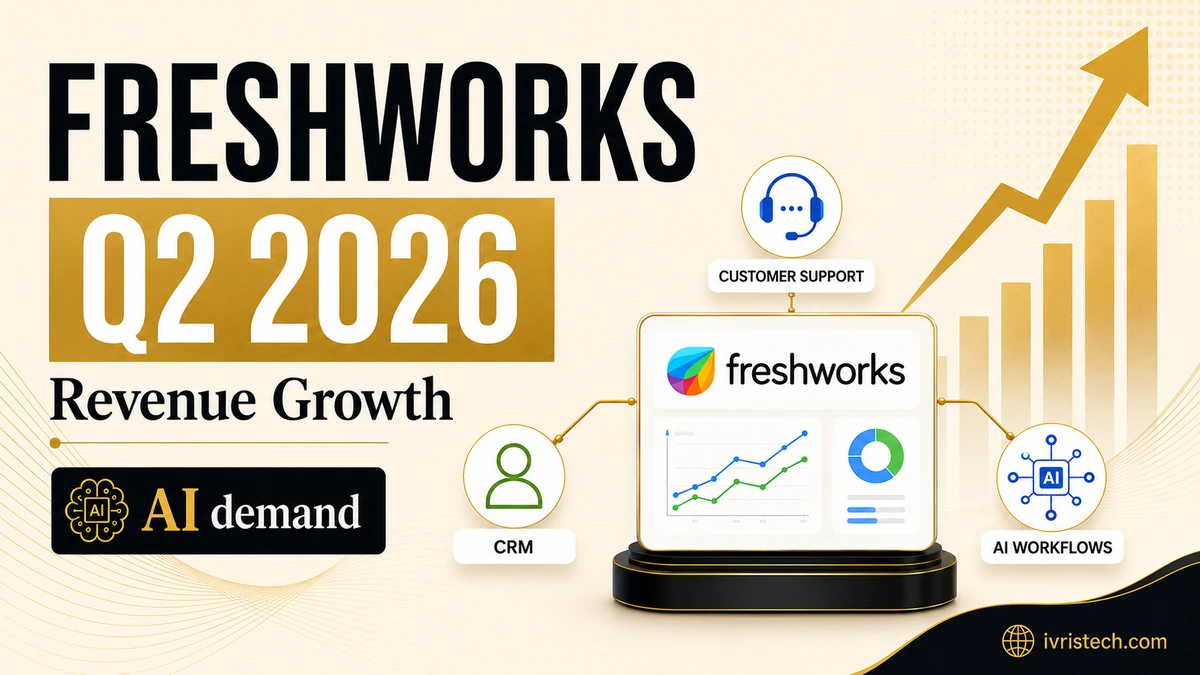
Freshworks reported $237.4 million in second-quarter 2026 revenue, up 16% year over year and 15% in constant currency. The company also raised its full-year revenue estimate to $963.5 million-$966.5 million.
The enterprise signals were stronger than the headline alone. Employee Experience ARR grew 24%, customers contributing more than $100,000 in ARR increased 25% to 1,746, and Freddy AI Copilot was attached to more than 71% of new enterprise deals. Freshworks also posted $3.2 million in GAAP net income, its first GAAP-profitable quarter of 2026.
Our read: the 71% attach rate is credible evidence that AI is becoming part of Freshworks’ enterprise sales motion. It is not proof that 71% of enterprise customers actively use Freddy AI, renew it, or expand it. The disclosed denominator is new enterprise deals, so buyers still need usage, paid-customer, and retention data before treating the figure as base-wide adoption.
Direct answer – What does Freshworks’ Q2 2026 growth show about enterprise AI demand?
Freshworks’ Q2 results show that Freddy AI is attaching to new enterprise sales while the company grows upmarket. Revenue rose 16%, Employee Experience ARR grew 24%, and Freddy AI Copilot was attached to more than 71% of new enterprise deals. The caveat is that attachment measures the initial sale, not installed-base usage, renewal, or AI-specific retention.
Key Takeaways
- Freshworks Q2 2026 revenue reached $237.4 million, up 16% year over year and 15% in constant currency.
- Freddy AI Copilot was attached to more than 71% of new enterprise deals, according to Freshworks.
- Employee Experience ARR grew 24%, while customers above $100,000 in ARR increased 25% to 1,746.
- Freshworks reported $3.2 million in GAAP net income and raised its 2026 revenue estimate to $963.5 million-$966.5 million.
- The missing AI metrics are paid-customer count, active usage, AI-specific expansion, renewal, and retained revenue.
What Freshworks Reported in Q2 2026
Freshworks’ revenue increased from $204.7 million in Q2 2025 to $237.4 million in Q2 2026. GAAP income from operations reached $6.1 million, compared with an $8.7 million operating loss a year earlier. Non-GAAP income from operations was $55.9 million, equal to a 23.6% margin.
The upmarket customer mix also moved in the same direction. Freshworks ended the quarter with 4,091 customers above $50,000 in ARR, up 18%, and 1,746 customers above $100,000, up 25%. Its Q2 earnings presentation shows the $100,000-plus cohort rising from 1,392 customers a year earlier.
Companywide net dollar retention was 104%, down from 106% in Q1 2026 and 106% in Q2 2025. That still indicates modest expansion across the existing customer cohort, but it does not isolate customers using Freddy AI or the Employee Experience product line.
Why the 71% Attach Rate Is a Real Demand Signal
An attach rate answers a more concrete question than general AI interest: how often did Freddy AI Copilot enter a new enterprise transaction? At more than 71%, the product was present in a clear majority of those deals. Combined with 24% Employee Experience ARR growth and 25% growth in the $100,000-plus customer tier, the figure supports Freshworks’ claim that AI is helping its upmarket sales motion.
Product shape may be part of the reason. A named, service-specific AI add-on can be easier to scope and evaluate than a broad platform promise. Our analysis of Salesforce’s Fin acquisition explains the same buying logic in customer service: a narrower agent path gives teams a defined workflow, outcome, and pilot boundary.
The attach rate should still be read as commercial evidence, not a causal revenue model. Freshworks did not disclose how much Q2 revenue came from Freddy AI, whether every attachment was sold at standard paid terms, or how much AI contributed to the increase in large accounts.
What the Freshworks AI Metric Does Not Prove
Our earlier reporting on Salesforce’s Agentforce ARR and adoption gap showed how AI revenue can concentrate inside a relatively small high-spend cohort. Freshworks discloses a different stage of the funnel: attachment at the initial enterprise sale. Neither metric alone reveals active usage across the full customer base.
The same discipline applies to GoDaddy’s Airo bookings-versus-adoption gap. Bookings show contract momentum; attach rate shows product inclusion. Buyers still need to know how many customers activate the feature, reach first value, return to it, and renew or expand after the first contract.
Retention is the next layer. Our analysis of Parloa’s 150% NRR shows why a cohort metric can be more informative than a launch or partnership headline. Freshworks reported 104% companywide net dollar retention, but not AI-specific NDR, renewal, or expansion. That prevents a clean test of whether Freddy AI demand is durable after the initial sale.
What B2B Buyers Should Ask Freshworks Next
- Define the denominator. Ask how Freshworks defines a new enterprise deal, which deal sizes are included, and whether expansion deals are excluded.
- Separate attachment from paid adoption. Request the number of paying Freddy AI customers, the share sold at standard terms, and the share bundled or promoted.
- Measure production usage. Track active users, sessions or resolutions, repeat use, workflow completion, deflection, and time to value.
- Connect AI to retention. Compare renewal, expansion, and NDR for customers with Freddy AI against similar customers without it.
The strongest Q2 conclusion is narrower than “enterprise AI adoption is solved.” Freshworks has shown that Freddy AI is entering new enterprise deals at a high rate while large-account growth and profitability improve. The next proof point is whether those attached customers use the product enough to renew, expand, and lift retained revenue.
Frequently Asked Questions
Freshworks reported $237.4 million in Q2 2026 revenue, up 16% from $204.7 million a year earlier. Growth was 15% in constant currency. The company also raised its full-year 2026 revenue estimate to a range of $963.5 million to $966.5 million.
Freshworks said Freddy AI Copilot was attached to more than 71% of new enterprise deals. The figure measures how often Copilot was included in that new-deal cohort. It does not mean 71% of all enterprise customers use Freddy AI or that every attached customer is active.
Yes. Freshworks reported $3.2 million in GAAP net income and $6.1 million in GAAP income from operations for Q2 2026. The company described it as its first GAAP-profitable quarter of 2026. Non-GAAP income from operations was $55.9 million.
No. It is a strong initial-sale signal, but the denominator is new enterprise deals rather than the installed customer base. Broad adoption would require paying-customer counts, active and repeat usage, production outcomes, renewal, AI-specific expansion, and retention data across existing enterprise accounts.