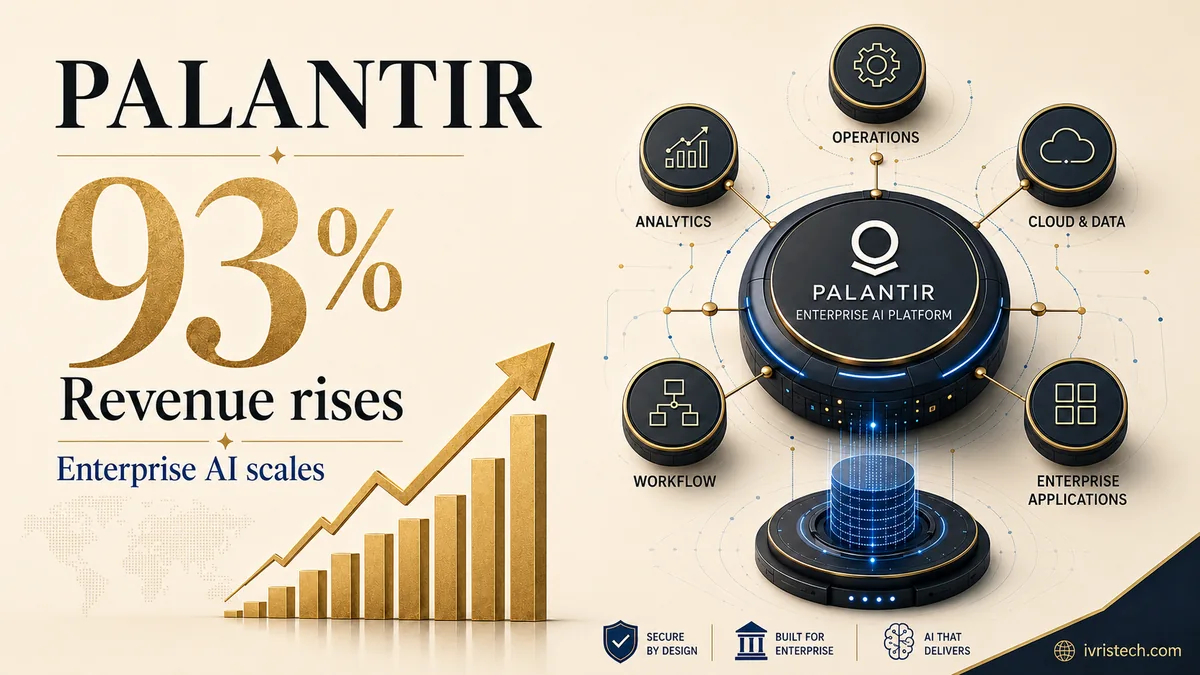
Palantir Technologies reported second-quarter 2026 revenue of $1.935 billion, up 93% year over year, while U.S. commercial revenue reached $764 million, up 149%, in its SEC-filed earnings release on August 3.
The contract indicators moved with revenue. Palantir closed 220 deals worth at least $1 million, including 73 worth at least $10 million. U.S. commercial total contract value rose 153% to $2.132 billion, and U.S. commercial remaining deal value rose 124% to $6.238 billion. Full-year revenue guidance increased to $8.150 billion to $8.158 billion.
For B2B buyers, the important part is not the stock reaction. It is the difference between evidence that enterprises are committing more budget to operational AI and proof that a particular deployment creates measurable value. Palantir supplied unusually strong demand evidence. It did not supply universal customer-level ROI.
Direct answer — What do Palantir’s Q2 2026 results say about enterprise AI adoption?
Palantir’s Q2 2026 results show strong U.S. demand for operational AI software: total revenue rose 93%, U.S. commercial revenue rose 149%, and U.S. commercial remaining deal value rose 124%. The caveat is adoption breadth. Palantir’s trailing-12-month U.S. commercial customer count grew 35%, far slower than revenue, so the quarter demonstrates vendor scale and larger contract activity, not universal customer ROI.
Key Takeaways
- Palantir’s Q2 2026 revenue reached $1.935 billion, up 93% year over year and 19% quarter over quarter.
- U.S. commercial revenue rose 149% to $764 million, while U.S. commercial customer count rose 35% to 653.
- The company closed 220 deals worth at least $1 million; U.S. commercial total contract value reached $2.132 billion, up 153%.
- U.S. commercial remaining deal value reached $6.238 billion, up 124%, while full-year revenue guidance rose to $8.150 billion to $8.158 billion.
- Palantir’s remaining deal value can include unexercised options and terminable contracts; neither it nor revenue discloses customer-level ROI.
What Palantir Reported in Q2 2026
U.S. commercial revenue grew 28% from the previous quarter, while the company’s official Q2 business update shows U.S. commercial customer count reached 653, up 35% year over year and 6% quarter over quarter. Palantir defines a customer as an organization from which it recognized revenue during the trailing 12 months. Revenue therefore grew much faster than the number of customer logos.
That difference shows the quarter was not only a logo-growth story. Larger contracts also mattered: 98 deals were worth at least $5 million and 73 were worth at least $10 million. The public materials do not split U.S. commercial revenue between new customers and expansion inside existing accounts, so the exact mix remains undisclosed.
Why the Commercial Numbers Matter More Than the Stock Move
Our read: the strongest enterprise-AI signal is the combination of revenue, total contract value, and remaining deal value. Revenue records sales already recognized. Palantir defines total contract value as the potential lifetime value of contracts signed or awarded, and remaining deal value as the value left at period end. Both measures can include unexercised options, and most contracts can be terminated. Their growth shows contract activity beyond current-quarter revenue, not guaranteed future revenue.
In our earlier reporting on OpenAI’s frontier-firms gap, the operational divide came from deeper, delegated work rather than simply sending more prompts. Palantir’s contract data supplies a vendor-side signal of a similar divide: some enterprises are committing large budgets to Palantir’s AI and data software. It does not measure how many projects across the wider market have made the same transition.
What the Results Do Not Prove
Palantir’s release does not disclose active-user penetration, production workflow counts, time to value, customer-level payback, or the distribution of ROI across commercial deployments. It also does not quantify how much of the 149% growth came from new logos versus expansion. Those omissions do not weaken the reported financial results. They limit what buyers can infer from them.
The same distinction appears in Salesforce’s Agentforce adoption gap, where fast AI revenue growth coexisted with a much smaller paid-customer cohort. Palantir offers stronger breadth evidence because its U.S. commercial customer count grew 35%, but that still does not establish that a comparable buyer will achieve the same outcome.
Management attributes the quarter partly to demand for AI sovereignty and customer control over data and operations. The results support demand for that positioning. They do not prove that the positioning caused all of the growth, that every deployment has produced economic value, or that other enterprise AI architectures cannot work.
What B2B Buyers Should Ask Before Scaling AI
- Separate demand proof from deployment proof. Revenue, deal counts, and remaining value establish vendor momentum. Ask separately for active production workflows, user adoption, exception rates, renewal behavior, and referenceable outcomes in a company comparable to yours.
- Define the economic baseline before the pilot. Record the current cost, cycle time, error rate, and revenue impact of the workflow. Set a payback window and an owner before the vendor configures the first use case.
- Map control and exit paths. Palantir’s sovereignty pitch makes model dependence, multi-cloud delivery, and vendor concentration part of the same procurement decision. Document where data is processed, whether it trains third-party models, and how workloads move if terms change.
- Stage autonomy. The implementation risks behind Gartner’s agentic AI failure forecast still apply when a vendor is growing quickly. Begin with supervised recommendations, measure accuracy and business impact, then expand permissions only when the evidence supports it.
Frequently Asked Questions
Palantir reported $1.935 billion in second-quarter 2026 revenue, up 93% from a year earlier and 19% from the previous quarter. U.S. revenue reached $1.573 billion. The company also raised full-year revenue guidance to a range of $8.150 billion to $8.158 billion.
U.S. commercial revenue reached $764 million, up 149% year over year and 28% quarter over quarter. U.S. commercial customer count reached 653, up 35% annually and 6% sequentially. Revenue therefore expanded much faster than the overall number of customer logos.
They provide strong evidence that some enterprises are making large, continuing commitments to Palantir. They do not prove that enterprise AI has moved beyond pilots everywhere. The release does not disclose active users, production workflow counts, customer-level payback, or ROI distribution across deployments.
Use the revenue, contract-value, and remaining-deal-value growth as evidence of vendor demand, not as a substitute for your own business case. Ask for comparable production references, define workflow baselines, measure adoption and exceptions, and set data-control and exit requirements before expanding a pilot.