Sarah runs RevOps at a 200-person HealthTech vendor. Her 2022 scoring model awarded +30 points for “visited /patient-portal-features 3x in the last week.” Her general counsel walked her through the HHS Office for Civil Rights Online Tracking Technologies Bulletin: the marketing page itself stayed trackable, but her analytics script had been pulling pixel-level data from the post-login patient experience for 18 months. She killed the tracker, lost half her engagement signals overnight, and watched her MQL queue collapse from 180 to 47 in one quarter.
Generic 5-criteria scoring models assume page-level tracking is legal everywhere, that one engaged contact equals one buyer, and that account-level signals are a bonus. Healthcare breaks all three. This guide gives you the 23-signal weight table for healthcare lead scoring, clinical-veto-weighted committee scoring (a CMO opposing your tool blocks the deal even when the CFO signs off), and a regulatory-trigger framework that turns HIPAA audits and CMS deadlines into positive signals — plus a downloadable Sheets template ready to copy into your CRM.
Key Takeaways
- The HHS OCR Online Tracking Technologies Bulletins (December 2022, updated March 2024) restrict tracking on authenticated patient-data pages and PHI-containing post-login content. Public marketing pages remain fully trackable, so the constraint is precise, not blanket.
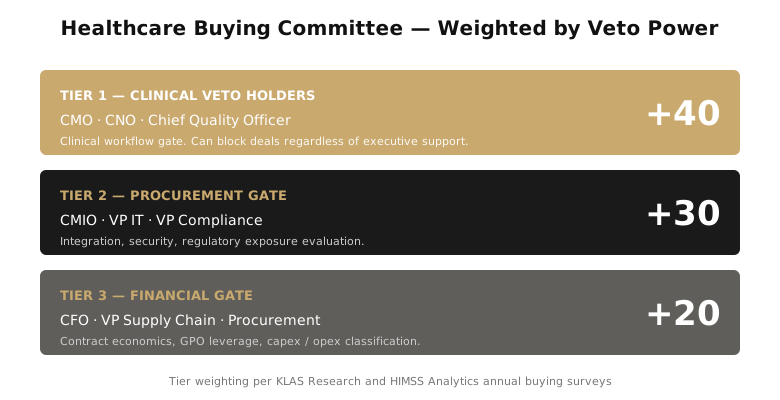
- Clinical veto-holders (CMO, CNO, Chief Quality Officer) need their own weight tier at +40 because clinicians can block deals regardless of executive support. A horizontal model that treats all C-suite roles the same misses this.
- Healthcare scoring runs at the account level, not the contact level. A 4-stakeholder hospital system buying committee accumulates signals into one account score (worked example: 300 points) where each individual contact would score 35 to 90 alone.
- Regulatory deadlines, active HIPAA audits, and recent breach disclosures on the HHS OCR Breach Portal are POSITIVE signals. They accelerate buying, not slow it.
- Decay window in healthcare is 90 days with quarterly recalibration. Federal healthcare (VA, IHS, Tricare/DHA) follows FAR/DFARS procurement and is out of scope for this commercial-segment model.
Why Generic 5-Criteria Lead Scoring Fails in Healthcare
Healthcare lead scoring is the practice of weighting prospect signals against the regulatory, organizational, and clinical realities of hospital systems, health-tech, and med-device buying. Generic 5-criteria models built for SaaS-selling-SaaS break in three predictable ways: page-tracking assumptions violate HHS OCR bulletins, single-contact MQL logic misses 4-stakeholder committees, and account-level signals get treated as a bonus instead of the unit of work.
The horizontal scoring model we walk through in lead scoring best practices assumes every vertical reads the same intent signals. Healthcare disproves that on three fronts. Page-tracking assumptions implode the moment your script touches an authenticated patient-data page. Single-contact MQL logic misses the 4-stakeholder healthcare committee — CMIO, VP IT, Compliance, CFO, CNO — where any one can stall the deal and any two aligned can kill it. And account-level scoring is not an ABM-advanced feature here, it is the default unit of work: Mayo Clinic, Mass General Brigham, Cleveland Clinic, NHS Foundation Trust, Sutter Health are the accounts, not the individual contacts at them.
HHS OCR Online Tracking Bulletins: What December 2022 and March 2024 Say
The Office for Civil Rights at the U.S. Department of Health and Human Services published guidance in December 2022 that restricted how HIPAA-regulated entities and their business associates can use online tracking technologies (analytics scripts, pixels, session replay tools) on web properties that handle Protected Health Information. A March 2024 update narrowed and clarified the scope after a Texas federal court vacated parts of the original guidance, but the core constraint held: tracking that connects an identifiable individual to a specific health condition or service implicates PHI and falls under HIPAA’s authorization requirements. The HHS HIPAA guidance index is the authoritative reference; the specific online-tracking bulletin sits inside that index.
Two things follow. First, this is not a “no tracking in healthcare” rule. Public marketing pages, ungated content, top-of-funnel resource hubs, and gated form submissions remain fully trackable. The line sits at authentication plus PHI exposure, not at the .health domain boundary. Second, the constraint does not depend on your scoring model being clever. If your analytics script fires on an authenticated patient page, you have a HIPAA exposure regardless of whether your scoring layer ever sees the data.
HIPAA-Compliant Tracking: Signals You Can vs Cannot Weight
HIPAA-compliant lead scoring weights only the prospect signals that do not implicate Protected Health Information. The 2022 and 2024 HHS OCR Online Tracking Technologies Bulletins restrict tracking on authenticated patient-data pages and PHI-containing post-login content. Public-facing marketing pages, gated form submissions, and self-disclosed firmographic data remain available, and those become the spine of a compliant scoring model.
IMPORTANT
The four signal patterns you cannot legally weight on authenticated patient-data pages: pixel-level engagement on patient-portal pages, session-replay on post-login content that exposes PHI, third-party analytics on appointment-scheduling tools that surface diagnosis information, and behavioral retargeting based on authenticated patient-page visits. All four require explicit HIPAA authorization. Move the scoring signal off the patient page and onto the marketing-funnel side.
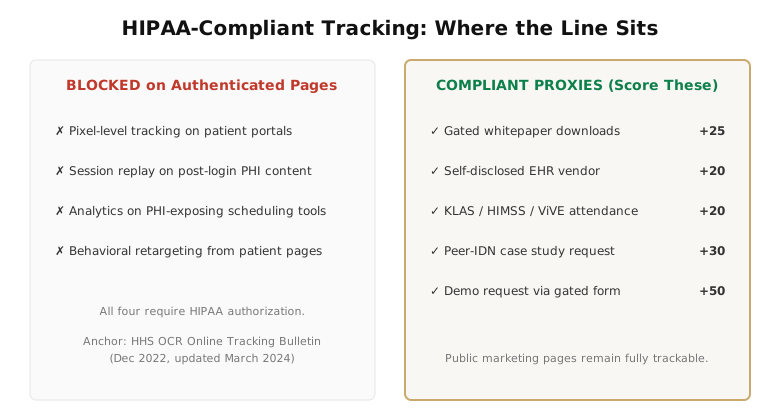
The Four Signal Categories Restricted on Authenticated Patient Pages
Authenticated patient portals (analytics pixels that fire after patient login and expose condition / appointment / medication / treatment); PHI-containing post-login content (internal hospital-system pages that surface a specific patient’s data); scheduling tools (PHI-exposed the moment a specialty selection like oncology or behavioral health connects to an identifiable user); and behavioral retargeting based on authenticated patient pages (propagates the same exposure to ad-platform audiences). A hospital-system prospect clicking through to your public pricing page is fully trackable; the same prospect inside your customer environment is not. The line sits at authentication plus PHI exposure.
Compliant Proxy Signals: What to Weight Instead
Gated whitepaper downloads on HIPAA-compliance, EHR-integration, FHIR, and patient-data-security topics — each download is an explicit form submission, no patient page involved — score at +25. KLAS / HIMSS / ViVE / RSNA / HLTH webinar or conference attendance is an explicit registration event at +20. Industry publication subscription (Becker’s, Healthcare IT News, Modern Healthcare) signals identified-buyer status at +15. Peer-hospital case study requests are the strongest non-PHI behavioral signal at +30. Demo requests via gated form score at +50 as a top-of-queue trigger.
The negative-scoring patterns from our criteria guide with point values still apply, but the healthcare disqualifier set shifts. A personal email on a healthcare form is a stronger negative signal than in horizontal B2B because compliance-aware healthcare buyers default to work email. The mental model on tracking: authentication plus PHI exposure draws the line, and your marketing site stays on the safe side of it. Pricing pages, product pages, blog posts, gated resources, and customer-story pages all carry standard analytics with no HIPAA implication — teams that overreact by killing all tracking lose legitimate signal flow they could have kept.
Healthcare Buyer Personas and Clinical Veto Power
A healthcare buying committee typically includes 6 to 10 stakeholders: clinical leaders, IT, compliance, finance, and procurement. Clinical roles like CMO, CNO, and Chief Quality Officer hold veto power. KLAS Research’s annual buying surveys consistently show clinicians can block adoption decisions regardless of executive sign-off. Scoring them at the same weight as any other VP is a model error.
The account-engagement metrics in our ABM measurement guide become the foundation when you score healthcare at the account level instead of per-contact. The roll-up logic stays the same; what changes is which contact roles carry the highest weights inside the account.
The Full Healthcare Buying Committee — Three Tiers
Clinical veto tier (+40): CMO / CMIO at the clinical-evaluation seat, CNO representing frontline workflow, CQO evaluating patient-safety and quality-metric impact. Engagement here is load-bearing. Procurement gate (+30): VP IT evaluates EHR integration (Epic, Oracle Health (formerly Cerner), Meditech, Allscripts/Veradigm, NextGen, athenahealth); VP Compliance evaluates HIPAA, HITECH, and state-level data exposure; VP Quality evaluates measurement alignment. Financial gate (+20): CFO, VP Supply Chain, Procurement evaluate contract economics, capex/opex classification, and GPO contract leverage. None of them can approve the deal alone, but each can stall it.
Clinical Veto Power: Why CMO, CNO, and CQO Engagement Saves or Kills Deals
The most consistent finding across KLAS Research and HIMSS Analytics buying surveys is that clinical workflow integration determines post-purchase adoption. A tool that wins the IT and finance evaluation but lacks CMO buy-in fails to roll out beyond pilot: clinicians refuse to use it citing workflow friction, or the CMO formally requests re-evaluation after pilot and restarts the cycle. The clinical veto tier scores at +40 — higher than the procurement gate (+30) and the financial gate (+20) — because that ordering reflects what actually drives outcomes. When clinical veto-holders are not engaged, the deal sits in pilot purgatory regardless of how many executive sign-offs you collect.
Federal and Government Healthcare: Out of Scope
This model targets commercial hospital systems, health-tech, and med-device buyers. Federal healthcare — the Department of Veterans Affairs, Indian Health Service, Tricare, the Defense Health Agency — follows a different procurement motion built on Federal Acquisition Regulation (FAR) and Defense Federal Acquisition Regulation Supplement (DFARS) contracting vehicles. The buying committee shape, evaluation criteria, and signal weights all shift. If federal healthcare is your ICP, build a separate model.
Healthcare Facility Tiers and Firmographic Scoring
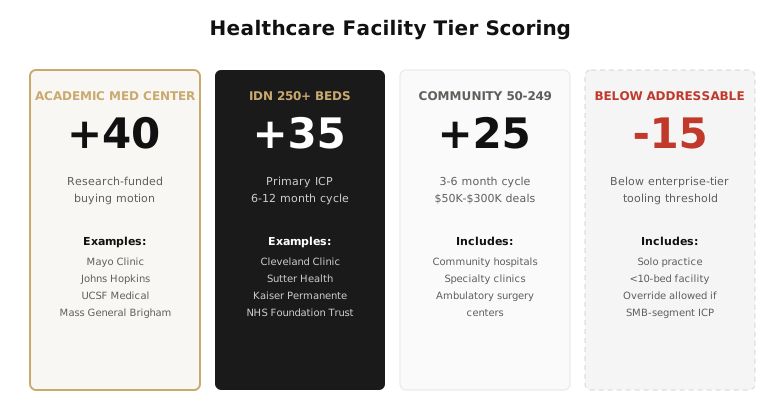
Healthcare facility scoring tiers a prospect by the procurement motion they follow. Hospital systems and IDNs above 250 beds run committee-driven evaluations with 6 to 12 month cycles. Academic medical centers add research funding constraints. Community hospitals, specialty clinics, and ambulatory surgery centers move faster but with smaller deals. KLAS Research’s market segmentation drives these tier definitions. The same bracket-and-score discipline behind scoring each facility tier on a revenue band stops those tiers from collapsing into one oversized-hospital bucket.
Hospital Systems, IDNs, Academic Medical Centers, and Community Tiers
IDNs 250+ beds (+35): primary ICP. Mayo Clinic, Cleveland Clinic, Mass General Brigham, Sutter Health, Kaiser Permanente, NHS Foundation Trusts, HCA Healthcare. Committee-driven evaluations, 6 to 12 month cycles, $200K to $2M annual deal range. Academic Medical Centers (+40): research-funded buying motion adds two evaluation layers — research grant compatibility and academic clinical-trial fit. Stanford Health Care, Johns Hopkins, UCSF Medical Center, Mayo Clinic, Mass General Brigham. Higher deal-expansion potential (research, education, clinical operations) and meaningful brand-halo effect on subsequent peer-IDN deals. Community / specialty / ASC 50-249 beds (+25): shorter cycles (3 to 6 months), smaller deals ($50K to $300K). Ambulatory surgery centers and specialty practices (ophthalmology, orthopedics, behavioral health) round out the addressable segment. Solo practice or sub-10-bed facility (-15): below enterprise-tier tooling threshold. Not a hard disqualification — override allowed for specialty practice management or single-provider productivity tools targeting that segment.
EMRAM modernization layer. The HIMSS Analytics EMR Adoption Model (EMRAM) ranks hospitals Stage 0 through 7 on EHR-modernization maturity. Stage 6-7 +20, Stage 4-5 +10, Stage 0-3 +0, additive on top of facility-band. A 250-bed IDN at EMRAM 6 has the digital readiness to adopt new clinical IT in months; the same facility at EMRAM 2 needs 18-24 months and a parallel modernization initiative first.
NAICS-code precision for firmographic enrichment. For automated enrichment via Clearbit or ZoomInfo, the relevant NAICS codes are 622 (hospitals), 621 (ambulatory health care services), and 623 (residential care). NAICS 622 + employee count above 250 surfaces the IDN tier; NAICS 621 surfaces the ambulatory-clinic tier; NAICS 623 surfaces long-term-care outside the acute-care ICP. NAICS is just one of the firmographic and technographic fields worth enriching, alongside headcount, revenue, and the clinical systems a facility runs.
GPO membership as named procurement signals. Vizient GPO +15 (largest healthcare GPO, ~$140B annual purchasing). Premier GPO +15. HealthTrust GPO +10. Account running competitive RFP across GPO contracts +20 (active vendor-evaluation). GPO contract availability shapes both deal economics and procurement signing speed — score named-GPO membership separately from facility-band.
Engagement Signals: Behavioral Scoring Healthcare-Style
Healthcare engagement scoring weights compliant proxy signals because authenticated patient-data tracking is restricted. Gated whitepaper downloads, KLAS or HIMSS webinar attendance, peer-hospital case study requests, demo submissions, and explicit EHR-integration self-disclosure form the spine of healthcare behavioral scoring. HIMSS Analytics surveys consistently rank these signals among the highest-intent activities healthcare buyers take pre-vendor-selection.
Compliant Content Engagement: Whitepapers and Publications
Healthcare buyers consume whitepapers more than any other B2B vertical because clinical and IT leaders need defensible reference material to circulate inside the buying committee. Score downloads of HIPAA-compliant EHR integration, FHIR interoperability, patient-data-security, or HL7 implementation whitepapers at +25. Becker’s Hospital Review, Healthcare IT News, Modern Healthcare, and HIMSS Media subscriptions score at +15 — the subscription itself is an identification event and often precedes downstream engagement by 2 to 4 weeks.
KLAS, HIMSS, ViVE, and Industry Conference Attendance
Conference attendance is an explicit, identified event. Score KLAS Decision Insights, HIMSS Global Health Conference, ViVE, RSNA, and HLTH attendance at +20 per session. Bonus +10 if the attendee posts publicly or follows up through your booth. The KLAS Research annual Best in KLAS report doubles as both an evaluation reference prospects consult and a credibility signal for placement-earning vendors.
High-Intent Buying Signals: Case Studies and Demo Requests
A case study request from a peer hospital system is the strongest non-PHI behavioral signal in healthcare scoring — score at +30. Peer-match matters: a community hospital requesting a community-hospital case study is stronger than the same hospital requesting an academic-medical-center case study, because the peer reference’s procurement motion shapes credibility. Demo requests via gated form score at +50 and bypass standard MQL routing, triggering immediate sales handoff regardless of cumulative account score.
EHR Vendor Self-Disclosure
Forms that ask “what EHR does your facility use?” with options for Epic, Oracle Health, Meditech, Allscripts/Veradigm, NextGen, and athenahealth produce self-disclosed firmographic signals that double as fit qualifiers. Score at +20 baseline, with vendor-specific overrides applied per the callout under the weight table. When a facility never fills that field, B2B data enrichment appends the EHR and firmographic data from third-party sources instead.
The MQL-to-SQL handoff threshold we cover in MQL vs SQL was built for one contact crossing one number. Healthcare’s reality is a 4-stakeholder committee crossing a combined account threshold. Route on account score, not contact score.
Negative Scoring and Regulatory Triggers
Healthcare negative scoring penalizes signals horizontal B2B models miss — personal email on a healthcare form is a stronger negative because compliance-aware buyers default to work email. Regulatory triggers run the other direction: active HIPAA audits, breach disclosures on the HHS OCR Breach Portal, and CMS-deadline windows accelerate buying. Both belong in the weight table, weighted distinctly. Those healthcare-specific weights make the most sense once you have the horizontal negative-scoring baseline healthcare adjusts from, where the same personal-email and competitor-domain signals carry their default B2B deductions.
Negative Signals: What to Subtract
Personal email on a healthcare form (-25): stronger negative than in horizontal B2B because compliance-aware buyers default to work email — a Gmail or Yahoo address usually signals a researcher, journalist, job seeker, or competitor. Wrong-segment domain (-20): federal healthcare prospects if you sell commercial, non-healthcare consultancies, or software-vendor competitors. Single engagement followed by 90-day stall (-20): indicates researcher, not buyer. Content-only prospects (downloads without form fills) score 0 — neutral — because top-of-funnel content consumption is normal for clinical and IT staff researching technical questions.
Regulatory Triggers as POSITIVE Signals
This is the inversion most B2B vendors miss. An active HIPAA audit is not buying-cycle drag, it is an acceleration signal: compliance needs evidence of remediation, IT needs solution-evaluation receipts for the audit committee, legal wants vendor-risk-assessment documentation. Score active audit pending at +30. Recent breach disclosure on the HHS OCR Breach Portal works the same way (public disclosures = identifiable accounts with active remediation budget): +30. Concrete dated regulatory windows beat hand-wavy “compliance deadlines”: Joint Commission (TJC, formerly JCAHO) triennial survey within 12 months, CMS Promoting Interoperability (formerly Meaningful Use) attestation within 90 days, OCR audit notification received, or state-level data-protection deadlines within 6 months — each at +25.
Time Decay: Healthcare 90-Day Window
Healthcare signal decay runs 90 days. Each signal weight × max(0, 1 − days_since_last_engagement ÷ 90). Full reset at 90 days. Quarterly recalibration aligned to healthcare procurement quarters: Q1 EOY budget close-out, Q2 fiscal-year planning, Q3 HIMSS / conference season, Q4 budget commitment. The window is longer than horizontal B2B (30 to 60 days) because healthcare evaluation cycles run 6 to 12 months — signals need to persist across at least one quarterly cadence.
The 23-Signal Healthcare Weight Table
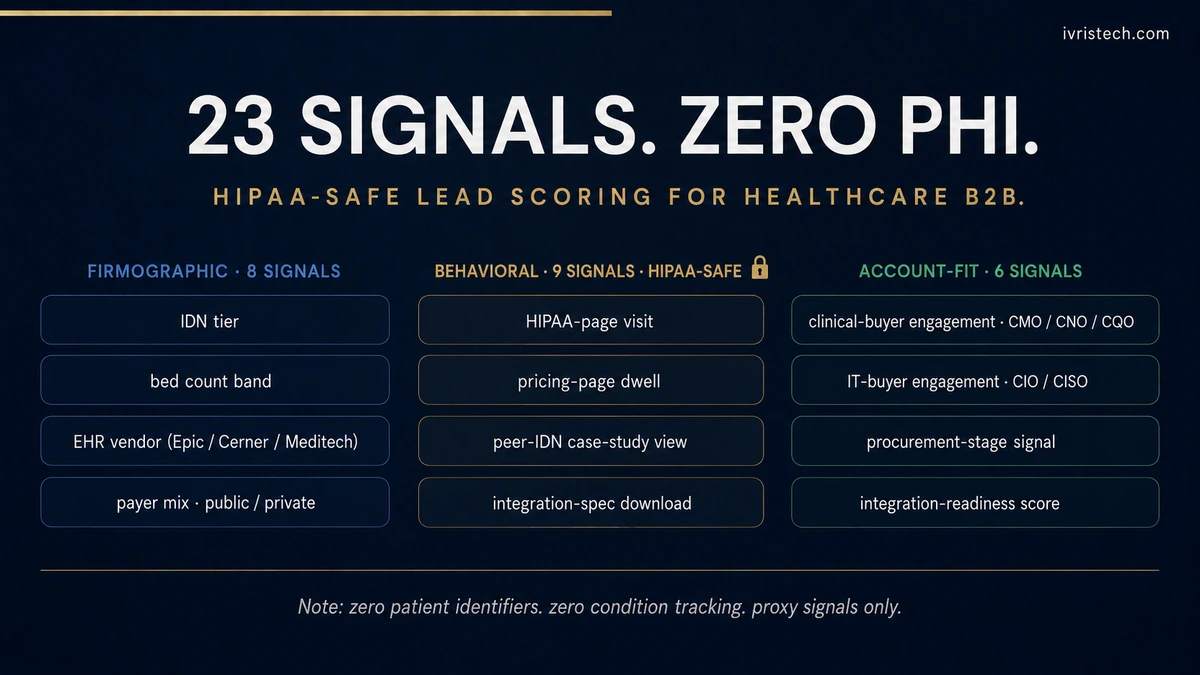
The 23-signal healthcare lead scoring matrix assigns point values across firmographic facility tier, buying-committee role, behavioral engagement, account-level technology fit, regulatory triggers, and negative signals. Total points per account, not per contact. MQA threshold defaults to 100, configurable per ICP. Decay window 90 days with quarterly recalibration aligned to healthcare procurement quarters.
| # | Signal Type | Specific Signal | Weight | Notes / Constraint |
|---|---|---|---|---|
| 1 | Firmographic (facility band) | Hospital system / IDN 250+ beds | +35 | Primary ICP |
| 2 | Firmographic (facility band) | Academic medical center | +40 | Separate procurement; research-funded |
| 3 | Firmographic (facility band) | Community hospital / specialty / ASC 50-249 beds | +25 | Shorter cycles, smaller deals |
| 4 | Firmographic (facility band) | Solo practice or <10-bed facility | -15 | Below addressable size |
| 5 | Firmographic (role band) | CMO / CNO / Chief Quality Officer engaged | +40 | Clinical veto power per Healthcare SERP AIO |
| 6 | Firmographic (role band) | CMIO / VP IT / VP Compliance engaged | +30 | Procurement gate |
| 7 | Firmographic (role band) | CFO / VP Supply Chain / Procurement engaged | +20 | Financial gate |
| 8 | Behavioral | Whitepaper download: HIPAA / EHR / FHIR / patient data | +25 | Gated-form proxy |
| 9 | Behavioral | KLAS / HIMSS / ViVE / RSNA / HLTH webinar or conference | +20 | Explicit registration |
| 10 | Behavioral | Industry publication subscription (Becker’s, Healthcare IT News, Modern Healthcare) | +15 | Identified-buyer signal |
| 11 | Behavioral | Case study request (peer hospital system) | +30 | Strongest non-PHI behavioral signal |
| 12 | Behavioral | Demo request via gated form | +50 | Top-of-queue trigger; bypass routing |
| 13 | Account (tech fit) | EHR vendor self-disclosed match (Epic, Oracle Health, Meditech, Allscripts/Veradigm, NextGen, athenahealth) | +20 | Vendor-specific overrides in callout below |
| 14 | Account (tech fit, banded) | HIMSS EMRAM modernization stage (Stage 6-7 / 4-5 / 0-3) | +20 / +10 / 0 | HIMSS Analytics EMR Adoption Model; modernization-readiness; pairs additively with facility-band |
| 15 | Account (tech fit) | Health-system tech-stack overlap (HIE membership, FHIR-capable, Epic App Orchard / Oracle Health Open Developer listed integrations) | +20 | Integration depth signal |
| 16 | Account (buying cycle) | Account in active pilot / RFI / RFP cycle (self-disclosed or Bombora / 6sense category intent surge) | +35 | Active evaluation |
| 17 | Account (regulatory) | Joint Commission (TJC, formerly JCAHO) survey within 12 months / CMS Promoting Interoperability attestation within 90 days / OCR audit notification received / recent breach disclosure on HHS OCR Breach Portal | +30 | POSITIVE signal; accelerates buying |
| 18 | Account (patient population) | Patient population >500K | +10 | Enterprise tier |
| 19 | Account (patient population) | Patient population 50K-500K | +5 | Mid-market tier |
| 20 | Account (patient population) | Patient population <50K | -5 | Below addressable for enterprise tooling |
| 21 | Account (payer mix) | High commercial payer mix, low Medicaid (for ROI-sensitive tools; verify per ICP) | +10 | Verify alignment with ICP economics |
| 22 | Account (change-readiness) | Recent C-suite hire (CMO, CIO, CMIO, COO within last 6 months) | +15 | New leader = new initiatives |
| 23 | Negative | Personal email on healthcare form (gmail, yahoo, hotmail, outlook.com) | -25 | Stronger negative than horizontal B2B |
| — | HHS OCR BLOCK | Tracking authenticated patient-portal pages / PHI-containing post-login content / logged-in patient communications | N/A — DO NOT WEIGHT | Anchored to HHS OCR Online Tracking Bulletin (Dec 2022 + Mar 2024) |
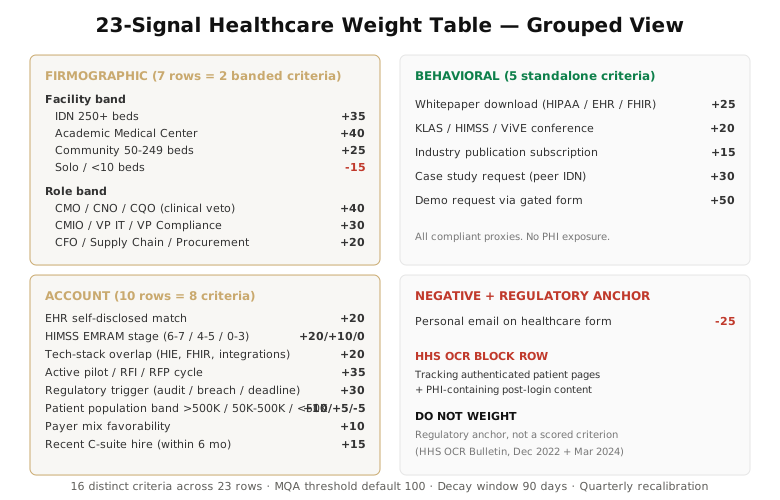
EHR vendor-specific overrides (apply on top of row 13 +20 baseline). Row 13 scores at +20 for any matched EHR. In production deployments, apply vendor-specific overrides reflecting market share, integration depth, and segment economics: Epic-anchored health system override to +25 (~40% market share, deepest integration interest, App Orchard ecosystem signal). Oracle Health (formerly Cerner) hold at +20 — flag VA / DoD overlap, and if a federal-healthcare signal is present, drop to 0 and re-route to the federal-procurement workflow. MEDITECH +15 (community-hospital concentration). Allscripts/Veradigm +10. NextGen +10. athenahealth +10 (ambulatory-heavy, smaller per-deal ACV).
Criterion count discipline. The model contains 16 distinct scoring concepts across 23 rows. Where a concept has tier or value bands (facility band rows 1 to 4, role band rows 5 to 7, EMRAM band row 14, patient population band rows 18 to 20), the bands count as one criterion together. The HHS OCR BLOCK row is a regulatory anchor, not a scored criterion; it documents what the model deliberately does not track.
Worked Example: HealthSystemX (Large IDN, 350-Bed)
HealthSystemX, a 350-bed IDN, accumulates over 90 days: Hospital 250+ beds (+35), CNO clinical-veto engagement via peer-IDN webinar (+40), CMIO at procurement gate (+30), HIPAA whitepaper download (+25), KLAS webinar (+20), peer-IDN case study request (+30), gated demo request (+50), Epic EHR disclosed (+20), 6sense RFP-cycle surge (+35), recent CMIO hire (+15). Total: 300 points, MQA threshold (100) crossed three times over.
Contrast: a horizontal person-level model splits these signals across 3-4 individual contacts. Each scores 35 to 90 — below the standard MQL threshold of 40 — and the opportunity surfaces as 3 or 4 mediocre leads instead of 1 hot account. The healthcare model surfaces it because it scores at the account level with clinical-role-weighted committee evaluation.
Implementing Healthcare Lead Scoring in HubSpot or Salesforce
Implementing healthcare lead scoring in HubSpot or Salesforce Einstein requires HIPAA-aware tracking configuration at the script layer, not the scoring layer. Allowlist trackable pages; exclude authenticated patient-portal paths from any analytics script that touches your scoring model. Rules-based scoring works for the first 6 to 12 months; AI/predictive becomes worth it past 5,000 scored historical leads with closed-won outcomes.
HubSpot Lead Scoring with HIPAA-Aware Tracking
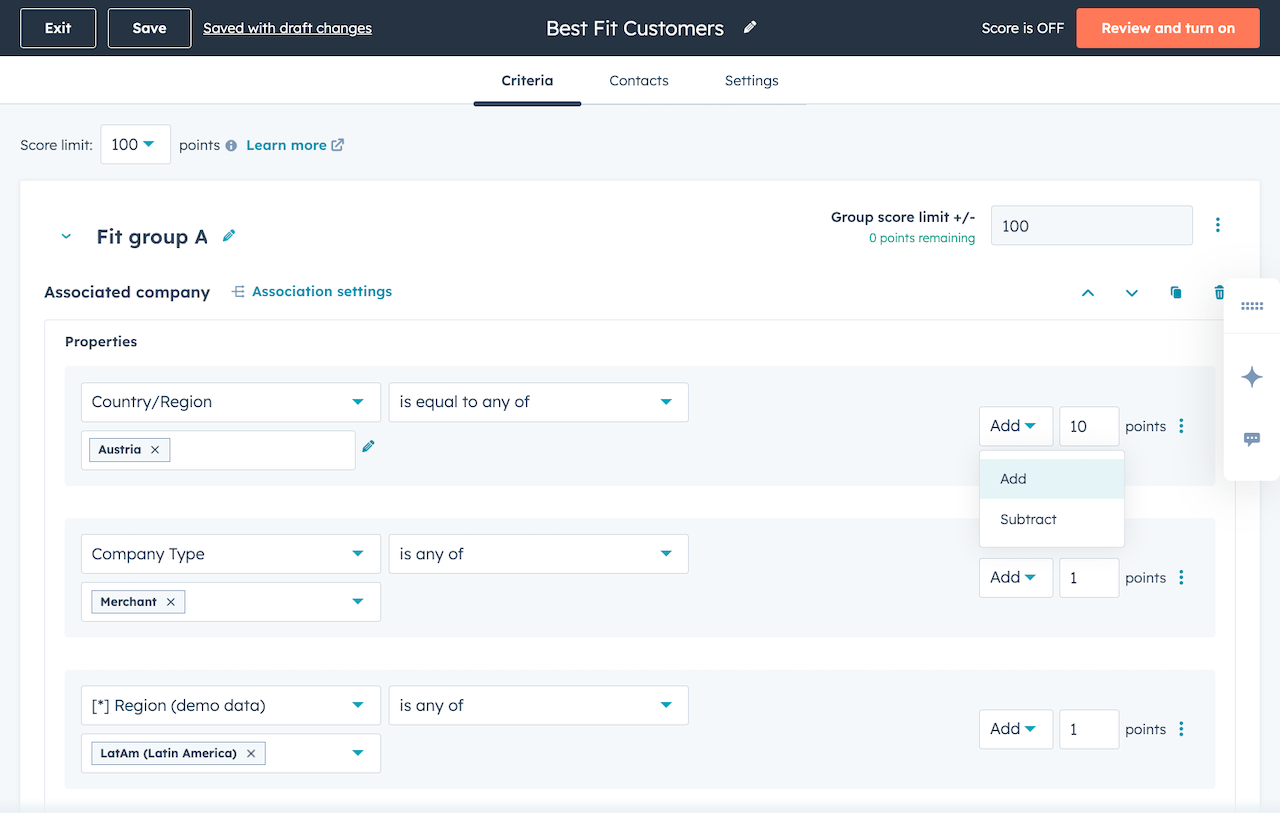
Build the 23-signal model as a custom score in HubSpot Professional or Enterprise. The HIPAA work happens upstream: load your HubSpot tracking script only on public marketing pages, never on authenticated patient-portal or post-login healthcare content. The decay formula auto-applies inside the Sheets template and replicates in HubSpot via a calculated property:
signal weight × max(0, 1 − days_since_last_engagement ÷ 90)At day 90 the signal resets to zero. The HubSpot Academy and Knowledge Base (“Score leads in HubSpot”) cover the rule-building UI mechanics.
Salesforce Einstein Lead Scoring for Healthcare
Einstein uses machine learning over historical conversion data. Under 5,000 scored historical leads with clean closed-won outcomes, the model overfits on noise; above that, Einstein surfaces non-obvious patterns. For healthcare deployments, exclude authenticated patient-data fields from the training feature set at field configuration — not at scoring-rule level — because Einstein’s auto-feature-selection will pull any available field into the model.
Salesforce Marketing Cloud Scoring for Healthcare
Marketing Cloud’s scoring engine sits upstream of Einstein. Score-on-engagement runs in the marketing engagement layer (Journey Builder, Email Studio); Einstein consumes scored leads for predictive ranking once 5,000+ historical conversions exist. Configure Marketing Cloud data extensions to exclude any PHI-flagged field from scoring rules — a separate exclusion from Einstein’s feature-set exclusion, because Marketing Cloud rules and Einstein features are independent configuration layers and missing one leaves the other exposed.
When to Graduate from Rules-Based to AI/Predictive
The 5,000-scored-historical-lead threshold is the practical floor. Below it, AI-trained models cannot distinguish signal from noise reliably and sales loses trust. Above it, AI surfaces patterns the rule writer missed (signal combinations, time-decay curves, role-by-EHR interaction effects). Hybrid approach: keep rules-based running as a sanity check while AI/predictive layers on top; flag for manual review when AI scores diverge from rules scores by 20+ points on the same account.
Healthcare in the Broader Industry Cluster
Healthcare is one of five distinct lead-scoring deep-dives in the IVRIS industry cluster, each weighting different regulatory environments, buying-committee shapes, and signal hierarchies. The horizontal scoring fundamentals — inputs the model needs from your inbound funnel — sit in the foundational lead-scoring pillar; the per-industry overrides live in each vertical’s deep-dive.
Manufacturing scores Tier-1 OEM versus Tier-2 supplier versus job shop with sector certifications (ISO 9001, IATF 16949, AS9100). Financial Services weights multi-stakeholder committees against GLBA and SOX. B2B SaaS scores product-led signals — free-trial activation, in-product usage events, PQL versus MQL distinction. B2B E-Commerce scores multi-approver buying workflows. The full SaaS deep-dive sits in the B2B SaaS lead scoring deep-dive, including PLG/sales-led merge logic at the account level, reverse-trial decay curves, and the reverse-ETL pattern that brings product-warehouse signals into the CRM.
Healthcare SaaS and Health IT vendor sub-segment. Healthcare-SaaS and pure Health IT vendors (clinical decision support, RCM software, telehealth platforms, patient engagement SaaS) score this model with one modification: clinical-veto weight stays at +40 because clinical workflow integration still determines adoption, but the IT-and-compliance tier (CMIO, VP IT) becomes the primary purchase initiator rather than the gate. Clinical veto remains a deal-blocker, just acts later in the evaluation cycle. Adjust signal ordering for SaaS-segment deployments, not the weights themselves.
The inbound funnel that feeds healthcare account-level scoring looks different from the per-lead inbound model. The inbound strategies for filling pipeline still apply, but the conversion event is account-first, not contact-first: a peer-IDN case study request from any contact at the target account is the signal, not which specific contact requested it.
Download the Industry Lead Scoring Template — the Healthcare tab has all 23 signals, HIPAA-safe flags, the 90-day decay formula, the per-signal decay calculator, and the MQA threshold calculator pre-built. Manufacturing tab arrives with the next cluster article; Financial Services, B2B SaaS, and B2B E-Commerce tabs follow.
Health-data rules by region: it is not just HIPAA
HIPAA-safe is a US frame. If you market to or score healthcare leads outside the US, a different regime governs how you may collect, store, and use health-related data. Confirm the local rule before you run a model on real records.
| Region | Governing regime | What it means for lead capture and scoring |
|---|---|---|
| United States | HIPAA | Protects PHI held by covered entities and business associates; most marketing to patients needs prior authorization. |
| United Kingdom | UK GDPR + DPA 2018; Caldicott Principles / NHS DSP Toolkit | Health data is special-category data: it needs explicit consent or a specific Article 9 condition; NHS-facing work adds Caldicott and DSP Toolkit duties. |
| European Union | GDPR Article 9 | Health-data processing requires explicit consent or a narrow legal basis; data-minimisation and purpose-limitation are enforced. |
| Canada | PIPEDA + provincial health-privacy laws (e.g. PHIPA in Ontario) | Knowledge-and-consent model federally; provincial health-information acts add stricter handling duties. |
| Australia | Privacy Act 1988 / Australian Privacy Principles; My Health Records Act | Health data is sensitive information: it generally needs consent to collect, with extra rules for My Health Record data. |
Bottom line: a HIPAA-safe model is necessary but not sufficient abroad; map your lawful basis per market. This is a summary, not legal advice. Last reviewed: June 2026.
Frequently Asked Questions
Not automatically. HIPAA is a US law. The UK and EU treat health data as special-category data under GDPR (explicit consent or a specific legal basis), Canada adds provincial health-privacy laws like PHIPA, and Australia treats it as sensitive information under the Privacy Act. A model built only around HIPAA can still breach those regimes, so map your lawful basis for each market you operate in.
No. The HHS OCR Online Tracking Technologies Bulletins (December 2022, March 2024 update) restrict tracking only on authenticated patient-data pages and PHI-containing post-login content. Public-facing marketing pages, ungated content, gated form submissions, and self-disclosed firmographic data remain fully trackable. The line sits at authentication plus PHI exposure, not at healthcare web tracking generally.
Use gated-form proxies (whitepaper downloads, webinar registrations, case study requests, demo requests) as your behavioral signal source. Self-disclosed EHR vendor and tech-stack data from forms provides firmographic fit. KLAS, HIMSS, and ViVE conference attendance signals identified-buyer status. The 23-signal weight table is built entirely from compliant signal categories.
Clinical workflow integration determines post-purchase adoption. KLAS Research’s annual buying surveys show clinicians who oppose a tool during evaluation can block adoption regardless of executive sign-off — either by refusing to use it post-pilot or by triggering a CMO-initiated re-evaluation that restarts the cycle. Weighting clinical veto-holders (CMO, CNO, CQO) at +40 reflects this reality.
Rules-based for the first 6 to 12 months. AI/predictive becomes worth it past 5,000+ scored historical healthcare leads with closed-won outcomes — below that the model overfits on noise. Hybrid approach: keep rules-based running as a sanity check while AI/predictive layers on top; flag for manual review when AI and rules scores diverge by more than 20 points on the same account.
No. Federal healthcare (VA, IHS, Tricare, DHA) runs on FAR/DFARS contracting, GSA schedules, and government contracting-officer roles. This model targets commercial healthcare B2B: private hospitals, IDNs, ambulatory surgery centers, and multi-specialty groups. The clinical-veto weighting and HIPAA-safe signals still apply, but the firmographic and engagement rubrics need a federal-specific rewrite.