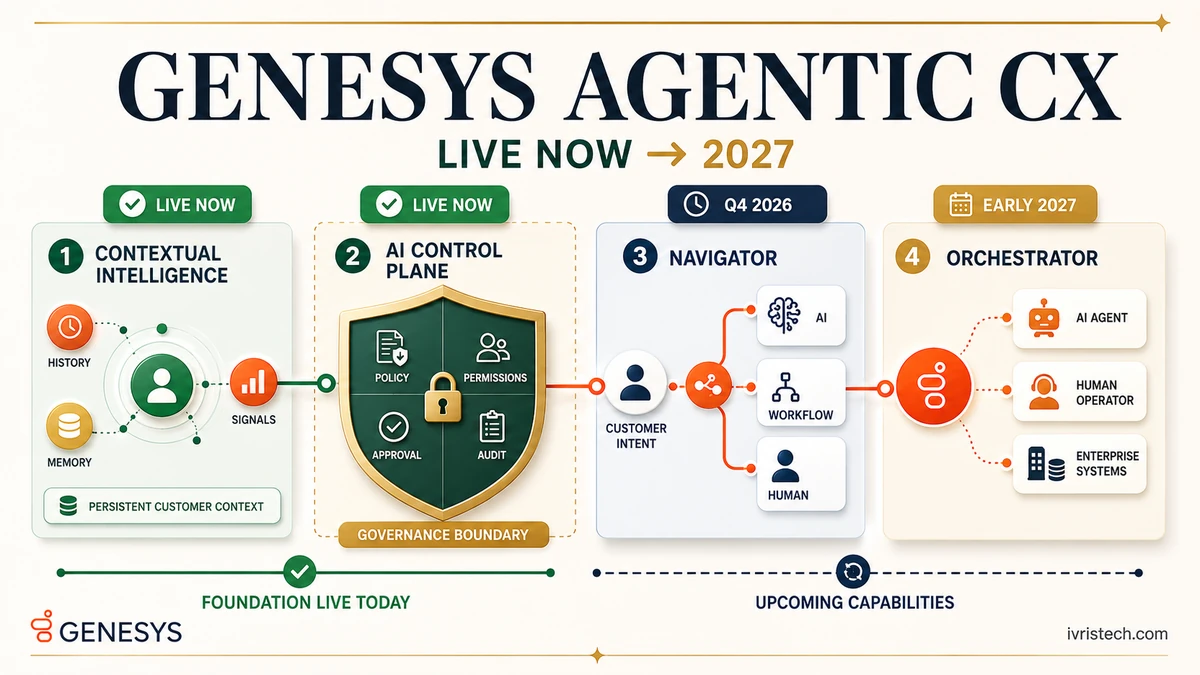
Genesys used Xperience 2026 on September 2 to introduce four layers for agentic customer experience: Genesys Cloud Navigator, Genesys Cloud Orchestrator, Contextual Intelligence and the AI Control Plane. The product-state detail matters. Contextual Intelligence and the AI Control Plane are available now, while Navigator and Orchestrator are scheduled for later general availability. That architecture story is separate from Genesys’s new outbound campaign diagnostics, which use Copilot to explain campaign health and blocking conditions rather than orchestrate customer journeys.
Navigator is expected to reach GA November 1, 2026 through January 31, 2027, with Orchestrator following February 1 through April 30, 2027. The memory and governance layers are shipping; two components that complete the intent-to-outcome path are still forward-looking.
For B2B marketing, RevOps and CX teams, this is a procurement and operating-model issue, not a naming detail. When we covered Talkdesk’s orchestration measurement gap, the question was whether AI activity could be connected to business outcomes. Genesys adds an earlier question: which part of the orchestration stack is actually deployable when the evaluation begins?
Direct answer — what is available in the Genesys agentic orchestration stack?
As of Genesys’s September 2, 2026 announcement, Contextual Intelligence and the AI Control Plane are available now. Genesys Cloud Navigator is expected to reach general availability between November 1, 2026 and January 31, 2027. Genesys Cloud Orchestrator is expected between February 1 and April 30, 2027. Governance and persistent context can therefore be evaluated today; the full Navigator-to-Orchestrator journey is still on the roadmap.
Key Takeaways
- Available now: Genesys Cloud Contextual Intelligence and the AI Control Plane.
- Future GA: Genesys Cloud Navigator is expected November 1, 2026 through January 31, 2027.
- Future GA: Genesys Cloud Orchestrator is expected February 1 through April 30, 2027.
- Governance sits in the AI Control Plane: policies, permissions, guardrails, observability and human approvals where needed.
- Human/AI coordination sits across Navigator and Orchestrator: Navigator chooses the next resource; Orchestrator is designed to maintain journey state and coordinate work across AI, people and systems.
What Genesys Actually Put Live on September 2
Contextual Intelligence is the persistent-memory layer. Genesys describes it as connecting real-time signals with customer identity, history, business events and journey context so later decisions do not start from a blank slate. This is available now.
The AI Control Plane is the governance layer. Genesys says it centralizes discovery, identity, policy and observability for AI participating in customer journeys. In its product launch blog, the company is more explicit: the layer applies policies, permissions, guardrails and human approvals where needed, while bringing interactions, tool calls, decisions and outcomes into a shared operational view. This is also available now.
Enterprises can therefore evaluate the memory and control foundation today. The components that decide where work goes and coordinate a changing journey are still scheduled releases.
Governance and Orchestration Sit in Different Layers
Genesys Cloud Navigator is designed to sit at the front of the journey. It interprets intent, clarifies ambiguity and determines whether the customer should move to an AI agent, an automated workflow or a human employee, while carrying context forward. That is where the first human-versus-AI routing decision is meant to happen.
Genesys Cloud Orchestrator is the journey-decisioning layer. It is designed to maintain journey state and coordinate the next step across AI agents, human employees and enterprise systems as conditions change. If verification or approval is required, Genesys says Orchestrator will keep the journey intact.
The AI Control Plane does a different job: it governs what those actors are allowed to do. Genesys’s own framing separates the journey decision from the permission boundary. That distinction also shows up in Twilio’s conversation-layer architecture, where memory and orchestration are separate operating concerns even though the product packaging differs.
Our read: this separation is the strongest part of the announcement. “Agentic orchestration” can become a catch-all for routing, automation, memory and governance; Genesys has assigned those jobs to distinct layers.
The Full Stack Is Still a Roadmap
Navigator and Orchestrator are not available now. The dedicated announcement gives specific windows: Navigator in November 2026 through January 2027, then Orchestrator in February through April 2027. Genesys’s launch blog summarizes them as Q4 2026 and H1 2027.
There is one source inconsistency worth recording. Genesys’s broader fiscal Q2 momentum release calls Orchestrator a first-quarter-of-next-fiscal-year release but prints February 1 through April 30, 2028. The dedicated product release says 2027, and the product blog also points to 2027. IVRIS is therefore treating the dedicated product announcement as the controlling availability source unless Genesys issues a correction.
Genesys does have agentic automation today through Agentic Virtual Agent. The narrower point is that the four-layer architecture announced September 2 is not one fully GA stack. That distinction is also why customer journey orchestration is distinct from ordinary automation.
What Enterprise CX Teams Should Verify Now
Separate current capability from roadmap capability in the evaluation sheet. Put Contextual Intelligence and AI Control Plane in a “deploy now” column. Put Navigator and Orchestrator in dated roadmap columns. Do not let a platform-level demo collapse those states into one procurement checkbox.
Map the human approval boundary before expanding autonomy. Ask which actions can run automatically, which require approval, which identities and permissions the Control Plane can enforce, and what happens when an AI agent requests a tool or action outside policy.
Test the handoff evidence. For one journey that moves from AI to a person and back to a system, verify whether identity, context, decisions, approvals and outcome state remain reconstructable.
Contract around the dates that matter. If Navigator or Orchestrator is part of the business case, record the GA dependency, plan and region eligibility, pricing assumptions and a fallback if the release moves.
Frequently Asked Questions
Yes. Genesys says the AI Control Plane is available now as of its September 2, 2026 announcement. It is positioned as the governance and oversight layer for enterprise AI, with centralized discovery, policy, permissions, guardrails and observability. Genesys also describes human approvals as part of the control model where required.
Genesys expects Navigator to reach general availability in the fourth quarter of its current fiscal year, from November 1, 2026 through January 31, 2027. Navigator is designed as the intent layer that decides whether a customer should move to an AI agent, an automated workflow or a human employee.
The dedicated Genesys product announcement expects Orchestrator in the first quarter of the company’s next fiscal year, February 1 through April 30, 2027. A separate Genesys momentum release prints 2028 while using the same “next fiscal year” wording; the dedicated release and product blog both point to 2027.
Genesys places governance in the AI Control Plane, including policies, permissions, guardrails and human approvals where needed. Navigator is intended to decide whether the next resource is AI, a workflow or a person, while Orchestrator is designed to coordinate the wider journey and preserve state when verification or approval interrupts it.