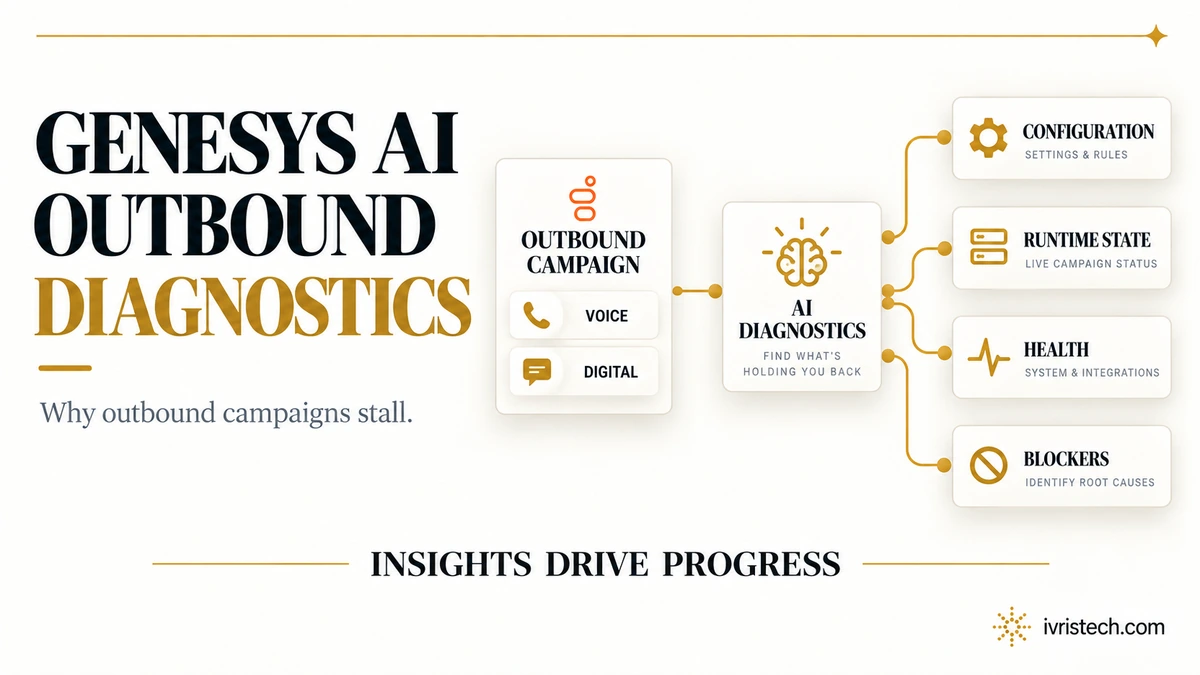
Genesys has scheduled AI-powered outbound campaign summarization and diagnostics for its September 14, 2026 Genesys Cloud release. The capability lets administrators ask natural-language questions about outbound voice and digital campaigns and receive explanations of configuration, runtime state, health and blocking conditions.
The underlying Genesys Cloud Copilot outbound campaign manager AI agent can retrieve campaign settings, contact-list details and filters, campaign state and progress, skipped contacts and reasons, health information, agent and outbound-line information, alerts, status timing and up to eight days of campaign event history. Genesys also states that the agent does not make campaign changes.
That action boundary is the important part. Much of sales AI is sold around generating messages or executing outreach. This feature points elsewhere: AI as an operational investigator. The useful question is whether it can shorten the time between “the campaign is not working” and a defensible explanation of why.
Direct answer — what do Genesys AI outbound campaign diagnostics do?
Genesys Cloud Copilot can summarize and diagnose outbound voice and digital campaigns using permission-aware Genesys system data. Administrators can ask about configuration, status, progress, health, skipped contacts, alerts and recent campaign events. The agent can recommend what to investigate, but Genesys says it does not modify campaigns, so diagnosis and corrective action remain separate.
- Genesys scheduled the capability for September 14, 2026, with availability still subject to region, licensing and release timing.
- The Copilot agent covers both outbound voice and digital campaigns, not only voice dialing.
- It can inspect campaign configuration, state, progress, health, blockers and up to eight days of campaign event history.
- The agent is read-only for campaigns: it only exposes data the user is permitted to access and does not make campaign changes.
What Genesys Actually Added
The feature is more specific than a generic “ask your data” assistant. For voice campaigns, Genesys can retrieve items such as contact lists and filters, scripts, queues, dialing mode, caller ID, DNC lists, rules, contactable time sets, abandon rate, dynamic queueing and sorting. For digital campaigns, it can retrieve contact lists, phone, email or WhatsApp columns, message rate, DNC lists, rules and sorting.
Administrators can then ask operational questions rather than manually assemble the evidence. Genesys gives examples such as asking for the status of a named campaign, how many contacts were attempted, how many were skipped and why, or comparing two campaigns to determine which appears healthier and requesting recommendations.
Diagnostic output can include campaign health, agent and outbound-line information, alerts, state-change timing and recent event history. Genesys says Copilot only displays data the user already has permission to access.
Why This Is Different From a Dashboard or Log
Genesys already had outbound diagnostics. Its Voice Campaigns view exposes health states such as Waiting for Agents, Waiting for Contacts, Waiting for Outbound Lines, Configuration Alert and Operational Alert. Its Campaign Health view can show a timeline of lifecycle events and health conditions for up to 30 days, plus metrics such as calls per second, calls per agent and compliance abandon rate.
The new layer does not make those views obsolete. It changes the retrieval step. Instead of moving between configuration, contact lists, diagnostics, agents, lines and event history, an administrator can ask a question and have Copilot assemble a response from accessible system data. That helps when the bottleneck is investigation time rather than missing telemetry.
There is also a clean boundary with Genesys’s agentic orchestration stack we covered earlier this month. That story was about coordinating human and AI experiences, governance and future orchestration components. Outbound campaign diagnostics are narrower: they explain the operating condition of a campaign. They are not a customer-journey orchestrator.
The Hidden Catch: Diagnosis Is Not Remediation
Genesys describes the new explanations as using “evidence-backed system data.” That is a useful design claim, but revenue teams should not translate it into “the AI is always right.” The system is summarizing evidence available through Genesys and the user’s permissions. A missing permission, incomplete context or a configuration relationship outside the retrieved evidence can still matter.
The second limit is deliberate: the outbound campaign manager AI agent does not make changes to campaigns. If Copilot says a campaign is waiting on agents, blocked by a configuration condition or skipping contacts for a particular reason, a human still has to validate the diagnosis and decide what to change.
That boundary is sensible for production outbound operations. Changing contact rules, dialing behavior, queues or compliance-sensitive settings carries more risk than explaining what the system sees. It also fits the broader copilot-versus-autopilot distinction in RevOps: teams need to know where observation ends and execution begins.
There is one release-status caveat. Genesys scheduled the feature for September 14, but its public “Features coming soon” page still carried the pre-release label at the time of writing and notes that availability can vary by region, product licensing and release schedule. Teams should verify the capability in their own tenant rather than assuming same-day universal access.
What Revenue Teams Should Test First
Start with a campaign whose behavior your team already understands. Ask Copilot for the campaign state, health, blockers, skipped-contact reasons and recent event history, then compare the answer with the underlying Campaign Health view and configuration. That gives you a fast accuracy check before anyone begins trusting the conversational layer during an incident.
Next, test one voice and one digital campaign. The evidence differs across channels, and the feature is useful only if it surfaces the configuration or runtime condition your team would otherwise hunt down manually.
Finally, define a human validation rule. Treat Copilot as the first diagnostic pass, not the change authority. If a recommendation would alter dialing logic, list filters, queue assignments, contactability rules or another production setting, require the operator to verify the underlying evidence before making the change. Diagnostic AI is useful precisely because it can compress investigation without pretending that investigation and remediation are the same job.
Frequently Asked Questions
It is a Genesys Cloud Copilot capability that lets administrators ask natural-language questions about outbound campaigns. The agent can summarize configuration, campaign state, progress, health, alerts, blocking conditions and recent events for voice and digital campaigns using Genesys system data available to that user.
No. Genesys explicitly says the outbound campaign manager AI agent does not make changes to campaigns. It can diagnose conditions and provide recommendations, but administrators remain responsible for validating the underlying evidence and making any configuration or operational changes themselves in production.
Yes. Genesys documents support for outbound voice and digital campaigns. The available configuration fields differ by campaign type, but the agent can retrieve campaign details, contact-list information, state and progress, and provide diagnostics across both categories through the same conversational Copilot layer.
Campaign Health views expose the underlying statuses, timelines and metrics administrators can inspect directly. The Copilot agent adds a conversational layer that retrieves and summarizes relevant evidence in response to a question. It reduces manual investigation, but it does not replace the source views or human validation.